





Dig Deeper: Should Truck Trailers Have Side Underride Guards?
Underride Legislation Calls for Side, Front Guards
The reintroduced Stop Underrides Act would require underride guards on the sides and front of all new trucks, and would update outdated standards, according to supporters.
March 5, 2021
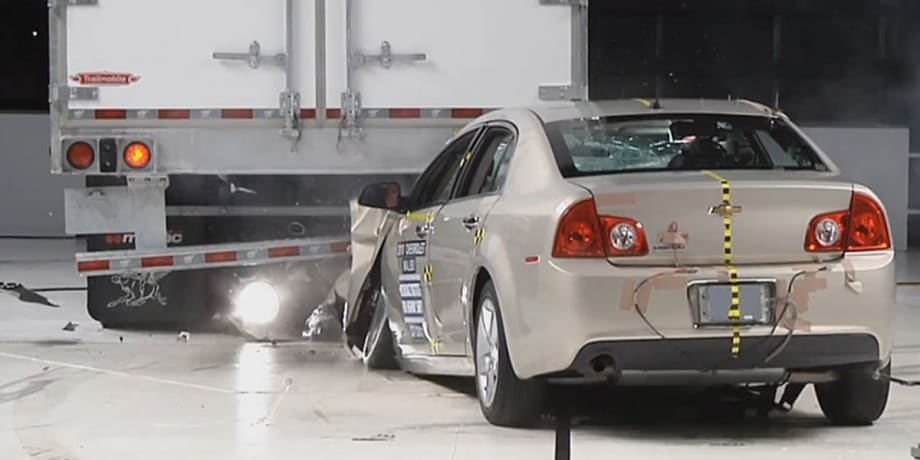
Under current federal law, underride guards are only required to be the back of a truck.
Photo: IIHS
3 min to read
Legislation has been reintroduced to strengthen standards intended to prevent deadly underride accidents involving tractor-trailers and straight trucks. The Stop Underrides Act would require underride guards on the sides and front of all new trucks, and would update outdated standards for underride guards on the rear of trucks, according to supporters.
Under current federal law, underride guards are only required to be the back of a truck. U.S. Sens. Kirsten Gillibrand (D-N.Y.) and Marco Rubio (R-Fla.), and U.S. Reps. Steve Cohen (D-Tenn.) and Mark DeSaulnier (D-Calif.) reintroduced the Stop Underrides Act and doubled down on the requirements.
This legislation would require the Department of Transportation to strengthen requirements for rear underride guards and add the requirement to single-unit trucks, as well as require trailers, semi-trailers and single trucks be equipped with side and front guards.
The bill also would update the annual inspection that all motor carriers perform to include underride guards as one of the critical components of inspection, and require the DOT to review underride standards periodically to evaluate the need for changes in response to technology advancements, according to a legislation summary published by Gillibrand's office. (The Federal Motor Carrier Safety Administration proposed the inspection requirement late last year.)
An underride crash occurs when a car slides under a large truck during an accident. When these accidents happen, a car’s safety features are rendered useless, because most of the car slides under the trailer and the trailer undercarriage crashes straight through the front windshield and into the passengers. The passengers in the car often suffer severe head and neck injuries, including decapitation. These accidents are often fatal, even at low speeds, legislators said in a press release.
More than 6,000 people died from underride accidents between 1994 and 2018, but this data is estimated to be undercounted due to differences in local police reporting, according to the press release. Studies and pilot programs show that a simple barrier attached to the lower area of a truck, called an underride guard, would help prevent a car from sliding underneath a truck in an accident.
“By strengthening outdated requirements and requiring new trucks to be equipped with adequate rear, side and front guards, our bill will help save lives and avoid horrific injuries,” said Cohen, a senior member of the House Transportation and Infrastructure Committee.
The trucking industry and trailer makers expressed concern previously when similar bills were introduced in 2017 and 2019 about issues such as weight, cost, the potential for lower guards to trap trucks on railroad grade crossings.
The legislation is cosponsored in the Senate by 11 other senators and endorsed by the Advocates for Highway and Auto Safety, Commercial Vehicle Safety Alliance, Institute for Safer Trucking, Citizens for Reliable and Safe Highways, Truck Safety Coalition, AnnaLeah & Mary for Truck Safety, Stop Underrides, and Parents Against Tired Truckers.
More Equipment

How Volvo Updated Its D13 for EPA 2027 [Watch]
Volvo’s updated D13 promises lower emissions without sacrificing performance or fuel economy. Take a closer look at what changed inside the engine in this HDT Spotlight video.
Read More →
Michelin Tire Improves Efficiency and Durability for Regional Fleets
The Michelin X Multi Energy D2 is a regional haul drive tire engineered to help fleets improve fuel efficiency, durability and traction in demanding stop-and-go operations.
Read More →
ZF Expands Commercial Vehicle Push in North America
ZF is expanding its North American commercial-vehicle presence with new transmission applications, electrification, trailer technology and autonomous-driving systems.
Read More →
Tesla Wants a Self-Driving Semi. Are Cameras Enough?
Could Tesla’s camera-only autonomous driving technology work on an 80,000-pound Semi? In this commentary, HDT's Deborah Lockridge takes a look at Tesla, Cybercab, and how autonomous trucks see the road.
Read More →
Kodiak: Driverless Long-Haul Truck Launch on Track for 2026
Kodiak AI says its driverless long-haul safety case is 93% complete and it remains on track to begin commercial operations by year-end 2026.
Read More →
What DOT’s Automated Vehicle Strategy Means for Trucking
The U.S. Department of Transportation issued a new automated-vehicle strategy that outlines plans for driverless-truck regulations, cross-state freight corridors, and federal safety standards.
Read More →
East Coast Port Launches $45M Electric Truck Push
The Port Authority of New York and New Jersey announced millions in incentives for zero-emission drayage trucks, yard tractors, and new charging hubs near the port.
Read More →
PlusAI Going Public to Fund Autonomous Truck Launch
A SPAC deal could provide PlusAI with up to $300 million as it works toward a 2027 commercial launch of factory-built autonomous trucks.
Read More →
NHTSA Moves to Rewrite Truck Fuel-Economy Rules
The National Highway Traffic Safety Administration says it lacks authority to regulate medium- and heavy-duty truck engines separately from complete vehicles, but the existing standards have not yet been eliminated.
Read More →
Detroit Opens Orders for EPA 2027 Engines
Detroit isn’t starting from scratch to meet EPA 2027 diesel emissions standards. Its Gen 6 DD13 and DD15 engines keep much of today’s platform while updating the fuel and aftertreatment systems.
Read More →