




Saia Partners with Tesla to Launch Two Electric Semis
Adding Tesla Semi-trucks to its fleet is part of Saia’s commitment to sustainability and innovation in logistics.

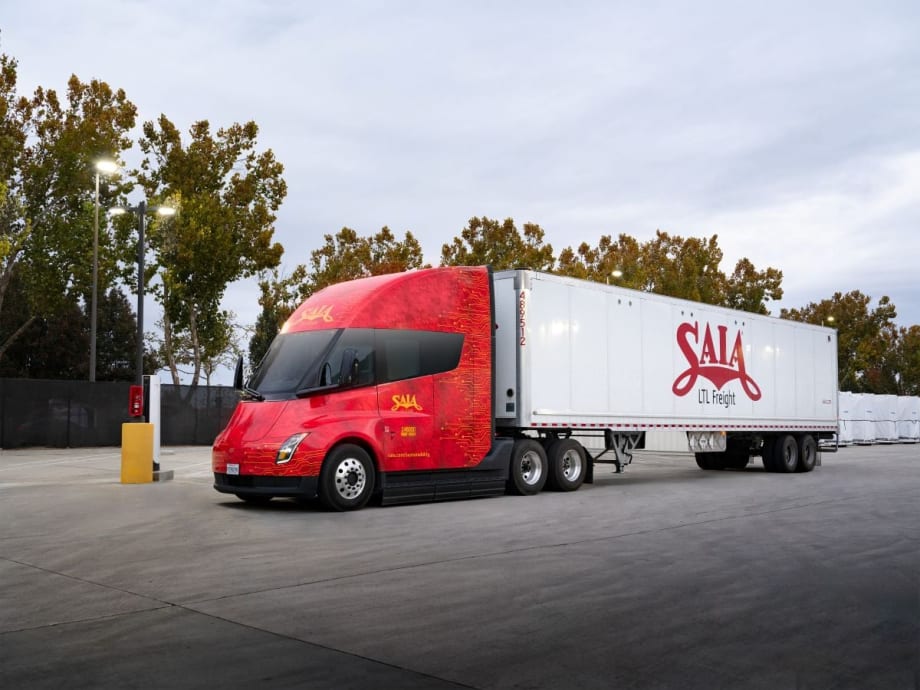
During a demonstration period held earlier last year, Saia rigorously tested the Tesla Semi in its operations with the tractor evaluated on its range, payload capacity, grade performance, and driver comfort.
Photo: Saia
Saia has announced that Saia LTL Freight has partnered with Tesla. The fleet will introduce two of the company’s first Tesla Semi trucks into its operations.
Saia is celebrating its 100th anniversary this year. And the company said this new collaboration signifies not just a milestone in the carrier’s history but also a bold commitment to the future. Saia will be exploring the latest technology to better serve its customers.
A Step Forward
The partnership represents another step forward in sustainable transportation as Saia becomes one of the early testers of Tesla’s electric semi-trucks.
According to Saia, the Tesla Semi brings “unparalleled” innovation to the logistics industry, reinforcing Saia’s role as a trailblazer for the future of freight transportation.
“Our partnership with Tesla underscores our dedication to evolution while staying true to the values that have guided us for the past century,” said executive vice president of operations Patrick Sugar. “As we celebrate 100 years of Saia, we’re focused on building a sustainable and innovative foundation for the next century.”
Since its founding in 1924, Saia has been at the forefront of delivering excellence in transportation, the company said.
The introduction of the Tesla Semi into Saia’s fleet reflects not only the company’s forward-thinking strategy but also its dedication to sustainability and meeting the evolving needs of customers. This collaboration aligns seamlessly with the company’s mission to provide top-tier service while minimizing its environmental footprint.
“This collaboration enhances our operational capabilities and exemplifies how Saia is positioning itself for a future where innovation and sustainability drive success,” added Sugar.
An Extensive Evaluation Process
During a demonstration period held earlier last year, Saia rigorously tested the Tesla Semi in its operations with the tractor evaluated on its range, payload capacity, grade performance, and driver comfort.
“We were very impressed with the Tesla Semi as it demonstrated an ability to handle both local and longer haul applications while still delivering notable power and efficiency. During a demonstration earlier this year, we achieved 1.73 kWh per mile,” said Sugar. “Our drivers were equally impressed, noting the smooth acceleration, comfortable design, and its ability to maintain speeds on steep inclines, even while hauling heavy payloads. This feedback underscores the enormous potential of the Tesla Semi.”
As Saia celebrates its centennial year, the partnership is another tangible example of how the carrier is working to reduce its carbon footprint by reducing emissions and improving tractor mileage as it seeks to be a good steward of the environment and conduct its operations in a responsible manner. By embracing innovative technology, Saia is setting a new standard for sustainability in logistics and reaffirming its role as a leader in the industry.
More Fuel Smarts

How Volvo Updated Its D13 for EPA 2027 [Watch]
Volvo’s updated D13 promises lower emissions without sacrificing performance or fuel economy. Take a closer look at what changed inside the engine in this HDT Spotlight video.
Read More →
Diesel Price Spike Shortens Payback for Natural Gas Trucks, Report Says
Energy Vision estimates fleets could recover the higher purchase price of an RNG-fueled Class 8 tractor in 1.3 to 2.8 years under current fuel-price scenarios.
Read More →
Calstart Becomes Catalyst Mobility, Reflecting Broader Focus
Calstart is now Catalyst Mobility, reflecting the nonprofit’s growing national role in clean transportation, including zero-emission trucks, infrastructure and incentive programs.
Read More →

Record Diesel Prices Squeeze Trucking Fleets
Average U.S. diesel prices have climbed to nearly $6 a gallon, surpassing the 2022 record as tight refinery capacity and Middle East disruptions keep fuel costs elevated.
Read More →
How Fuel Delivery Shapes Engine Performance
Fuel delivery depends on more than what happens at the injector. For fleet, maintenance and technical professionals, looking at the full path from pump to injector can provide useful context for understanding engine performance.
Read More →
East Coast Port Launches $45M Electric Truck Push
The Port Authority of New York and New Jersey announced millions in incentives for zero-emission drayage trucks, yard tractors, and new charging hubs near the port.
Read More →
California Bill Could Shed Light on Electric Truck Prices
Why do battery-electric Class 8 trucks remain so expensive? A California bill headed to Gov. Gavin Newsom would give fleets and state agencies more visibility into what manufacturers charge.
Read More →
Detroit Opens Orders for EPA 2027 Engines
Detroit isn’t starting from scratch to meet EPA 2027 diesel emissions standards. Its Gen 6 DD13 and DD15 engines keep much of today’s platform while updating the fuel and aftertreatment systems.
Read More →
Zero-Emission Truck Corridor Planned for West Coast
California, Oregon, Washington, British Columbia and Baja California are coordinating plans for truck charging and hydrogen fueling from Canada to Mexico.
Read More →
A Closer Look at Kenworth’s Electric T880E Vocational Truck [Video]
Learn more about Kenworth's T880E battery-electric vocational truck at the Paccar Technical Center, including its range, applications, upfitting considerations, and PTO options, in this HDT Spotlight video.
Read More →