





Related: Georgia Crash Prompts Call for Collision Avoidance Mandate
Safety Board Calls for Action on Collision Avoidance Systems
Collision avoidance systems reduce accidents and save lives and injuries, and should be standard on all new passenger and commercial vehicles, says the National Transportation Safety Board in recommendations announced Monday.
June 9, 2015
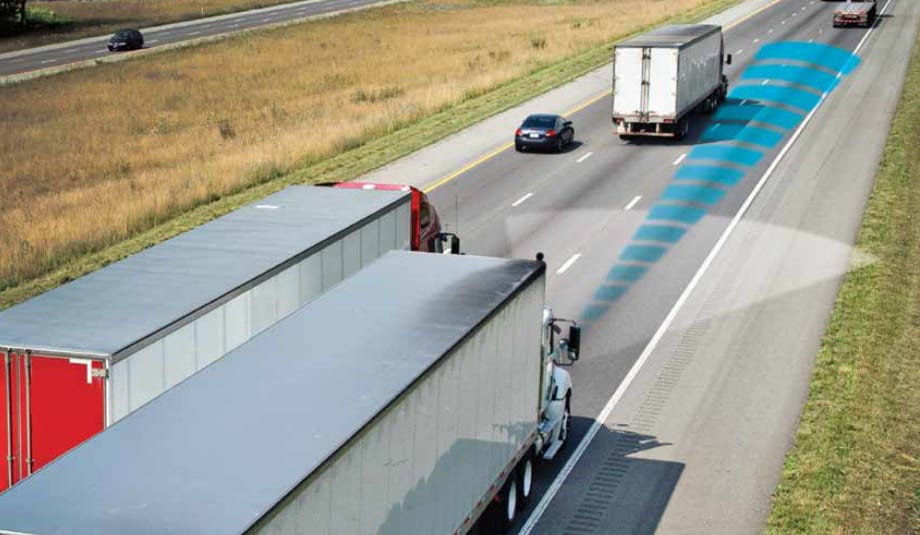
As this illustration for Meritor Wabco's Onguard system illustrates, forward collision avoidance technologies "see" obstacles ahead.
2 min to read
As this illustration for Meritor Wabco's Onguard system illustrates, forward collision avoidance technologies "see" obstacles ahead.
Collision avoidance systems reduce accidents and save lives and injuries, and should be standard on all new passenger and commercial vehicles, the National Transportation Safety Board declared in a statement yesterday.
In a Special Investigation Report, NTSB said the electronic systems can prevent or lessen the severity of rear-end crashes.
The safety board cited government accident statistics that indicated rear-end crashes killed about 1,700 people in 2012 and injured 500,000 more. More than 80% of these deaths and injuries might have been mitigated had the vehicles been equipped with a collision avoidance system, NTSB said.
“However, slow and insufficient action on the part of the National Highway Traffic Safety Administration to develop performance standards for these technologies and require them in passenger and commercial vehicles, as well as a lack of incentives for manufacturers, has contributed to the ongoing and unacceptable frequency of rear-end crashes,” the board said in the report issued last month.
NTSB said it has investigated rear-end crashes and has encouraged technological countermeasures since 1995. To date, the board has issued 12 recommendations pertaining to this safety issue, including in another Special Investigation Report in 2001.
However, the board has no power on its own to make regulations. NTSB investigates crashes of commercial motor vehicles, trains and airplanes, and often recommends actions in its reports to other government agencies, associations, industries and others.
“Due to a lack of progress in the implementation of NTSB recommendations intended to mitigate or prevent rear-end crashes, the recent technological advancements in collision avoidance technologies, and the continued prevalence of rear-end crashes, the NTSB is revisiting the topic of rear-end crash prevention,” it said.
"Because there will always be better technologies over the horizon, we must be careful to avoid letting perfection become the enemy of the good."
“The promise of a next generation of safety improvements has been used too often to justify inaction,” said NTSB Chairman Christopher A. Hart. "Because there will always be better technologies over the horizon, we must be careful to avoid letting perfection become the enemy of the good."
In the report, the NTSB recommends that manufacturers make collision avoidance systems standard equipment in newly manufactured vehicles, beginning with collision warning systems, and adding autonomous emergency braking once NHTSA completes standards for such braking systems.
Furthermore, the NTSB recommends that NHTSA develop tests and standards in order to rate the performance of each vehicle’s collision avoidance systems and to incorporate those results into an expanded NCAP 5-star safety rating scale.
The NTSB is also issuing a companion Safety Alert for consumers and commercial fleet owners that urges them to consider vehicles with collision warning and autonomous emergency braking functions.
More Safety & Compliance

ZF Expands Commercial Vehicle Push in North America
ZF is expanding its North American commercial-vehicle presence with new transmission applications, electrification, trailer technology and autonomous-driving systems.
Read More →
Truck Drivers Need More Than Another Alert
Fleets have more visibility into truck health, safety events, and driver activity than ever. The next challenge is turning all that information into useful guidance for the person who has to decide what to do next.
Read More →
Tesla Wants a Self-Driving Semi. Are Cameras Enough?
Could Tesla’s camera-only autonomous driving technology work on an 80,000-pound Semi? In this commentary, HDT's Deborah Lockridge takes a look at Tesla, Cybercab, and how autonomous trucks see the road.
Read More →
What DOT’s Automated Vehicle Strategy Means for Trucking
The U.S. Department of Transportation issued a new automated-vehicle strategy that outlines plans for driverless-truck regulations, cross-state freight corridors, and federal safety standards.
Read More →
NYC Expands Speed, Pedestrian Safety Tech Across Fleet
New York City is expanding intelligent speed assistance and pedestrian-alert systems across its municipal fleet, moving the technologies from pilot programs into vehicle procurement and retrofit requirements.
Read More →
FMCSA Removes 110 Truck Driver Training Schools from Certified ELDT List
Federal regulators also are targeting more than 160 additional training providers and launching a nationwide audit of third-party CDL skills testers as part of a broader crackdown on trucking fraud.
Read More →
Beyond DOT Compliance: What Makes a Trucking Fleet Truly Safe?
A trucking fleet can follow every rule and still make unsafe decisions. The real test comes when safety conflicts with freight, productivity, or cost.
Read More →
Hours of Service Pilot Programs: FMCSA Readies for 2027 Rollout
Two pilot programs could eventually reshape hours-of-service rules, giving truck drivers options to pause their 14-hour clock or use longer split sleeper rest periods.
Read More →
New Guide Offers Pet Safety Tips for Truck Drivers
Hundreds of thousands of pets travel in truck cabs. A new safety guide from Volvo Trucks and the Center for Pet Safety offers practical advice for truck drivers who bring dogs and cats along for the ride.
Read More →
Medical Cards, English Proficiency Reshape Roadcheck Violations
Medical-card violations jumped to the top of the driver out-of-service list during CVSA’s 2026 International Roadcheck, while English-language proficiency violations appeared among the leading violations for the first time.
Read More →