




Roadcheck 2006 Targets Unsafe Tractor-Trailers
About 10,000 specially-trained and certified officers will blanket North America's roadways June 6-8 to prevent truck and bus accidents and save lives.
About 10,000 specially-trained and certified officers will blanket North America's roadways June 6-8 to prevent truck and bus accidents and save lives.
Called Roadcheck 2006, federal, state, provincial and local officers will be conducting North American Standard Inspections around the clock for 72 hours throughout North America.
These inspections involve a 37-step procedure that includes items related to vehicle, driver and cargo safety. Officers also will be giving drivers educational materials on various aspects of commercial vehicle, driver and hazardous materials safety.
As has been the case the last few years, Roadcheck 2006 will also focus on enforcement and education of safety belt use among commercial drivers. Although the latest FMCSA statistics indicate an increase in use from 48 to 54 percent among truck drivers, this number is still far too low. In comparison, the use rate among automobile drivers is 82 percent. During Roadcheck 2005, 1,150 safety belt violations were documented during the three-day event, versus 755 in 2004. In all of 2005, 57,510 safety belt violations were recorded against commercial drivers.
"Roadcheck is an important reminder of the critical role these officers play every day in the health and well-being of everyone who travels the highways," said Stephen Campbell, executive director of the Commercial Vehicle Safety Alliance (CVSA). "Lives are being saved because roadside inspections conducted by CVSA-certified inspectors take place every day throughout North America. The inspections conducted over the three-day event in 2005 (61,278) resulted in 15 lives saved and 266 injuries avoided."
"America's economy depends on keeping people and goods moving safely through our transportation system," said U.S. Department of Transportation Secretary Norman Y. Mineta. "When federal, state and local law enforcement work together, through programs such as Roadcheck, we will prevent crashes and save lives."
From 2001 to 2003, roadside inspection and traffic enforcement activities on trucks and buses conducted by these certified officers saved 2,241 lives and helped to avoid 37,424 injuries and 49,126 crashes. Between 1998 and 2003, there was a 48 percent increase in the number of lives saved from these activities. There are more than 3 million North American Standard roadside inspections conducted annually.
More Safety & Compliance

A Camera Isn't a Safety Program. Here's What Brokers Are Screening for Now
Footage alone may not be enough to pass broker vetting processes. Here's what counts as a defensible safety program now.
Read More →
Marijuana and Trucking’s Drug-Testing Dilemma
Marijuana is getting stronger, laws are changing, and drug tests still can’t reliably establish impairment. What does that mean for truck drivers and the fleets that employ them?
Read More →
PrePass, Kodiak Connect Driverless Trucks to Roadside Enforcement
The system will allow enforcement agencies to verify Enhanced Inspection information and decide whether Kodiak’s autonomous trucks can bypass roadside screening sites.
Read More →

From One Generation to the Next: How Mentorship Builds Safer Truck Drivers
After three decades in trucking, Harold Perry shares what he's learned about driver safety, mentorship, and helping the next generation build confidence behind the wheel.
Read More →
FMCSA Pauses Biennial-Update Enforcement Amid Motus Transition
Carriers whose updates were due on or after June 1 have more time, while FMCSA works to stabilize its new registration system and warns of phishing sites impersonating its new carrier registration system, Motus.
Read More →
ZF Expands Commercial Vehicle Push in North America
ZF is expanding its North American commercial-vehicle presence with new transmission applications, electrification, trailer technology and autonomous-driving systems.
Read More →
Truck Drivers Need More Than Another Alert
Fleets have more visibility into truck health, safety events, and driver activity than ever. The next challenge is turning all that information into useful guidance for the person who has to decide what to do next.
Read More →
Tesla Wants a Self-Driving Semi. Are Cameras Enough?
Could Tesla’s camera-only autonomous driving technology work on an 80,000-pound Semi? In this commentary, HDT's Deborah Lockridge takes a look at Tesla, Cybercab, and how autonomous trucks see the road.
Read More →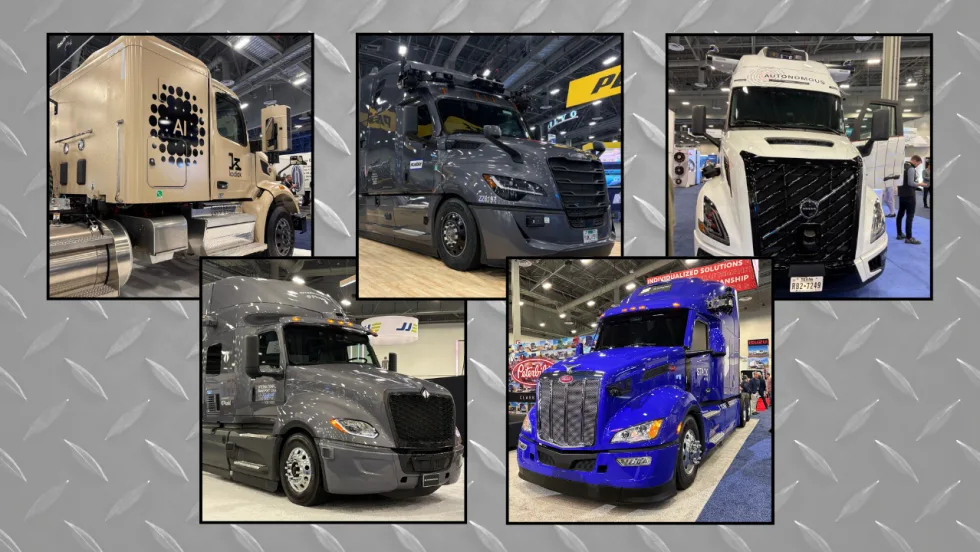
What DOT’s Automated Vehicle Strategy Means for Trucking
The U.S. Department of Transportation issued a new automated-vehicle strategy that outlines plans for driverless-truck regulations, cross-state freight corridors, and federal safety standards.
Read More →
NYC Expands Speed, Pedestrian Safety Tech Across Fleet
New York City is expanding intelligent speed assistance and pedestrian-alert systems across its municipal fleet, moving the technologies from pilot programs into vehicle procurement and retrofit requirements.
Read More →