



Did You Know?
Hands-free phone calls using a headset or earpiece was associated with lower drowsiness for truck drivers, according to the VTTI study.
 MENU
MENU SEARCH
A Virginia Tech Transportation Institute study found that truck drivers using hand-held cell phones were more at risk of an unsafe event on the road than those using a hands-free device.

Texting on a hand-held phone was one of the most infrequent types of cell phone use by truck drivers in this VTTI study.
Photo: HDT/Canva via -aniaostudio from Getty Images Signature
Any task that involves a driver’s hands and eyes has the highest risk of resulting in an incident or unsafe event on the road, according to study findings by the Virginia Tech Transportation Institute.
Many of these types of tasks involved hand-held electronics, said Susan Soccolich, a VTTI research associate for the institute’s division of freight, transit and heavy vehicle safety, during a presentation at the Fleet Safety Conference in California on Nov. 11.
For example, the following tasks increase the risk of an unsafe event:
texting on a cell phone: 23 times the risk
interacting with a dispatching device: 10 times the risk
dialing on a cell phone: 6 times on the risk
VTTI’s study, “Analysis of Naturalistic Driving Data to Assess Distraction and Drowsiness in Drivers of Commercial Motor Vehicles,” showed the longer a truck driver’s eyes were off the forward roadway, the greater the risk of being involved in a safety critical event. There was a significant increase once the driver’s eyes were off the road for more than two seconds.
Drivers who were browsing on a cell phone had one of the highest average times their eyes were off the roadway (four seconds). Drivers who were texting had their eyes off the road for an average of five seconds.
The study found that talking/listening on a hand-held phone (the most common cell phone use behavior) showed no change in risk while talking/listening on a hands-free device showed a reduced risk of being involved in a safety critical event. The study collected data over 3.8 million driving miles from various heavy-duty truck fleets.
When a driver was perceived to be at-fault during a safety critical event, over 5% of drivers were browsing on a cell phone.
“What’s interesting about this study is what we’re not seeing as much as we used to,” Soccolich said.
Texting on a hand-held phone was one of the most infrequent types of cell phone use in the study. About 1% of drivers texted or were involved in a safety critical event.
“These drivers are browsing, and they’re talking and listening, as the regulations allow,” she said. “But they’re not texting in the way we may think based on how people behave in their everyday life.”
Hand-held cell phone tasks greatly increase the risk of safety critical events on the road. When the driver is perceived to be at-fault for the incident, these tasks increase the risk by four times.
Hands-free cell phone tasks cut the risk of these incidents in half. These drivers are involved in about as half as many events, Soccolich said.
The types of tasks impact the risk levels. See chart below. An odds ratio above 1 indicates an increased risk, while an odds ratio below 1 indicates no change in the risk.
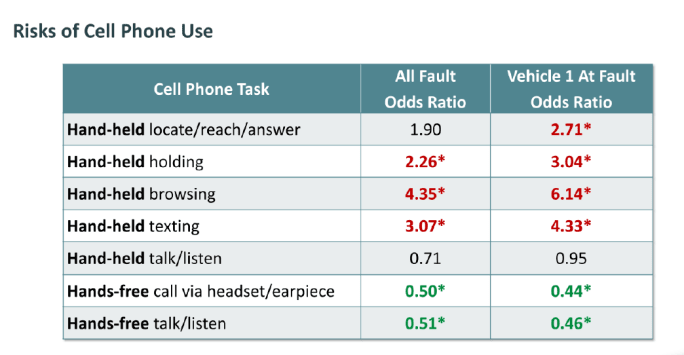
Hands-free cell phone tasks cut the risk of incidents in half.
Graph: VTTI

Carriers whose updates were due on or after June 1 have more time, while FMCSA works to stabilize its new registration system and warns of phishing sites impersonating its new carrier registration system, Motus.
Read More →
ZF is expanding its North American commercial-vehicle presence with new transmission applications, electrification, trailer technology and autonomous-driving systems.
Read More →
Fleets have more visibility into truck health, safety events, and driver activity than ever. The next challenge is turning all that information into useful guidance for the person who has to decide what to do next.
Read More →
Could Tesla’s camera-only autonomous driving technology work on an 80,000-pound Semi? In this commentary, HDT's Deborah Lockridge takes a look at Tesla, Cybercab, and how autonomous trucks see the road.
Read More →
The U.S. Department of Transportation issued a new automated-vehicle strategy that outlines plans for driverless-truck regulations, cross-state freight corridors, and federal safety standards.
Read More →
New York City is expanding intelligent speed assistance and pedestrian-alert systems across its municipal fleet, moving the technologies from pilot programs into vehicle procurement and retrofit requirements.
Read More →
Federal regulators also are targeting more than 160 additional training providers and launching a nationwide audit of third-party CDL skills testers as part of a broader crackdown on trucking fraud.
Read More →
A trucking fleet can follow every rule and still make unsafe decisions. The real test comes when safety conflicts with freight, productivity, or cost.
Read More →
Two pilot programs could eventually reshape hours-of-service rules, giving truck drivers options to pause their 14-hour clock or use longer split sleeper rest periods.
Read More →
Hundreds of thousands of pets travel in truck cabs. A new safety guide from Volvo Trucks and the Center for Pet Safety offers practical advice for truck drivers who bring dogs and cats along for the ride.
Read More →