




Pressure Grows to Prohibit Flammables in Tanker Wet Lines
The pressure is on in Washington to get flammable liquids out of the pipes beneath cargo tanks. These "wet lines" can carry up to 50 gallons of cargo. In a crash they occasionally rupture and spill their contents, sometimes to fatal effect. That happened last July in New Jersey, when a car struck a gasoline tanker, wedged beneath the tank and burned in the spill of 13 gallons of gas from the wet lines
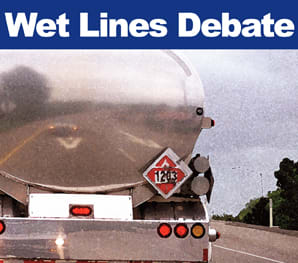
The pressure is on in Washington to get flammable liquids out of the pipes beneath cargo tanks. These "wet lines" can carry up to 50 gallons of cargo. In a crash they occasionally rupture and spill their contents, sometimes to fatal effect. That happened last July in New Jersey, when a car struck a gasoline tanker, wedged beneath the tank and burned in the spill of 13 gallons of gas from the wet lines,
killing the driver.
Rep. James Oberstar, D-Minn., cited this and other incidents in his introduction of a measure that would prohibit flammable liquid in wet lines, starting two years from passage of the law for new tank trucks and at the end of 2020 for tankers already in service. This is one provision in a bill to reauthorize the federal hazardous materials safety program run by the Pipeline and Hazardous Materials Safety Administration. Other major provisions would regulate transportation of lithium batteries in airplanes, improve training for emergency responders, toughen hazmat permitting and almost double the number of federal hazmat investigators.
It is not clear if the Senate will seek a similar provision - it has not introduced its version of the bill.
Trucking concerned
Trucking interests are deeply concerned about the wet lines provision, which would in effect require tank lines to retrofit a pumping system to empty the lines. The prohibition goes to Class 3 flammable liquids, which includes petroleum fuels.
"We believe that the industry's safety record demonstrates that a mandate for wetlines-purging equipment is simply not justified," said Barbara Windsor, President of Hahn Transportation, a tank line, and First Vice Chairman of American Trucking Associations.
Oberstar said that there have been 184 incidents over the past decade in which wet lines were damaged or ruptured. PHMSA has identified 13 fatalities and seven injuries from crashes involving wet lines. Six of the fatalities and all of the injuries were attributable to spills from the wet lines, as opposed to the impact of the collision.
Windsor said that there have been more than 180 million shipments of flammable liquids in that period, making the risk of a fatal wet lines incident about one in 30 million. "The odds of being struck by lightning during your lifetime are 6,000 times greater than the odds of being killed in a wet lines incident," she said in testimony November 16 to the Subcommittee on Railroads, Pipelines and Hazardous Materials, a panel of the House Transportation and Infrastructure Committee which Oberstar chairs.
NTSB support
The wet lines prohibition has been a long-time goal of the National Transportation Safety Board. Last May Board member Deborah Hersman told the hazmat subcommittee that the risk of wet lines has been recognized for 30 years and reiterated an earlier call for prohibition. "Because the risk is primarily from cargo tank vehicles making gasoline deliveries at neighborhood service stations and convenience stores, the exposure of the public is not acceptable," she said in her testimony.
Five years ago, in response to NTSB pressure, PHMSA looked into the possibility of a rule prohibiting flammables in wet lines, and then rejected the idea when it found that the costs exceeded the benefits. Last September it gave notice that it intends to begin a new rulemaking "to prohibit flammable liquids from being transported in unprotected product piping on existing and newly manufactured DOT specification cargo tank motor vehicles." The proposal has not yet been published.
Costs
A major issue in both the legislation and the rulemaking will be the cost and risk of retrofitting the tanker fleet.
In the earlier rulemaking, estimates of the cost varied by source. PHMSA, for example, estimated that 15,000 tank trailers would be affected at a cost of up to $4,000 per trailer. The industry, on the other hand, said 26,000 trailers would be affected at a cost of up to $5,000 each.
Daniel Furth, Vice President of the National Tank Truck Carriers, said it is important for legislators and rulewriters to understand that tankers are considerably different from other types of trailers.
"In the tank truck business the equity investment is the trailer," he said, noting that tank carriers will keep their trailers for 20 or more years because they are so expensive to buy.
That longevity means that Oberstar's proposal would require the tanker fleet to retrofit line-purging equipment. This would impose considerable risk to carrier personnel, because it is extremely dangerous to weld or otherwise mount wet lines purging equipment onto a fuel tank, even when it has been cleaned, Furth said.
Welding operations on tankers have led to fires and explosions that have killed at least 20 workers over the past decade, NTTC has found. The risk would be compounded if carriers had to undertake an industry-wide retrofit under the pressure of a mandate, Furth said.
Alternatives urged
Hahn, in her testimony, urged Congress to back off the mandate in the bill and let PHMSA come up with a regulatory solution. By prohibiting the transport of flammables in wet lines, Congress would prevent development of alternatives, she said. The bill should be amended to let the agency review tank design and permit wet line transportation in cases where there is little risk. Another alternative she suggested was to require petroleum terminals to remove flammables from wet lines during the loading process.
"It seems much more reasonable to require modification of a couple of hundred petroleum loading racks, than to require tens of thousands of cargo tanks to be retrofitted and redesigned," she said.
More Drivers

From One Generation to the Next: How Mentorship Builds Safer Truck Drivers
After three decades in trucking, Harold Perry shares what he's learned about driver safety, mentorship, and helping the next generation build confidence behind the wheel.
Read More →
Truck Drivers Need More Than Another Alert
Fleets have more visibility into truck health, safety events, and driver activity than ever. The next challenge is turning all that information into useful guidance for the person who has to decide what to do next.
Read More →
FMCSA Removes 110 Truck Driver Training Schools from Certified ELDT List
Federal regulators also are targeting more than 160 additional training providers and launching a nationwide audit of third-party CDL skills testers as part of a broader crackdown on trucking fraud.
Read More →
Hours of Service Pilot Programs: FMCSA Readies for 2027 Rollout
Two pilot programs could eventually reshape hours-of-service rules, giving truck drivers options to pause their 14-hour clock or use longer split sleeper rest periods.
Read More →
Medical Cards, English Proficiency Reshape Roadcheck Violations
Medical-card violations jumped to the top of the driver out-of-service list during CVSA’s 2026 International Roadcheck, while English-language proficiency violations appeared among the leading violations for the first time.
Read More →
Driver Trust Can Make or Break the Success of Fleet Safety Technology
New Teletrac Navman research suggests that onboarding, transparency about driver data, and positive feedback can play a significant role in how commercial drivers respond to safety and coaching technology.
Read More →
EEOC Sues KLLM Over Alleged Sex Discrimination in Driver Training
KLLM is facing a federal sex-discrimination lawsuit over policies the EEOC alleges put female truck driver trainees at a disadvantage.
Read More →
FMCSA Moves to Codify English Language Requirements for Commercial Drivers
By changing regulations on English-language proficiency requirements for commercial drivers, rather than relying on a guidance memo, the FMCSA said future administrations won't be able to walk back the Trump administration's stricter enforcement with just a memo.
Read More →
Drivers Put Western Star Trucks to the Test at Star Nation Experience
Watch to get an inside look at the Western Star trucks, technology, and community behind the Star Nation Experience 2026!
Read More →
Trump Administration Looks to Put More Veterans Behind the Wheel
The Freedom Haulers program pulls together existing and expanded programs at several federal agencies to recruit veterans to drive commercial heavy-duty trucks and cut the red tape for them to get a CDL, training, and employment.
Read More →