





What Would Trump's North American Tariffs Mean for Trucking?
Drayage Truckers Face Freight Surge as Imports Rise Due to Threats of Tariffs and Dockworker Strike
Threats of a dockworkers strike and tariffs are pushing a surge in container imports as retailers try to get ahead of these potential disruptors. What does it mean for drayage truckers?
December 10, 2024
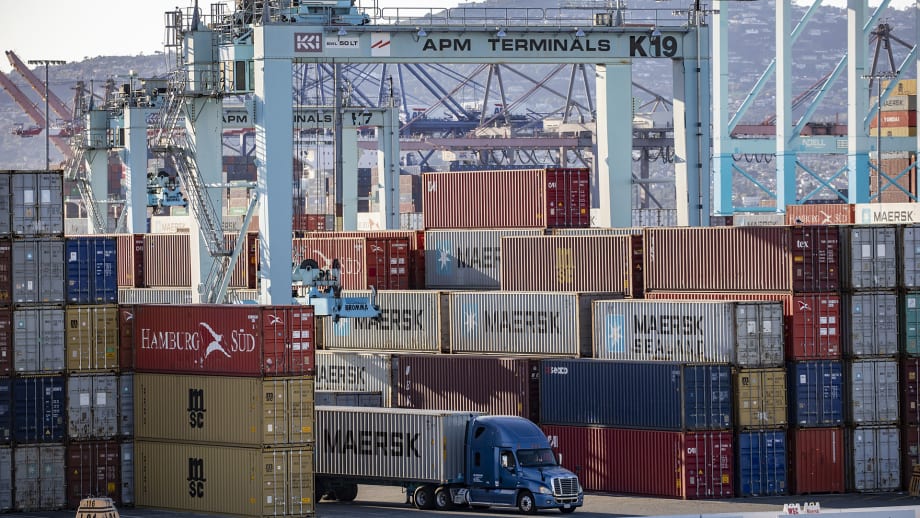
The Port of Los Angeles has been handling a record number of containers.
Photo: Courtesy Port of Los Angeles
5 min to read
With a strike possible at East Coast and Gulf Coast container ports and President-elect Donald Trump planning to increase tariffs, retailers are trying to import cargo ahead of those potential disruptions. While the drayage truckers serving the southern California ports say they can handle a surge, at the same time there are concerns, according to the Harbor Trucking Association.
"We say, 'Bring it,'" Matt Schrap, CEO of the association, told HDT in an interview.
However, there are a lot of uncertainties to the situation, as well as factors beyond the drayage companies' control. That includes difficulties in getting appointments, challenges in the labor force due to the state's strict laws severely restricting the use of owner-operators, as well as a concern that a surge now will mean a big slowdown later.
What's Happening at the Ports?
The Global Port Tracker report released December 9 by the National Retail Federation and Hackett Associates showed a surge in container imports. It reported an expected 14%-plus increase year over year for the last two months of 2024 and predicts the higher volumes will continue through next spring.
“Either a strike or new tariffs would be a blow to the economy, and retailers are doing what they can to avoid the impact of either for as long as they can,” said Jonathan Gold, NRF Vice President for Supply Chain and Customs Policy.
Talks have broken down between the International Longshoremen’s Association and the U.S. Maritime Alliance. After a three-day strike in October, the two sides agreed to a contract extension, but that expires January 15. Gold said there's potential for a strike in January to be longer.
“That has retailers spending extra to bring in cargo early or continue shifting it to the West Coast to avoid any potential disruptions, much like they did earlier this year."
Hackett Associates Founder Ben Hackett said that "prospects of reaching a quick agreement on the key sticking point of automation are not looking good.”
Retailers Try to Get Ahead of Tariffs
“Then there are issues as President-elect Trump promises to increase tariffs when he takes office [January 20],” added Hackett.
The NRF has said Trump's tariff proposal could cost Americans $78 billion in annual spending.
“It is not clear whether this will actually take effect immediately or whether it will take time to implement the tariffs, but shippers are moving up as much cargo as they can before then," Hackett said.
He said retailers are under pressure as they frontload cargo to avoid both the disruption of the strike and higher costs from the tariffs.
Harbor Trucking's Schrap said there's a lot of uncertainty here, and retailers and beneficial cargo owners are easily spooked.
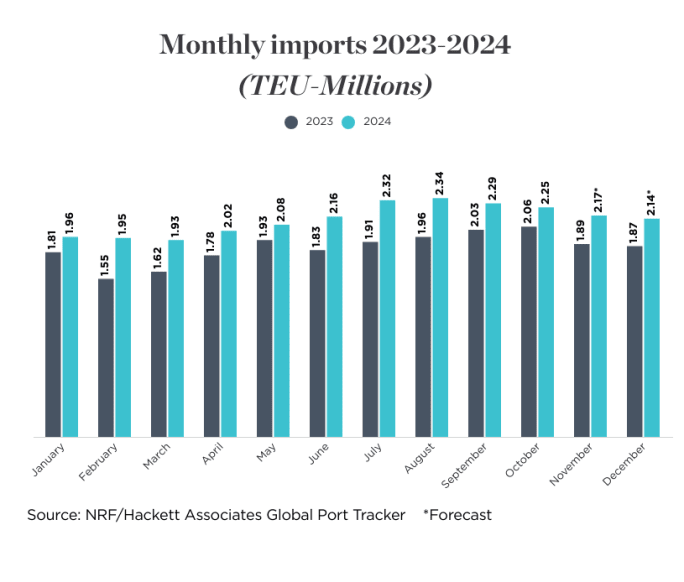
Global Port Tracker projected November cargo imports at 2.17 million TEU, up 14.4% year over year.
Source: Global Port Tracker
The Port of Los Angeles recently announced it handled a record 905,026 TEUs in October, a 25% increase over the previous year. It’s the first time the port has exceeded 900,000 TEUs for four consecutive months.
However, he noted, paraphrasing a comment from an article in the New York Times, "Trump's campaign promises are written in pencil."
Predictions for Import Cargo Coming Into U.S. Ports
U.S. ports covered by Global Port Tracker handled 2.25 million Twenty-Foot Equivalent Units, or TEU (one 20-foot container or its equivalent) in October (the Port of Miami has yet to report final data). That was down 1.2% from September but up 9.3% year over year.
Ports have not yet reported November’s numbers, but Global Port Tracker projected the month at 2.17 million TEU, up 14.4% year over year.
Before the October strike and November’s elections, November had been forecast at 1.91 million TEU.
December is forecast at 2.14 million TEU, up 14.3% year over year. Previously, December had been forecast at 1.88 million TEU.
If both those estimates hold true, 2024's total would be 25.6 million TEU, up 14.8% from 2023. In comparison, before the strike and elections, the total for 2024 was forecast at 24.9 million TEU.
Challenges for Southern California's Port Truckers
After the supply chain problems that hit the nation's container ports during the record surge of the Covid-19 pandemic, Schrap said, there were some painful lessons learned at the Southern California ports.
Today, he said, all the terminals at the Ports of Los Angeles and Long Beach require appointments. However, each one has a different system. Efficiently booking those appointments manually would require a human to essentially sit in front of a computer all day continually clicking on "refresh" to see new appointments.
So drayage truckers have turned to third-party software to help. But there are some that are abusing the system and hedging their bets by booking multiple appointments, which has led some terminals to push for not allowing the third-party solutions.
And, while prioritizing dual transactions was designed to keep truckers from having to make separate trips to pick up loaded containers and drop off empty ones, it also puts a new constraint on making appointments.
Meanwhile, there are California's regulations to deal with. The Advanced Clean Fleets rule requiring zero-emissions trucks targeted drayage fleets first. And there is AB5, the law that makes it virtually impossible to use the traditional trucking owner-operator model.
On top of AB5, Schrap said, California’s new AB2754 law regarding independent contractors will make shippers look twice at using motor carriers with owner-operators who do not maintain their own DOT authority.
Cargo Import Predictions for 2025
The Global Port Tracker report also included estimates for the first few months of 2025:
January: 2.2 million TEU, up 12% year over year
February: 1.87 million TEU, down 4.1% from last year because of fluctuations in the timing of Lunar New Year shutdowns at Asian factories.
March: 2.17 million TEU, up 12.7% year over year.
April: 2.15 million TEU, up 6.6% from the same month in 2023.
“We call on both parties at the ports to return to the table, get a deal done and avoid a strike,” Gold said.
“And we call on the incoming administration to use tariffs in a strategic manner rather than a broad-based approach impacting everyday consumer goods.”
About Global Port Tracker
Global Port Tracker, which is produced for the National Retail Federation by Hackett Associates, provides historical data and forecasts for the following U.S. ports:
Los Angeles/Long Beach, California
Oakland, California
Seattle, Washington
Tacoma, Washington
New York/New Jersey
Port of Virginia
Charleston, South Carolina
Savannah, Georgia
Port Everglades, Florida
Miami, Florida
Jacksonville, Florida
Houston, Texas
More Fleet Management

Sponsored•September 16, 2026
Color Match Smarter: Tools That Restore & Perform
For fleet managers and collision repair professionals keeping heavy-duty trucks on the road, getting the color right the first time isn't just about appearance — it's about efficiency, turnaround time, and bottom-line results. Discover how today's digital color tools are transforming the repair process from guesswork to precision.
Read More →
FMCSA Pauses Biennial-Update Enforcement Amid Motus Transition
Carriers whose updates were due on or after June 1 have more time, while FMCSA works to stabilize its new registration system and warns of phishing sites impersonating its new carrier registration system, Motus.
Read More →
Sponsored•September 14, 2026
2026 Blueprint for Countering Smarter Supply Chain Theft
Cargo theft is no longer just the cost of doing business. It's a multi-billion-dollar criminal enterprise exploiting vulnerabilities across your fleet, drivers, and supply chain.
Read More →


Sponsored•September 1, 2026
How Telematics Improves Visibility, Control, and Performance in Refrigerated Fleets
Explore how telematics help refrigerated fleets improve visibility, uptime, efficiency, compliance, and cargo protection across connected cold chain operations.
Read More →
What the U.S.-Canada Trade War Means for Trucking
Escalating U.S.-Canada tariffs could disrupt cross-border freight, reduce truck volumes, raise costs, and create new uncertainty for carriers on both sides of the border.
Read More →
What Are Trucking’s Top Concerns for 2026?
The American Transportation Research Institute wants to know what's worrying trucking fleet managers, drivers, and other stakeholders in its annual Industry Issues survey.
Read More →
American Trucking Associations Looks for a New Leader
ATA President and CEO Chris Spear abruptly left his job at the association on August 21, at a pivotal time for the trucking industry.
Read More →
Public Wi-Fi Cybersecurity Risks: How Truck Drivers and Fleets Can Protect Their Data
Public Wi-Fi can expose truck drivers and fleets to credential theft, malware, and other cyber threats. Here’s how to reduce the risk on the road.
Read More →
For Nicky Cupp, Fleet Innovation Starts With Frustration
HDT Truck Fleet Innovator Nicky Cupp turns everyday pain points at Fraley & Schilling into opportunities for better technology and smarter processes.
Read More →
Adam Buttgenbach’s Approach to Electric Trucks: Start With Where They Fit
HDT Truck Fleet Innovator Adam Buttgenbach helped PepsiCo build one of North America’s largest EV fleets by focusing on where electric trucks make operational sense.
Read More →