




Related: California Rules Seven Port Truckers Wrongly Classified as Independents
Port Drivers Awarded $6.9 Million in Back Pay
The California Labor Commissioner’s office has awarded 38 truck drivers $6.9 million in back pay after ruling that the drivers had been improperly classified as independent contractors.
by Staff
December 23, 2015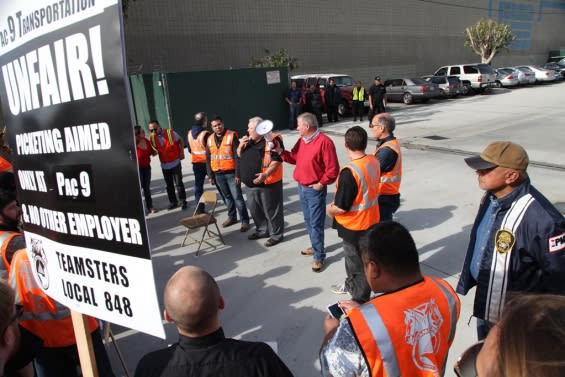
Photo via Teamsters Union
2 min to read
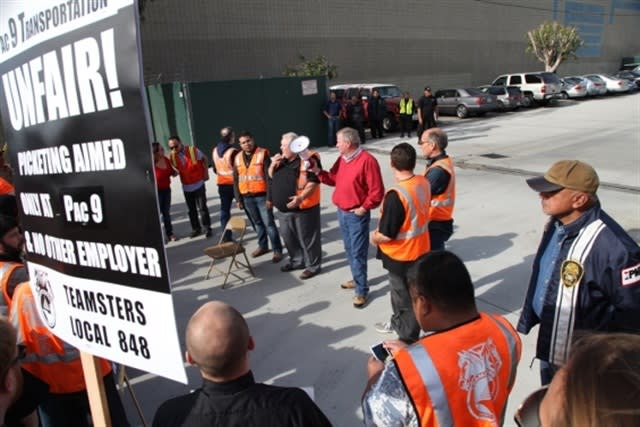
Photo via Teamsters Union
The California Labor Commissioner’s office has awarded 38 truck drivers $6.9 million in back pay after ruling that the drivers had been improperly classified as independent contractors, according to the Los Angeles Times.
The drivers, who had worked for Pacific 9 Transportation serving Southern California ports as independent contractors, filed a claim with the California Division of Labor Standards on the misclassification issue. The Labor Commissioner’s Office ruled in the drivers' favor, ordering Pacific 9 to compensate drivers for paycheck deductions, wages and legal costs related to the issue.
In some cases, drivers will receive payouts that amount to hundreds of thousands of dollars. Pacific 9 is ordered to pay interest for the years since the payments were considered due to the drivers.
The average amount awarded to drivers in this case is $182,270 and the largest individual amount awarded is $386,703.14.
“We have finally had our day in court and we are extremely grateful that the government has realized that it isn’t just a handful of drivers that are misclassified – it is all of us,” said Daniel Linares, a driver for Pacific 9.
The Harbor Trucking Association, which represents the interests of trucking companies that service the ports, released a statement criticizing the Labor Commissioner’s decision as a “loss of freedom and control” for drivers.
Pacific 9 will have the opportunity to appeal the decision.
Throughout the year, drivers have been striking at the Ports of Los Angeles and Long Beach over the driver misclassification issue. The most recent strike occurred in early November.
At the heart of the issue is the claim that certain port drivers are not independent-contractors in the traditional sense and are only classified that way to avoid paying for such employee benefits as health insurance, unemployment compensation, and workers compensation.
Despite being labeled independent, the drivers argue they are driving trucks owned by the trucking companies and working exclusively for them without being able to negotiate rates, refuse loads or take work from competitors.
During the most recent strikes, the Los Angeles City Council adopted a resolution calling for all companies servicing the ports to comply with federal and state employment labor laws and provide striking drivers with proper wage and benefits.
As many as 720 drivers have filed wage complaints with the Labor Commissioner’s office since 2012.
More Fleet Management

Sponsored•September 16, 2026
Color Match Smarter: Tools That Restore & Perform
For fleet managers and collision repair professionals keeping heavy-duty trucks on the road, getting the color right the first time isn't just about appearance — it's about efficiency, turnaround time, and bottom-line results. Discover how today's digital color tools are transforming the repair process from guesswork to precision.
Read More →
FMCSA Pauses Biennial-Update Enforcement Amid Motus Transition
Carriers whose updates were due on or after June 1 have more time, while FMCSA works to stabilize its new registration system and warns of phishing sites impersonating its new carrier registration system, Motus.
Read More →
Sponsored•September 14, 2026
2026 Blueprint for Countering Smarter Supply Chain Theft
Cargo theft is no longer just the cost of doing business. It's a multi-billion-dollar criminal enterprise exploiting vulnerabilities across your fleet, drivers, and supply chain.
Read More →


Sponsored•September 1, 2026
How Telematics Improves Visibility, Control, and Performance in Refrigerated Fleets
Explore how telematics help refrigerated fleets improve visibility, uptime, efficiency, compliance, and cargo protection across connected cold chain operations.
Read More →
What the U.S.-Canada Trade War Means for Trucking
Escalating U.S.-Canada tariffs could disrupt cross-border freight, reduce truck volumes, raise costs, and create new uncertainty for carriers on both sides of the border.
Read More →
What Are Trucking’s Top Concerns for 2026?
The American Transportation Research Institute wants to know what's worrying trucking fleet managers, drivers, and other stakeholders in its annual Industry Issues survey.
Read More →
American Trucking Associations Looks for a New Leader
ATA President and CEO Chris Spear abruptly left his job at the association on August 21, at a pivotal time for the trucking industry.
Read More →
Public Wi-Fi Cybersecurity Risks: How Truck Drivers and Fleets Can Protect Their Data
Public Wi-Fi can expose truck drivers and fleets to credential theft, malware, and other cyber threats. Here’s how to reduce the risk on the road.
Read More →
For Nicky Cupp, Fleet Innovation Starts With Frustration
HDT Truck Fleet Innovator Nicky Cupp turns everyday pain points at Fraley & Schilling into opportunities for better technology and smarter processes.
Read More →
Adam Buttgenbach’s Approach to Electric Trucks: Start With Where They Fit
HDT Truck Fleet Innovator Adam Buttgenbach helped PepsiCo build one of North America’s largest EV fleets by focusing on where electric trucks make operational sense.
Read More →