




Phillips Industries Unveils Solar Panel Technology for Trucks
Phillips' Solar solutions can supplement or replace diesel usage, by providing up to 34 hours of power.

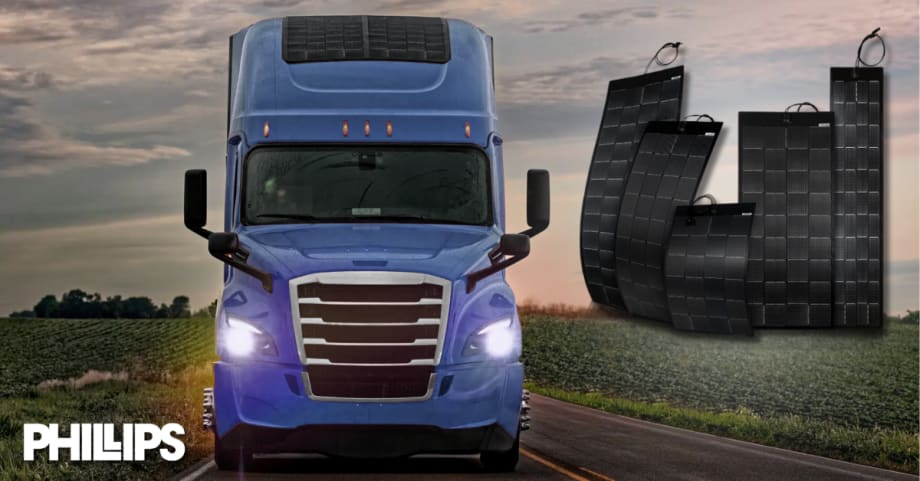
New, stick-on solar panels from Phillips Solar offer fleets fuel savings, elimination of jump starts, extended battery life, increased reliability, liftgate support, and additional power to offset parasitic loads.
Photo: Phillips Industries
Phillips Industries has launched advanced solar panel technology for commercial trucks and trailers. Phillips now offers monocrystalline silicon (mono-cSI) solar panels for commercial vehicle applications.
The company said that the new panels are 80% lighter than traditional glass systems. They also produce 20% more energy with a 50% higher power density through the use of thin film technology, according to Phillips.
Numerous Advantages for Commercial Vehicles
Phillips' Solar solutions offer a clean energy source that can supplement or replace diesel usage, according to the company. They provide up to 34 hours of power without running a diesel engine. Phillips said this virtually eliminates engine idling.
Tractor and trailer solar systems offer commercial vehicle operators numerous other advantages, as well, according to Phillips. These include fuel savings, elimination of jump starts, extended battery life, increased reliability, liftgate support, and additional power to offset parasitic loads.
The aerodynamic, peel-and-stick design of Phillips’ solar panels simplifies installation. No drilling is required. The patented grid design withstands extreme vibrations, winds up to 155 mph, and impacts from road debris, rocks, and tree branches, the company said.
Maximum Power Output Year-Round
In real-world conditions, Phillip said its solar panels deliver performance in all lighting conditions and maximizing power output all day, year-round.
Implementing these panels can significantly reduce fuel costs and CO2 emissions, the company added. A recent study revealed that fleets equipped with Phillips’ Solar panels achieved an average of 0.23 mpg higher fuel efficiency than similar models, saving over 400 gallons of fuel and reducing CO2 emissions by 9.3 tons per truck per year.
Phillips’ Solar is designed with patented grid technology that allows cells to work independent of each other. The panels optimize performance even when damaged, in scattered light and extreme weather conditions.
Elevating Fleet Operations
Phillips said the additional of its solar panel technology to commercial vehicles has several advantages for fleets. These include:
Extended Battery Life: Frequent engine starts and the high electrical demand from auxiliary equipment can lead to increased battery wear and failures. Phillips’ Solar helps maintain battery charge levels, reducing strain on the battery and extending its lifespan, which in turn decreases maintenance costs and downtime due to battery replacement.
Compliance and Decreased Fuel Costs: Many regions have strict anti-idling laws to reduce emissions, forcing drivers to turn off engines during stops, which can affect the operation of critical systems like HVAC. Phillips’ Solar helps power these systems without the engine running, reducing fuel consumption and ensuring compliance with regulations.
Driver Comfort and Retention: Maintaining a comfortable environment in the cab is crucial for driver satisfaction and retention, especially given the current driver shortage in the industry. Phillips’ Solar panel capture energy to help run heating and cooling systems, and power devices such as refrigerators and entertainment systems, enhancing driver comfort during long hauls without the need for additional batteries.
Environmental Impact and Sustainability Goals: With increasing pressure to reduce carbon footprints, companies in the commercial vehicle industry are looking for ways to decrease diesel consumption and emissions. Phillips’ Solar provides a clean energy source that can supplement or replace diesel usage for various functions, aiding companies in achieving sustainability targets.
Operational Efficiency in Remote Areas: Vehicles operating in remote or rural areas may not have easy access to power sources for recharging batteries or running equipment. Phillips’ Solar ensures that essential systems can function independently of external power sources, improving operational reliability and efficiency in off-grid scenarios.
Federal Tax Incentives
Phillips also noted that the Investment Tax Credit (ITC), also known as the federal solar tax credit, allows businesses to deduct a significant percentage of the cost of installing solar energy systems from their federal taxes. This tax credit not only reduces the initial capital expenditure required to integrate solar technology into commercial fleets but also accelerates the return on investment.
"By integrating our solar technology, fleets can expect not only significant improvements in fuel efficiency and battery life but also enhanced compliance with evolving environmental regulations, said Rob Phillips, CEO of Phillips Industries. This shift towards solar energy is more than an operational upgrade; it's a strategic move towards sustainability that will redefine the economic and environmental landscape of commercial trucking."
Phillips’ Solar panels are now available in seven distinct kits ideal for Class 8 tractors, reefer units and liftgates, each including the necessary panels and components for complete installation and deployment. The kits feature easy peel-and-stick installation, heavy-duty solar chargers, and advanced jump-start avoidance technology.
More Fuel Smarts

How Volvo Updated Its D13 for EPA 2027 [Watch]
Volvo’s updated D13 promises lower emissions without sacrificing performance or fuel economy. Take a closer look at what changed inside the engine in this HDT Spotlight video.
Read More →
Diesel Price Spike Shortens Payback for Natural Gas Trucks, Report Says
Energy Vision estimates fleets could recover the higher purchase price of an RNG-fueled Class 8 tractor in 1.3 to 2.8 years under current fuel-price scenarios.
Read More →
Calstart Becomes Catalyst Mobility, Reflecting Broader Focus
Calstart is now Catalyst Mobility, reflecting the nonprofit’s growing national role in clean transportation, including zero-emission trucks, infrastructure and incentive programs.
Read More →

Record Diesel Prices Squeeze Trucking Fleets
Average U.S. diesel prices have climbed to nearly $6 a gallon, surpassing the 2022 record as tight refinery capacity and Middle East disruptions keep fuel costs elevated.
Read More →
How Fuel Delivery Shapes Engine Performance
Fuel delivery depends on more than what happens at the injector. For fleet, maintenance and technical professionals, looking at the full path from pump to injector can provide useful context for understanding engine performance.
Read More →
East Coast Port Launches $45M Electric Truck Push
The Port Authority of New York and New Jersey announced millions in incentives for zero-emission drayage trucks, yard tractors, and new charging hubs near the port.
Read More →
California Bill Could Shed Light on Electric Truck Prices
Why do battery-electric Class 8 trucks remain so expensive? A California bill headed to Gov. Gavin Newsom would give fleets and state agencies more visibility into what manufacturers charge.
Read More →
Detroit Opens Orders for EPA 2027 Engines
Detroit isn’t starting from scratch to meet EPA 2027 diesel emissions standards. Its Gen 6 DD13 and DD15 engines keep much of today’s platform while updating the fuel and aftertreatment systems.
Read More →
Zero-Emission Truck Corridor Planned for West Coast
California, Oregon, Washington, British Columbia and Baja California are coordinating plans for truck charging and hydrogen fueling from Canada to Mexico.
Read More →
A Closer Look at Kenworth’s Electric T880E Vocational Truck [Video]
Learn more about Kenworth's T880E battery-electric vocational truck at the Paccar Technical Center, including its range, applications, upfitting considerations, and PTO options, in this HDT Spotlight video.
Read More →