





How will the EPA's 2027 Emissions Regulations Impact Your Fleet?
Peterbilt Details Medium-Duty and EV Truck Enhancements
Peterbilt hosted a "Commitment to Class" educational seminar for suppliers and customers in Sonoma, California, with updates on enhancements to its medium-duty and battery-electric product lines.
August 18, 2024
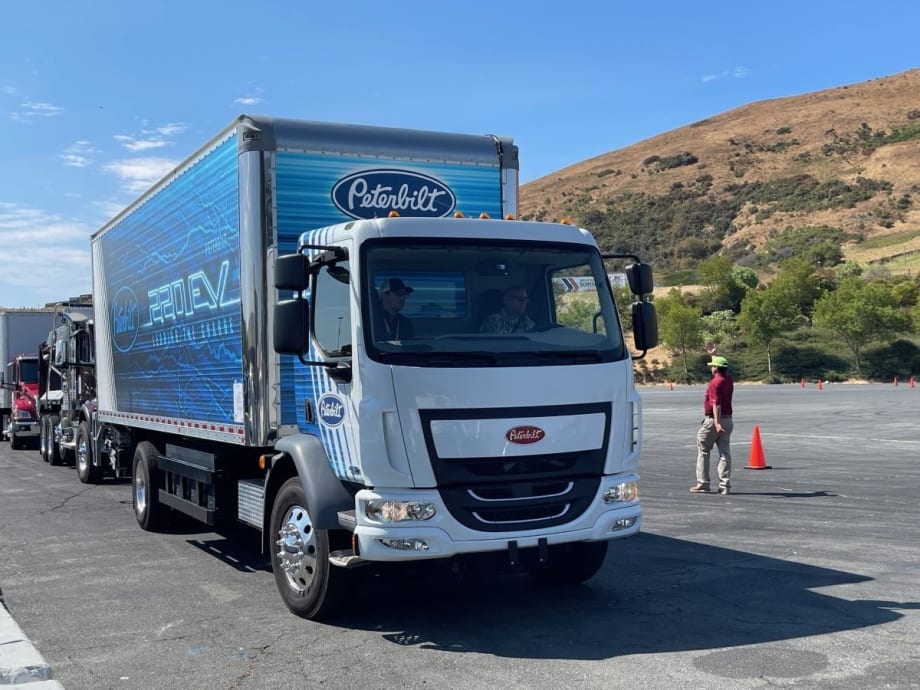
Peterbilt dealers in ACT states will soon have to purchase a certain percentage of EV trucks in order to sell larger numbers of diesel units.
Photo: Jack Roberts
4 min to read
Peterbilt officials talked about the 2027 emissions pre-buy, medium-duty updates, and the latest on its electric trucks during a “Commitment to Class” event for customers and suppliers at the Fairmont Sonoma Mission Inn & Spa in Sonoma, California, on Aug. 7.
The North American trucking industry is girding itself for a tumultuous ride heading into the 2027, when the U.S. Environmental Protection Agency’s Phase 3 Greenhouse Gas emissions regulations become law.
Common thinking in the industry is that the largest Class 8 prebuy in history has either already begun or will spark off soon. And Peterbilt clearly wanted to set the stage by detailing its latest product enhancements and improvements before fleets get serious about obtaining trucks before the 2027 regulations come into play.
A Bumpy Year for Truck Sales
That said, the bulk of the meeting was focused on the OEM’s medium-duty product line. Jim Wallace, director of medium-duty products, Peterbilt, opened by noting that 2024 has already been a tumultuous year for both heavy- and medium-duty truck sales.
“The U.S. and Canadian truck industry retail sales are estimated to be in the range of 240,000 to 280,000 Class 8 trucks in 2024," he told attendees. “The medium-duty market remains sturdy and is trending slightly over 100,000 trucks this year. It’s been a little bumpy. But still a very healthy year.”
Peterbilt puts great emphasis on its dealer network, and Wallace noted that the OEM has been investing heavily in this space since 2015. The company so far has added 96 new locations since that time. Its dealer network has also added 1,000 service bays, 950 new service trucks and 1,400 technicians.
In fact, Wallace added, Peterbilt has a dedicated, in-house management team whose sole task is to make sure its dealer population of technicians is constantly expanding.
TX-8 Transmission Upgrades
There was also news on the TX-8 automated manual transmission.
Peterbilt customers can now spec the TX-8 with a new mobile PTO. This new feature allows PTO engagement beyond first gear.
“It’s important to note that we are working closely with Paccar Parts to get PTOs into our parts distribution centers,” said Tiffany Cavazos, Peterbilt’s new medium-duty marketing manager.
Cavazos also announced an increase in the TX-8 maximum torque rating from 1,000 lbs.-ft. to 1,050 lbs.-ft.
An EV Deployment Partner
Patrick Wallace, EV marketing manager, Peterbilt, built onto the message he delivered to HDT readers late last year concerning the coming requirements for electric truck deployment.
Wallace noted that the California Air Resource Board Advanced Clean Truck rule requires OEMs in that state to sell a certain number of zero-emission trucks. That means California fleets looking to buy diesel units will have fewer non-diesel trucks available on dealer lots. (And that doesn't even take into consideration the related Advanced Clean Fleets rule in California, which requires fleets to transition to zero-emissions trucks.)
Wallace warned that while the ACT regulation is currently limited to California, other states will soon follow suit.
“This will eventually be a nationwide requirement,” he warned attendees.
In a private conversation with HDT later, Wallace expanded on his comments.
“There are definitely challenges with the transition to electric trucks,” he said. “Cost is definitely a challenge for everybody. Fleets desire a truck that is the same price as a diesel and has the same range.
"I think there’s some acceptance out there that we’re not there yet. And, as a result, I think this transition toward EVs is moving more slowly than legislators would like.”
What Advanced Clean Trucks Rules Mean for Dealers
ACT is also placing extra demands on dealers in California and other states that will soon be adopting the regulation, Wallace added.
If a fleet wants diesel trucks in ACT states, he explained, then Peterbilt has to sell a certain percentage of battery-electric trucks to even have the diesel products available to sell.
“The way we’re managing that is that if you’re a dealer, and you want a certain allocation of diesel trucks, you’re going to have to buy a certain number of electric vehicles as well,” he explained.
“If the dealer wants 20 diesel trucks, then that sales package is going to have to include two electric trucks. And the dealers can do whatever they like with those trucks. They can use them as service trucks, if they want to. But that’s the way it’s going to work.”
More Equipment

How Volvo Updated Its D13 for EPA 2027 [Watch]
Volvo’s updated D13 promises lower emissions without sacrificing performance or fuel economy. Take a closer look at what changed inside the engine in this HDT Spotlight video.
Read More →
Michelin Tire Improves Efficiency and Durability for Regional Fleets
The Michelin X Multi Energy D2 is a regional haul drive tire engineered to help fleets improve fuel efficiency, durability and traction in demanding stop-and-go operations.
Read More →
ZF Expands Commercial Vehicle Push in North America
ZF is expanding its North American commercial-vehicle presence with new transmission applications, electrification, trailer technology and autonomous-driving systems.
Read More →
Tesla Wants a Self-Driving Semi. Are Cameras Enough?
Could Tesla’s camera-only autonomous driving technology work on an 80,000-pound Semi? In this commentary, HDT's Deborah Lockridge takes a look at Tesla, Cybercab, and how autonomous trucks see the road.
Read More →
Kodiak: Driverless Long-Haul Truck Launch on Track for 2026
Kodiak AI says its driverless long-haul safety case is 93% complete and it remains on track to begin commercial operations by year-end 2026.
Read More →
What DOT’s Automated Vehicle Strategy Means for Trucking
The U.S. Department of Transportation issued a new automated-vehicle strategy that outlines plans for driverless-truck regulations, cross-state freight corridors, and federal safety standards.
Read More →
East Coast Port Launches $45M Electric Truck Push
The Port Authority of New York and New Jersey announced millions in incentives for zero-emission drayage trucks, yard tractors, and new charging hubs near the port.
Read More →
PlusAI Going Public to Fund Autonomous Truck Launch
A SPAC deal could provide PlusAI with up to $300 million as it works toward a 2027 commercial launch of factory-built autonomous trucks.
Read More →
NHTSA Moves to Rewrite Truck Fuel-Economy Rules
The National Highway Traffic Safety Administration says it lacks authority to regulate medium- and heavy-duty truck engines separately from complete vehicles, but the existing standards have not yet been eliminated.
Read More →
Detroit Opens Orders for EPA 2027 Engines
Detroit isn’t starting from scratch to meet EPA 2027 diesel emissions standards. Its Gen 6 DD13 and DD15 engines keep much of today’s platform while updating the fuel and aftertreatment systems.
Read More →