




Outside Shops Demand 'Right To Repair,' But That's Not Fair to Dealers, One Says
The "right to repair" one's vehicle wherever one chooses isn't in the U.S. Constitution or Bill of Rights, but many people in the maintenance and parts business believe it almost should be. Original-equipment dealers don't agree and have some real-money reasons why certain servicing information should remain proprietary. The issue has a lengthy history, and now there's legislation pending in Congress that would give independent shops what they want
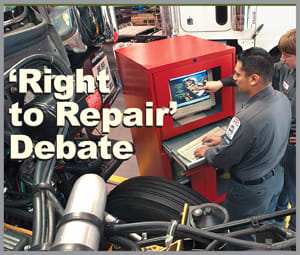
The "right to repair" one's vehicle wherever one chooses isn't in the U.S. Constitution or Bill of Rights, but many people in the maintenance and parts business believe it almost should be. Original-equipment dealers don't agree and have some real-money reasons why certain servicing information should remain proprietary. The issue has a lengthy history, and now there's legislation pending in Congress that would give independent shops what they want.
They want access to information and special tools needed to service and repair modern trucks, said two shop proprietors at the recent Fall Meeting of the Technology & Maintenance Council of the American Trucking Associations. OE truck dealers refuse to provide these, forcing owners to take their vehicles to dealers' shops where they sit in line and charges are often higher.
This is a monopoly and it ought to be illegal, the independents said. House Resolution 2057 would make it so, said the two shop owners, Marc Karon, president of Total Truck Parts, with several facilities in Florida, and Dave Scheer, president of Inland Truck Parts, with 27 locations in the central U.S.
OE dealers don't have the capacity to handle all repairs of late-model trucks, so they concentrate on warranty fixes and more routine work waits, Karon charged. The nature of OE franchising means there is only one dealer in a given geographic area, so customers are forced to use it. An industry agreement forged in 2001 allows for arbitrating disputes, but it requires face-to-face negotiations among lawyers who must travel to Loudon County, Va., for meetings.
HR 2057 Opposition
The service industry would prefer a more effective industry solution, maybe through TMC, to government intervention, Karon said. But opposition from dealers and truck OE manufacturers might make passage of HR 2057 necessary. It has several sponsors in the House of Representatives but faces an uncertain future. A similar bill was considered in the Senate nine years ago but died.
Like Karon's company, Scheer's has trained, certified technicians and large stocks of parts and the tools to install them, Sheer said. But his people are hobbled when they encounter diagnostic fault codes that they cannot decipher or can't get specialty tools. On several occasions mechanics needed only vehicle wiring diagrams to repair a truck or install new equipment, but the local dealers refused to provide them. So the trucks had to be sent to their shops for work involving the wiring system, then returned to an Inland shop where the work was completed.
"I'll pay a fair market price for this information," Scheer said. "I don't want design information and proprietary knowledge. These restrictions are artificial and are not free enterprise... Let the market decide" who should repair motor vehicles.
The OE Side
There are legal and competitive reasons for dealers guarding information about the trucks they sell, said Gerald Chunn of the Lone Star Truck Group, a Freightliner and Western Star dealer with facilities in Texas, Louisiana and New Mexico. An OE dealer has to meet expensive requirements that independent shops don't, he said, so deserve special protection. Selling trucks in this economy has become unprofitable, but franchise laws in Texas require that dealers take trade-ins, even if they lose money on them.
The OEM requires dealers to invest millions of dollars in facilities, parts and tools and assumes the dealer can pay for them. Some parts are never sold and some tools are never used, but the OEM insists that dealers buy them on the chance that they will be, Chunn said. Meanwhile, the OE invests hundreds of millions of dollars a year developing new trucks and systems to make them more efficient and keep them legal, and wants to be sure the vehicles are properly maintained. Dealers provide a nationwide network that over-the-road users can use, and they back each others' work.
Getting Information
"Independent shops bring no new products to market, they don't sell trucks, and they stock few of the parts I must," Chunn said. As to information needed to work on a truck, "If an '88 Mack comes into my shop in New Mexico, I can find 99 percent of the information I need to work on that Mack on the Internet," so independent shops should try harder to obtain what they need on the Net. To fleet managers in the audience, Chunn said, "You as customers can get 100 percent of the information you need for your trucks from OE repair shops."
In the case of those trucks Scheer talked about - the ones whose wiring diagrams were unobtainable to his mechanics - could the trucks' owners have gotten the diagrams from dealers, then turned them over to Sheer's people? "Absolutely," Chunn said. "'Give me your fax number - I'll send it right over.'" Did Sheer's people ask the trucks' owners to do that? "I don't know," Sheer answered, but suggested that would've been awkward.
A Balance
But increasingly complex vehicles and OEMs' swing to use of proprietary components makes the situation more serious, said Darry Stuart, a fleet consultant and former TMC general chairman, during a question-and-answer session. Information becomes more specialized, and only OE dealers have direct access to it. Independent technicians can't rely on their years of experience to sort out problems.
"We're trapped by technology and vertical integration," Stuart declared. "It's changing so fast that experience doesn't prevail anymore... There has to be a balance."
Updated 9/29/09 to correct the spelling of Gerald Chunn's name and to clarify the lead sentence.
More Drivers

From One Generation to the Next: How Mentorship Builds Safer Truck Drivers
After three decades in trucking, Harold Perry shares what he's learned about driver safety, mentorship, and helping the next generation build confidence behind the wheel.
Read More →
Truck Drivers Need More Than Another Alert
Fleets have more visibility into truck health, safety events, and driver activity than ever. The next challenge is turning all that information into useful guidance for the person who has to decide what to do next.
Read More →
FMCSA Removes 110 Truck Driver Training Schools from Certified ELDT List
Federal regulators also are targeting more than 160 additional training providers and launching a nationwide audit of third-party CDL skills testers as part of a broader crackdown on trucking fraud.
Read More →
Hours of Service Pilot Programs: FMCSA Readies for 2027 Rollout
Two pilot programs could eventually reshape hours-of-service rules, giving truck drivers options to pause their 14-hour clock or use longer split sleeper rest periods.
Read More →
Medical Cards, English Proficiency Reshape Roadcheck Violations
Medical-card violations jumped to the top of the driver out-of-service list during CVSA’s 2026 International Roadcheck, while English-language proficiency violations appeared among the leading violations for the first time.
Read More →
Driver Trust Can Make or Break the Success of Fleet Safety Technology
New Teletrac Navman research suggests that onboarding, transparency about driver data, and positive feedback can play a significant role in how commercial drivers respond to safety and coaching technology.
Read More →
EEOC Sues KLLM Over Alleged Sex Discrimination in Driver Training
KLLM is facing a federal sex-discrimination lawsuit over policies the EEOC alleges put female truck driver trainees at a disadvantage.
Read More →
FMCSA Moves to Codify English Language Requirements for Commercial Drivers
By changing regulations on English-language proficiency requirements for commercial drivers, rather than relying on a guidance memo, the FMCSA said future administrations won't be able to walk back the Trump administration's stricter enforcement with just a memo.
Read More →
Drivers Put Western Star Trucks to the Test at Star Nation Experience
Watch to get an inside look at the Western Star trucks, technology, and community behind the Star Nation Experience 2026!
Read More →
Trump Administration Looks to Put More Veterans Behind the Wheel
The Freedom Haulers program pulls together existing and expanded programs at several federal agencies to recruit veterans to drive commercial heavy-duty trucks and cut the red tape for them to get a CDL, training, and employment.
Read More →