





Related from the archives: OOIDA Refutes Recent Electronic Logging Device Study (2014)
OOIDA Fires Back on ELD Rule Ahead of September Court Hearing
The Owner-Operator Independent Drivers Association has filed a reply brief to the government's arguments defending its controversial electronic logging mandate in the association's lawsuit, scheduled to be heard by a federal court next month.
August 15, 2016
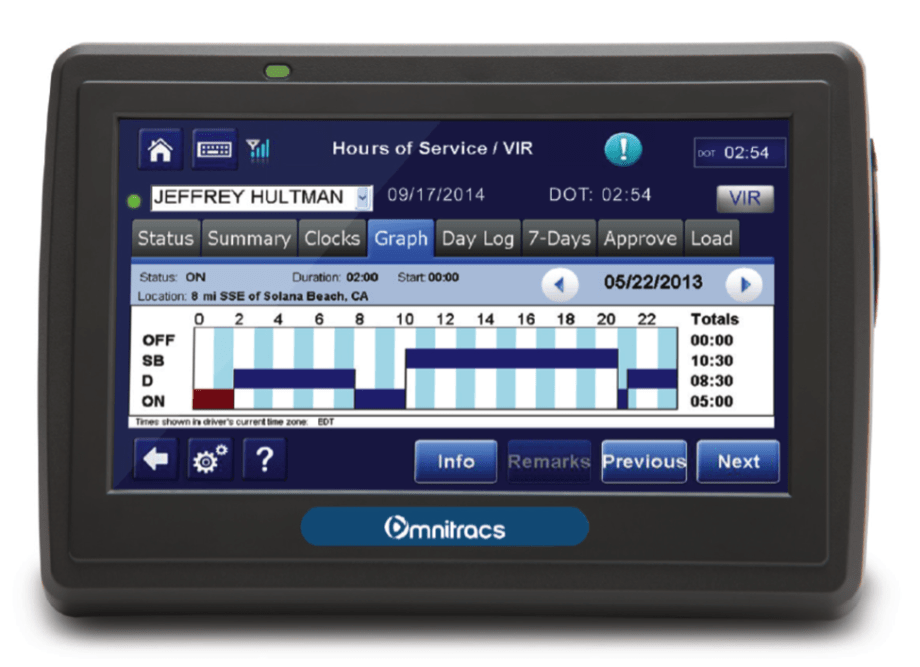
Photo: Omnitracs
5 min to read
Photo: Omnitracs
The Owner-Operator Independent Drivers Association has filed a reply brief to the government's arguments defending its controversial electronic logging mandate in the association's lawsuit, scheduled to be heard by a federal court next month.
OOIDA is seeking an injunction to halt the implementation of the rule.
Friday, Aug. 12, OOIDA filed a reply brief in the suit, originally filed last December only a day after the final rule was published by the Federal Motor Carrier Safety Administration. The reply brief is a legal precursor to oral arguments on Sept. 13.OOIDA's case hinges on five arguments:
The devices as mandated are unable to do the job as prescribed.
The rule offers no protection against harassment of drivers.
The benefits of the rule do not outweigh the costs
They erode drivers’ Fourth Amendment protections against unreasonable searches and seizures
Driver privacy is not protected
The ELD mandate affects an estimated 3 million interstate drivers of vehicles manufactured after model year 2000. By December 2017, drivers will have to replace paper logbooks with electronic devices.
The association previously challenged a similar mandate in August 2011 and the court ruled in favor of OOIDA's arguments that the previous rule did not protect drivers against harassment. FMCSA went back to the drawing board to rewrite the rule in a way that would address the court’s concerns.
With this track record of derailing mandatory e-logs once before, the association is confident it can do it again.
In June, FMCSA forcefully defended the ELD rule in a brief that it was required to submit to the U.S. Court of Appeals for the Seventh Circuit. In that brief, FMCSA argued that the ELD rule is constitutional as it does not violate the Fourth Amendment prohibition of unreasonable searches; that the mandate does not impinge on drivers’ rights to privacy, and that its cost-benefit analysis “amply supports” the rulemaking.
The reply brief filed by OOIDA Friday is in response to FMCSA’s brief. According to an article on the website of association magazine Land Line, the brief counters the agency's arguments thus:
1. Do ELDs do what they’re supposed to do? In the Moving Ahead for Progress in the 21st Century (MAP-21) highway bill, Congress directed FMCSA to “prescribe regulations … requiring that a commercial motor vehicle … be equipped with an electronic logging device … capable of recording a driver’s hours of service and duty status accurately and automatically.”
However, OOIDA says ELDs as mandated don’t do this, because they can’t automatically track non-driving on-duty time.
2. Does the law protect against driver harassment? This is the key issue that OOIDA used to prevail in its 2011 lawsuit, and the association says the agency still has not addressed this issue satisfactorily, despite an express prohibition on driver harassment, with civil penalties for violations and a procedure for drivers to file written complaints of harassment by a carrier.
“FMCSA takes the position that it is not required to address all instances of harassment, but only those related to HOS violations, and then only harassment perpetrated by motor carriers,” the OOIDA brief states.
3. Do they save more than they cost? OOIDA’s suit claims FMCSA has no proof that ELDs improve hours of service compliance or reduce crashes. In its June brief, FMCSA pointed out that “as an initial matter,” it was “not statutorily required to do a cost-benefit analysis at all, so any objection to that analysis provides no basis to vacate the rule.” Nevertheless, FMCSA said its own analysis, using data from motor carriers already using electronic logs, fully supports the rule. OOIDA’s reply brief disagrees, saying “FMCSA has provided no valid evidentiary support for its conclusion that ELDs will reduce HOS violations or crash risk.”
The association says FMCSA has not studied the effectiveness of the devices, and ignored a 2014 study that found no differences between trucks using electronic logs and trucks not using them in recordable and fatigue-related crash rates.
4. Does an ELD constitute unreasonable search? FMCSA in its June brief flatly declared that “ELDs do not violate the Fourth Amendment. ELDs are neither a ‘search’ nor a ‘seizure’ under the Fourth Amendment. ELDs are not surreptitiously attached to a vehicle by the government, but are installed by a motor carrier openly and pursuant to regulation with the advanced knowledge of the carrier and driver, who effectively consent to their installation and use by voluntarily participating the commercial motor carrier industry.”
OOIDA’s reply brief points to a 2012 Supreme Court ruling against law enforcement agencies placing GPS or other tracking devices on private citizens’ vehicles without a warrant. OOIDA dismissed FMCSA’s argument that trucking is a “pervasively regulated” industry and that drivers are giving their consent to search merely by agreeing to participate in the industry.
5. Do they violate driver privacy? FMCSA in its brief said the rule “takes appropriate measures to preserve the confidentiality of personal data contained in ELDs, relying in part on existing regulations and federal law protecting the release of private information, as well as committing the agency to redact private information from the administrative record in an enforcement action, and further requiring motor carriers to protect private data consistent with sound business practices and requiring ELDs have secure access to data and use encryption methods while transferring data.”
FMCSA said the OOIDA brief “contains only vague assertions that the agency should have done more, without specifying exactly what additional procedures they desire or explaining why the provisions adopted are not ‘appropriate measures’ as Congress required.”
In its reply, OOIDA said the agency is misrepresenting what Congress required.“FMCSA’s truncation of the statutory language conveniently omits reference to the words ‘shall institute appropriate measures’ and gratuitously represents that ‘Congress required the FMCSA to consider ‘appropriate measures.’”
The OOIDA brief goes on to detail ways data can be used to harass drivers, in unrelated criminal investigations for example.
More Drivers

Truck Drivers Need More Than Another Alert
Fleets have more visibility into truck health, safety events, and driver activity than ever. The next challenge is turning all that information into useful guidance for the person who has to decide what to do next.
Read More →
FMCSA Removes 110 Truck Driver Training Schools from Certified ELDT List
Federal regulators also are targeting more than 160 additional training providers and launching a nationwide audit of third-party CDL skills testers as part of a broader crackdown on trucking fraud.
Read More →
Hours of Service Pilot Programs: FMCSA Readies for 2027 Rollout
Two pilot programs could eventually reshape hours-of-service rules, giving truck drivers options to pause their 14-hour clock or use longer split sleeper rest periods.
Read More →
Medical Cards, English Proficiency Reshape Roadcheck Violations
Medical-card violations jumped to the top of the driver out-of-service list during CVSA’s 2026 International Roadcheck, while English-language proficiency violations appeared among the leading violations for the first time.
Read More →
Driver Trust Can Make or Break the Success of Fleet Safety Technology
New Teletrac Navman research suggests that onboarding, transparency about driver data, and positive feedback can play a significant role in how commercial drivers respond to safety and coaching technology.
Read More →
EEOC Sues KLLM Over Alleged Sex Discrimination in Driver Training
KLLM is facing a federal sex-discrimination lawsuit over policies the EEOC alleges put female truck driver trainees at a disadvantage.
Read More →
FMCSA Moves to Codify English Language Requirements for Commercial Drivers
By changing regulations on English-language proficiency requirements for commercial drivers, rather than relying on a guidance memo, the FMCSA said future administrations won't be able to walk back the Trump administration's stricter enforcement with just a memo.
Read More →
Drivers Put Western Star Trucks to the Test at Star Nation Experience
Watch to get an inside look at the Western Star trucks, technology, and community behind the Star Nation Experience 2026!
Read More →
Trump Administration Looks to Put More Veterans Behind the Wheel
The Freedom Haulers program pulls together existing and expanded programs at several federal agencies to recruit veterans to drive commercial heavy-duty trucks and cut the red tape for them to get a CDL, training, and employment.
Read More →
Putting Mack’s Command Steer to the Test
A test drive of Mack’s Command Steer active steering system evaluates how it can make truck driving easier and less tiring.
Read More →