




OOIDA ELD Exemption Denied
The Owner-Operator Independent Drivers Association’s request for a broad exemption to the ELD mandate for small-business truckers has been denied.

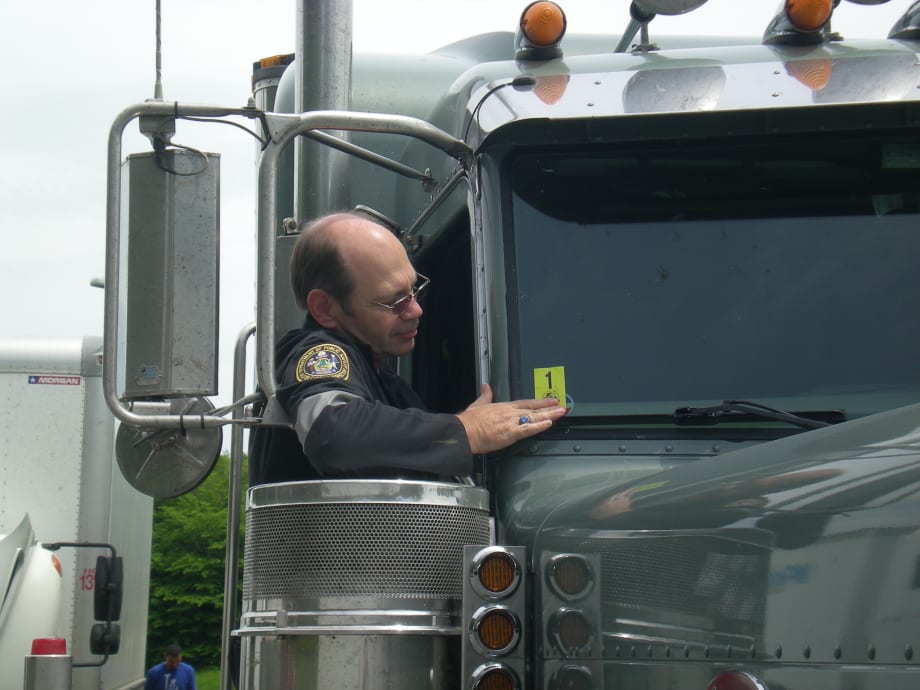
The FMCSA said OOIDA's broad ELD exemption request would be too burdensome for roadside inspectors.
Photo: CVSA
The Owner-Operator Independent Drivers Association’s request for a broad exemption to the ELD mandate for small-business truckers has been denied.
OOIDA, which represents truck drivers and owner-operators, had requested at least a five-year exemption to the rule requiring electronic logging devices to track truck driver hours of service. The exemption was requested for motor carriers classified as small businesses that have a proven safety history.
The request was submitted eight months ago to the Federal Motor Carrier Safety Administration.
“We are puzzled and disappointed at the response from the agency,” said Todd Spencer, executive vice president of OOIDA. “For months, the FMCSA has been granting exemptions to other organizations, some not even actually in trucking, but relying on trucks for their businesses.”
The association said in its request that small-business truckers that have already proven their ability to operate safely should not be subject to the rule, asking for an exemption for those defined as small business by the Small Business Administration, with no attributable at-fault crashes, and that do not have a Carrier Safety Rating of “Unsatisfactory.”
Critics of the exemption request said granting it would gut the ELD rule, which went into full effect April 1 with a few exemptions. In joint comments submitted to the Federal Motor Carrier Safety Administration, the Alliance for Driver Safety and Security (aka the Trucking Alliance) and the Advocates for Highway and Auto Safety said OOIDA’s request “would gut the long-settled electronic logging device rule by allowing nearly all trucking companies to delay compliance. The two groups called OOIDA’s request “a transparent attempt to bypass Congress and the courts by regurgitating discredited arguments which seek to advance special interests at the expense of road safety for all motorists.”
According to OOIDA’s Land Line magazine, the agency cited as a reason for its denial that most of the request challenged the basis of the electronic rule itself and did not recognize the “significant difficulty that would be encountered in trying to identify and validate drivers who meet the proposed exemption criteria, especially during roadside inspections.”
Support for the OOIDA ELD Exemption
In February, more than two dozen Congressmen, in a letter to the Federal Motor Carrier Safety Administration, encouraged the agency to grant OOIDA’s application.
The letter, from Reps. Brian Babin (R-TX) and Steve King (R-IA) and co-signed by another 23 representatives, said they viewed OOIDA’s request as “wholly consistent with the Trump Administration's goal of providing relief from costly and burdensome federal regulations to American small businesses.”
Last month, new legislation brought to the U.S. House of Representatives by congressmen from Montana and Minnesota proposed an exemption from the electronic logging device mandate for small carriers and agricultural haulers.
“Congress is taking notice that the mandate was not ready for prime time,” said Spencer in the release announcing the FMCSA's denial of the request. “There are numerous legislative proposals that would provide relief from the mandate, and we’re hoping Congress moves forward with them.”
Among the numerous concerns cited in the request, the issue of self-certification of vendors is one of the biggest issues brought up by OOIDA. “Most small-business motor carriers can ill afford to make these purchases only to learn later that the ELD is non-compliant. Yet they are required to do so or risk violation,” said Spencer.
A five-year exemption, it said, would provide necessary time for ELD manufacturers to be fully vetted by the agency, which would alleviate small-business motor carriers from learning that they purchased a device that could damage their vehicles electronic control module or be hacked.
Another Small-Business ELD Exemption Proposal Still Pending
Another group that filed for an exemption around the same time as OOIDA is the Small Business in Transportation Coalition. Its ELD exemption request is still pending and still open for comments at https://www.regulations.gov/comment?D=FMCSA-2018-0180-0012
SBTC says the FMCSA agreed to extend the July 5 deadline by a few days due to technical difficulties with the regulations.gov portal used by the public to file comments electronically. On Twitter, the group criticized OOIDA’s exemption request as a “departure from reality.”
SBTC President James Lamb said its proposal for exemption would be a more manageable one than the rejected OOIDA proposal. It asks for carriers with under 50 employees to be declared exempt. “That should be interpreted as 50 driver employees,” Lamb wrote in an email to members and others.
“This is more manageable and can be tied into MCS-150 data in the FMCSA system rather than make an inspector standing in the rain have to cross-reference multiple data fields in the system to determine if an exemption scenario exists,” he explained. “That is, the FMCSA system can be programmed to flash ‘ELD Exempt’ on the screen so the inspector is told the carrier is exempt rather than have to figure it out on his or her own. And that is simply triggered by the number of drivers in the database as reported in by the carrier on the carrier's last MCS-150.”
Related: Senators Push FMCSA Chief to Reform Trucker Hours of Service Rule
More Safety & Compliance

FMCSA Pauses Biennial-Update Enforcement Amid Motus Transition
Carriers whose updates were due on or after June 1 have more time, while FMCSA works to stabilize its new registration system and warns of phishing sites impersonating its new carrier registration system, Motus.
Read More →
ZF Expands Commercial Vehicle Push in North America
ZF is expanding its North American commercial-vehicle presence with new transmission applications, electrification, trailer technology and autonomous-driving systems.
Read More →
Truck Drivers Need More Than Another Alert
Fleets have more visibility into truck health, safety events, and driver activity than ever. The next challenge is turning all that information into useful guidance for the person who has to decide what to do next.
Read More →
Tesla Wants a Self-Driving Semi. Are Cameras Enough?
Could Tesla’s camera-only autonomous driving technology work on an 80,000-pound Semi? In this commentary, HDT's Deborah Lockridge takes a look at Tesla, Cybercab, and how autonomous trucks see the road.
Read More →
What DOT’s Automated Vehicle Strategy Means for Trucking
The U.S. Department of Transportation issued a new automated-vehicle strategy that outlines plans for driverless-truck regulations, cross-state freight corridors, and federal safety standards.
Read More →
NYC Expands Speed, Pedestrian Safety Tech Across Fleet
New York City is expanding intelligent speed assistance and pedestrian-alert systems across its municipal fleet, moving the technologies from pilot programs into vehicle procurement and retrofit requirements.
Read More →
FMCSA Removes 110 Truck Driver Training Schools from Certified ELDT List
Federal regulators also are targeting more than 160 additional training providers and launching a nationwide audit of third-party CDL skills testers as part of a broader crackdown on trucking fraud.
Read More →
Beyond DOT Compliance: What Makes a Trucking Fleet Truly Safe?
A trucking fleet can follow every rule and still make unsafe decisions. The real test comes when safety conflicts with freight, productivity, or cost.
Read More →
Hours of Service Pilot Programs: FMCSA Readies for 2027 Rollout
Two pilot programs could eventually reshape hours-of-service rules, giving truck drivers options to pause their 14-hour clock or use longer split sleeper rest periods.
Read More →
New Guide Offers Pet Safety Tips for Truck Drivers
Hundreds of thousands of pets travel in truck cabs. A new safety guide from Volvo Trucks and the Center for Pet Safety offers practical advice for truck drivers who bring dogs and cats along for the ride.
Read More →