




NTSB Conducting Tests at Site of June 2011 Amtrak Train Crash
NTSB investigators have returned to the scene of an accident between an Amtrak passenger train and a tractor and double trailer combination in rural Nevada on June 24, 2011.
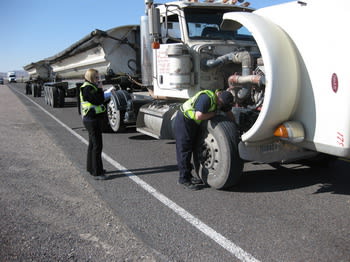
Testing equipment is installed on the truck's brake system to measure air-brake lag time. Photo by NTSB.
NTSB investigators have returned to the scene of an accident between an Amtrak passenger train and a tractor and double trailer combination in rural Nevada on June 24, 2011.
As a result of the accident, the truck driver, a train crew member, and four train passengers were killed.
Investigators were on site conducting tests and gathering data to gain more information about the performance of the vehicle and the circumstances and dynamics of the sequence of events leading up to the accident.
At the NTSB's request, John Davis Trucking, the motor carrier whose vehicle was involved in the crash, supplied a truck and set of trailers for the test that were nearly identical to those involved in the accident. The Nevada Highway Patrol and the Nevada Department of Transportation provided support essential to the testing operation.
In the area of human performance, investigators conducted tests to determine if the driver could have heard the train's horn. The train's locomotive event recorder and audio captured by a microphone mounted external to the locomotive revealed that the horn was sounded four times as the train approached the crossing. Based on information from the recordings, investigators calculated the distances between the truck and the crossing during the four horn blasts.
Investigators timed the test to coincide with a regularly scheduled Amtrak train that travels along the accident segment of the railroad tracks on a daily basis. During the test, train horn sounds were recorded from the inside of the exemplar truck as the Amtrak train approached along with ambient noise of the truck-tractor under a variety of driving conditions.
In the area of vehicle performance, investigators gathered additional data about the braking system and deceleration characteristics of the exemplar truck. Testing equipment was installed within the air-operated commercial vehicle braking system to measure air brake lag time on each of the nine axles of the truck-combination unit. The exemplar truck-tractor combination unit was then skid-tested near the accident site in order to gather information about the speed, stopping distance, and deceleration of the combination unit using multiple methods of data collection.
NTSB investigators are continuing to develop additional factual information and are in the process of analyzing the data derived from the tests performed in Nevada. The accident docket, which includes factual reports and hundreds of pages of documents, is expected to be opened within several months. A Board Meeting, where the determination of the probable cause of the accident will be made, is expected next year.
To read more about the investigation, visit: www.ntsb.gov
More Safety & Compliance

Marijuana and Trucking’s Drug-Testing Dilemma
Marijuana is getting stronger, laws are changing, and drug tests still can’t reliably establish impairment. What does that mean for truck drivers and the fleets that employ them?
Read More →
PrePass, Kodiak Connect Driverless Trucks to Roadside Enforcement
The system will allow enforcement agencies to verify Enhanced Inspection information and decide whether Kodiak’s autonomous trucks can bypass roadside screening sites.
Read More →
From One Generation to the Next: How Mentorship Builds Safer Truck Drivers
After three decades in trucking, Harold Perry shares what he's learned about driver safety, mentorship, and helping the next generation build confidence behind the wheel.
Read More →
FMCSA Pauses Biennial-Update Enforcement Amid Motus Transition
Carriers whose updates were due on or after June 1 have more time, while FMCSA works to stabilize its new registration system and warns of phishing sites impersonating its new carrier registration system, Motus.
Read More →
ZF Expands Commercial Vehicle Push in North America
ZF is expanding its North American commercial-vehicle presence with new transmission applications, electrification, trailer technology and autonomous-driving systems.
Read More →
Truck Drivers Need More Than Another Alert
Fleets have more visibility into truck health, safety events, and driver activity than ever. The next challenge is turning all that information into useful guidance for the person who has to decide what to do next.
Read More →
Tesla Wants a Self-Driving Semi. Are Cameras Enough?
Could Tesla’s camera-only autonomous driving technology work on an 80,000-pound Semi? In this commentary, HDT's Deborah Lockridge takes a look at Tesla, Cybercab, and how autonomous trucks see the road.
Read More →
What DOT’s Automated Vehicle Strategy Means for Trucking
The U.S. Department of Transportation issued a new automated-vehicle strategy that outlines plans for driverless-truck regulations, cross-state freight corridors, and federal safety standards.
Read More →
NYC Expands Speed, Pedestrian Safety Tech Across Fleet
New York City is expanding intelligent speed assistance and pedestrian-alert systems across its municipal fleet, moving the technologies from pilot programs into vehicle procurement and retrofit requirements.
Read More →
FMCSA Removes 110 Truck Driver Training Schools from Certified ELDT List
Federal regulators also are targeting more than 160 additional training providers and launching a nationwide audit of third-party CDL skills testers as part of a broader crackdown on trucking fraud.
Read More →