





Related: Anheuser-Busch Adds 21 Electric Trucks in California
Nikola, BYD Complete First Emissions-Free Beer Delivery for Anheuser-Busch
Using a Nikola hydogen-electric truck and a BYD electric truck, Anheuser-Busch completed a delivery from its brewery to a local wholesale partner that the company is touting as its first "zero-emissions beer delivery."
November 22, 2019
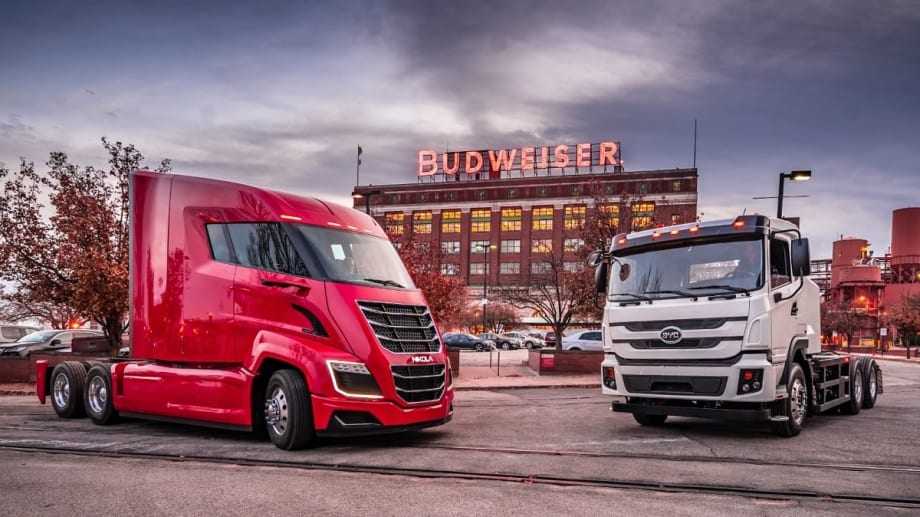
Using a Nikola hydogen-electric truck and a BYD electric truck, Anheuser-Busch completed a delivery from its brewery to a local wholesale partner that the company is touting as its first "zero-emission beer delivery".
Photo: Nikola
3 min to read
Anheuser-Busch, in partnership with Nikola Motor Company and BYD Motors completed a zero-emissions beer delivery in the company’s hometown of St. Louis, using Nikola’s hydrogen-electric truck and a BYD electric truck to deliver beer from the local Anheuser-Busch brewery to the Enterprise Center.
A Nikola hydrogen-electric truck picked up the load of beer and delivered it to Anheuser-Busch local wholesaler partner, Lohr Distributors, marking the first commercial delivery onboard a Nikola hydrogen-electric vehicle.
Lohr Distributors then delivered the beer to the Enterprise Center, home of the St. Louis Blues, on a BYD electric truck – a milestone delivery for the brewer as the beer reached its destination with zero-emissions from transportation.
“At Anheuser-Busch, we are continuously searching for innovative ways to improve sustainability across our entire value chain, progressing towards reaching our sustainability goals and driving our industry forward,” said Ingrid De Ryck, vice president of procurement and sustainability at Anheuser-Busch. “This zero-emission delivery has shown what is possible when we bring together the various strengths and assets within our supplier network to work towards a shared objective of a better world.”
The delivery builds on Anheuser-Busch’s ongoing commitment to sustainability and existing partnerships with both Nikola and BYD. Through its 2025 sustainability goals, Anheuser-Busch has committed to reducing carbon emissions across their value chain by 25% by 2025.
Last year, Anheuser-Busch placed an order for up to 800 hydrogen-electric powered semi-trucks from Nikola, a pioneer in hydrogen-electric renewable technology. The partnership will help the brewer transition their entire long-haul dedicated fleet to zero-emission vehicles.
“As the first commercial delivery of freight with our hydrogen-electric truck, this is an exciting time for both Nikola and Anheuser-Busch. This milestone will become an example for all other OEM’s to move away from diesel trucks and towards zero emission vehicles,” said Trevor Milton, Nikola’s chief executive officer. “We look forward to helping the Anheuser-Busch team achieve their sustainability goals by leveraging Nikola’s zero-emissions technology. We are now preparing production vehicles for Anheuser-Busch and plan on delivering the trucks as fast as possible.”
To complement the Nikola partnership within their routes, Anheuser-Busch also announced a pilot project with BYD in California last month to improve the sustainability of its fleet at four Anheuser-Busch distribution facilities across southern California. The 21 BYD electric trucks as well as a 958.5 kW solar array to charge the vehicles will be implemented this year as the largest Class 8 electric truck deployment in North America.
“Partnering with Anheuser-Busch is a great opportunity to showcase BYD’s performance and reliability with an industry leader,” said Stella Li, President of BYD Motors. “Our dedication to innovation pairs nicely with Anheuser-Busch’s sustainability commitment.”
Anheuser-Busch is hosting more than 100 strategic suppliers and partners in St. Louis this week for the company’s inaugural Eclipse Summit to discuss best practices and align on collective action in sustainability. Both Nikola and BYD will be participating in the summit to highlight their cutting-edge technology and the impact of their partnerships with the brewer.
More Fuel Smarts

How Volvo Updated Its D13 for EPA 2027 [Watch]
Volvo’s updated D13 promises lower emissions without sacrificing performance or fuel economy. Take a closer look at what changed inside the engine in this HDT Spotlight video.
Read More →
Diesel Price Spike Shortens Payback for Natural Gas Trucks, Report Says
Energy Vision estimates fleets could recover the higher purchase price of an RNG-fueled Class 8 tractor in 1.3 to 2.8 years under current fuel-price scenarios.
Read More →
Calstart Becomes Catalyst Mobility, Reflecting Broader Focus
Calstart is now Catalyst Mobility, reflecting the nonprofit’s growing national role in clean transportation, including zero-emission trucks, infrastructure and incentive programs.
Read More →

Record Diesel Prices Squeeze Trucking Fleets
Average U.S. diesel prices have climbed to nearly $6 a gallon, surpassing the 2022 record as tight refinery capacity and Middle East disruptions keep fuel costs elevated.
Read More →
Sponsored•September 9, 2026
How Fuel Delivery Shapes Engine Performance
Fuel delivery depends on more than what happens at the injector. For fleet, maintenance and technical professionals, looking at the full path from pump to injector can provide useful context for understanding engine performance.
Read More →
East Coast Port Launches $45M Electric Truck Push
The Port Authority of New York and New Jersey announced millions in incentives for zero-emission drayage trucks, yard tractors, and new charging hubs near the port.
Read More →
California Bill Could Shed Light on Electric Truck Prices
Why do battery-electric Class 8 trucks remain so expensive? A California bill headed to Gov. Gavin Newsom would give fleets and state agencies more visibility into what manufacturers charge.
Read More →
Detroit Opens Orders for EPA 2027 Engines
Detroit isn’t starting from scratch to meet EPA 2027 diesel emissions standards. Its Gen 6 DD13 and DD15 engines keep much of today’s platform while updating the fuel and aftertreatment systems.
Read More →
Zero-Emission Truck Corridor Planned for West Coast
California, Oregon, Washington, British Columbia and Baja California are coordinating plans for truck charging and hydrogen fueling from Canada to Mexico.
Read More →
A Closer Look at Kenworth’s Electric T880E Vocational Truck [Video]
Learn more about Kenworth's T880E battery-electric vocational truck at the Paccar Technical Center, including its range, applications, upfitting considerations, and PTO options, in this HDT Spotlight video.
Read More →