




New Wheel Covers Hide Fasteners for Optimized Aerodynamics
Deflecktor has designed a new generation of aerodynamic wheel covers, which it says offer a more aerodynamic shape because the fastening system is entirely contained behind the smooth, aerodynamic wheel cover face.


This clear cover illustrates the attaching mechanism. Photo: Deborah Lockridge
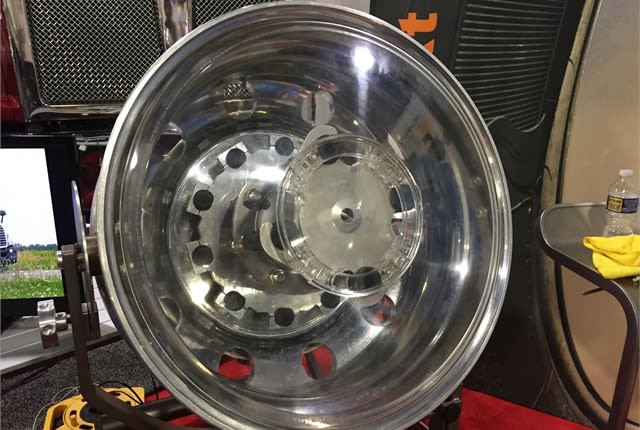
This clear cover illustrates the attaching mechanism.Photo: Deborah Lockridge
ATLANTA — Deflecktor has designed a new generation of aerodynamic wheel covers, which it says offer a more aerodynamic shape because the fastening system is entirely contained behind the smooth, aerodynamic wheel cover face.
“This is the first cover that the fastening system isn’t taking the front seat to the aerodynamic shape,” explained company founder Jon Fleck at the North American Commercial Vehicle Show. “The aerodynamic shape is optimized. There’s no buttons, there’s no brackets, there’s no nuts and bolts.”
The company took a similar approach to design covers for the front axle, which deals specifically with the paddlewheel effect. “The paddlewheel affect is addressing the lug nuts spinning at 520 revs per mile within this apocalyptic flow of air at the front of the vehicle," Fleck explained.
The new wheel covers are lightweight and durable and are priced to allow fleets to realize a faster return on their investment.
“With no low pressure troughs on its face, the various finishes live long and stay clean through the most challenging environments. The covers float entirely free of the wheel,” says a press release.
A simple, rigged fastener design offers instant on/off access to the wheel end. Sensory feedback assures the user of the wheel cover’s secure and accurate installation
Deflecktor offers these wheel covers in a durable injected polymer that feature several finish choices; mirror chrome, painted silver (11 coats), optically clear polycarbonate, and an injected color of choice. All metal components are aerospace-quality stainless that are entirely sourced in the USA. Assembly occurs in the St Croix River Valley of Minnesota and Wisconsin, where most research and development happens.
This new Deflecktor cover is aggressively priced to ensure the fastest ROI. The Deflecktor design has multiple worldwide patents pending.
The company has been making aerodynamic wheel covers since the early ‘90s, with a product originally called the Spot wheel cover. But as founder Jon Fleck explained, the “Spot cover was dear, and fuel wasn’t.” But by 2006 Schneider was testing them with good results. The Great Recession put a pause on the adoption, but by 2010, however, Schneider was using the wheel covers and experiencing about a 1% fuel savings, Fleck said.
More Fuel Smarts

How Volvo Updated Its D13 for EPA 2027 [Watch]
Volvo’s updated D13 promises lower emissions without sacrificing performance or fuel economy. Take a closer look at what changed inside the engine in this HDT Spotlight video.
Read More →
Diesel Price Spike Shortens Payback for Natural Gas Trucks, Report Says
Energy Vision estimates fleets could recover the higher purchase price of an RNG-fueled Class 8 tractor in 1.3 to 2.8 years under current fuel-price scenarios.
Read More →
Calstart Becomes Catalyst Mobility, Reflecting Broader Focus
Calstart is now Catalyst Mobility, reflecting the nonprofit’s growing national role in clean transportation, including zero-emission trucks, infrastructure and incentive programs.
Read More →

Record Diesel Prices Squeeze Trucking Fleets
Average U.S. diesel prices have climbed to nearly $6 a gallon, surpassing the 2022 record as tight refinery capacity and Middle East disruptions keep fuel costs elevated.
Read More →
How Fuel Delivery Shapes Engine Performance
Fuel delivery depends on more than what happens at the injector. For fleet, maintenance and technical professionals, looking at the full path from pump to injector can provide useful context for understanding engine performance.
Read More →
East Coast Port Launches $45M Electric Truck Push
The Port Authority of New York and New Jersey announced millions in incentives for zero-emission drayage trucks, yard tractors, and new charging hubs near the port.
Read More →
California Bill Could Shed Light on Electric Truck Prices
Why do battery-electric Class 8 trucks remain so expensive? A California bill headed to Gov. Gavin Newsom would give fleets and state agencies more visibility into what manufacturers charge.
Read More →
Detroit Opens Orders for EPA 2027 Engines
Detroit isn’t starting from scratch to meet EPA 2027 diesel emissions standards. Its Gen 6 DD13 and DD15 engines keep much of today’s platform while updating the fuel and aftertreatment systems.
Read More →
Zero-Emission Truck Corridor Planned for West Coast
California, Oregon, Washington, British Columbia and Baja California are coordinating plans for truck charging and hydrogen fueling from Canada to Mexico.
Read More →
A Closer Look at Kenworth’s Electric T880E Vocational Truck [Video]
Learn more about Kenworth's T880E battery-electric vocational truck at the Paccar Technical Center, including its range, applications, upfitting considerations, and PTO options, in this HDT Spotlight video.
Read More →