




New Legislation Would Allow States to Raise Truck Weight Limits
New legislation introduced in the Senate would allow state Departments of Transportation to raise interstate weight limits to 97,000 pounds for trucks with six axles instead of five
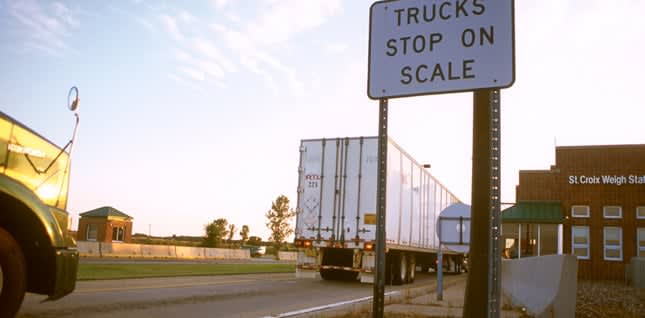
Under the new bill, states can opt to allow six-axle trucks to carry up to 97,000 pounds.(Photo by Michelin)
New legislation introduced in the Senate would allow state Departments of Transportation to raise interstate weight limits to 97,000 pounds for trucks with six axles instead of five.
The Safe and Efficient Transportation Act was recently unveiled by Sens. Mike Crapo (R-Idaho), Herb Kohl (D-Wis.) and Susan Collins (R-Maine). The rule would allow shippers to use extra cargo space and reduce truck loads, fuel, emissions and vehicle miles traveled, according to the Coalition for Transportation Productivity (CTP), a group of more than 160 shippers and allied associations. An identical bill is being considered in the House of Representatives.
"This bipartisan legislation gives states the option to increase interstate truck weight limits in a safe manner so that we can get more goods from the farm or factory to consumers in fewer trips and fewer vehicle miles," said Crapo. "Many trucks now hit the federal weight limit with space left in their trailers. The U.S. DOT estimates that the use of six-axle trucks could save as much as $14.5 billion in shipping costs annually. SETA will also make U.S. goods more competitive in the global marketplace, as Canada, the United Kingdom, and many other countries already have higher weight limits."
The American Trucking Associations issued a statement in support of the bill.
"ATA supports a number of reforms to federal truck size and weight regulations as part of our Sustainability Initiative," said Bill Graves, ATA president and CEO. "More efficient trucks, like those allowed under this legislation, will significantly reduce the trucking industry's carbon output."
"The American Trucking Associations estimates that the trucking industry will haul 30 percent more tonnage in 2021 than it does today," said John Runyan, executive director of CTP, which also applauded the new rule. "If current weight restrictions remain the same, that means our economy will require 18 percent more trucks on the road driving 27 percent more miles than they do now. The Safe and Efficient Transportation Act would ease the burden on our roads by adjusting weight limits to safely reduce the number of trucks required to ship a given amount of goods."
The House version was originally introduced by Reps. Michael Michaud (D-Maine) and Jean Schmidt (R-Ohio). It currently has 54 co-sponsors.
More Drivers

Truck Drivers Need More Than Another Alert
Fleets have more visibility into truck health, safety events, and driver activity than ever. The next challenge is turning all that information into useful guidance for the person who has to decide what to do next.
Read More →
FMCSA Removes 110 Truck Driver Training Schools from Certified ELDT List
Federal regulators also are targeting more than 160 additional training providers and launching a nationwide audit of third-party CDL skills testers as part of a broader crackdown on trucking fraud.
Read More →
Hours of Service Pilot Programs: FMCSA Readies for 2027 Rollout
Two pilot programs could eventually reshape hours-of-service rules, giving truck drivers options to pause their 14-hour clock or use longer split sleeper rest periods.
Read More →
Medical Cards, English Proficiency Reshape Roadcheck Violations
Medical-card violations jumped to the top of the driver out-of-service list during CVSA’s 2026 International Roadcheck, while English-language proficiency violations appeared among the leading violations for the first time.
Read More →
Driver Trust Can Make or Break the Success of Fleet Safety Technology
New Teletrac Navman research suggests that onboarding, transparency about driver data, and positive feedback can play a significant role in how commercial drivers respond to safety and coaching technology.
Read More →
EEOC Sues KLLM Over Alleged Sex Discrimination in Driver Training
KLLM is facing a federal sex-discrimination lawsuit over policies the EEOC alleges put female truck driver trainees at a disadvantage.
Read More →
FMCSA Moves to Codify English Language Requirements for Commercial Drivers
By changing regulations on English-language proficiency requirements for commercial drivers, rather than relying on a guidance memo, the FMCSA said future administrations won't be able to walk back the Trump administration's stricter enforcement with just a memo.
Read More →
Drivers Put Western Star Trucks to the Test at Star Nation Experience
Watch to get an inside look at the Western Star trucks, technology, and community behind the Star Nation Experience 2026!
Read More →
Trump Administration Looks to Put More Veterans Behind the Wheel
The Freedom Haulers program pulls together existing and expanded programs at several federal agencies to recruit veterans to drive commercial heavy-duty trucks and cut the red tape for them to get a CDL, training, and employment.
Read More →
Putting Mack’s Command Steer to the Test
A test drive of Mack’s Command Steer active steering system evaluates how it can make truck driving easier and less tiring.
Read More →