New Federal Strategy to Develop Zero-Emission Infrastructure Along Freight Corridors
The federal government unveiled a strategy designed to guide the deployment of zero-emission medium- and heavy-duty vehicle charging and hydrogen fueling infrastructure along freight corridors, encouraging federal and state government and private-sector investments.
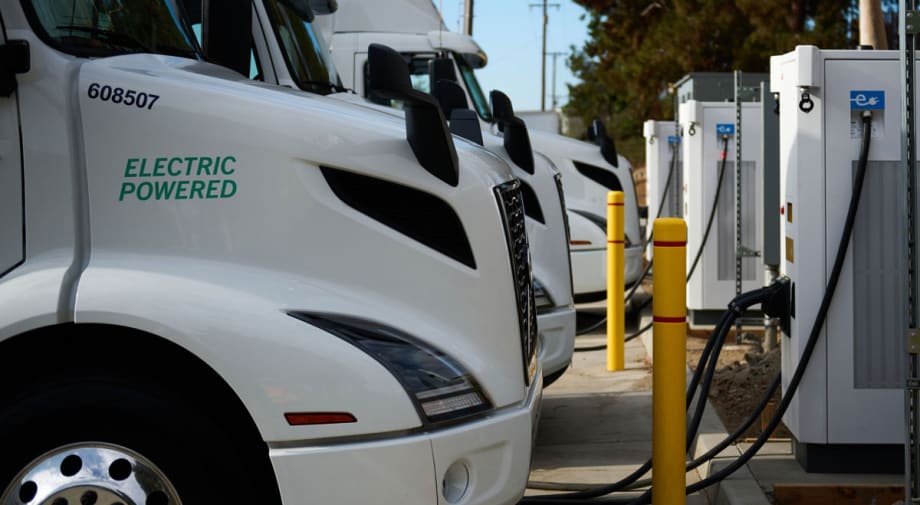
The early phases of the new strategy will focus on states with ZEV deployment-enabling policies, such as California, where this Prologis/Performance Team charging facility is located.
The strategy is designed to guide the deployment of zero-emission medium- and heavy-duty vehicle charging and hydrogen fueling infrastructure from 2024 to 2040, according to an announcement, encouraging federal and state government and private-sector investments to develop charging infrastructure.
Ad Loading...
It’s a cross-agency effort, developed by the Joint Office of Energy and Transportation and the U.S. Department of Energy in collaboration with the Department of Transportation and the Environmental Protection Agency.
“A core objective of the strategy is to meet freight truck and technology markets where they are today, determine where they are likely to develop next, and set an ambitious pathway that mobilizes actions to achieve decarbonization,” the administration said in its announcement.
“Focusing deployment on areas with substantial freight volume starts deployment in areas with the most opportunity to spark further investment.”
Ad Loading...
The strategy targets public investment to:
Amplify private sector momentum.
Focus utility and regulatory energy planning.
Align industry activity.
Improve air quality in communities heavily impacted by diesel emissions.
4 Phases to Zero-Emission Freight Corridors
The National Zero-Emission Freight Corridor Strategy will prioritize and accelerate infrastructure along key freight corridors and hubs in four phases:
Establish priority hubs based on freight volumes (2024-2027)
Connect hubs along critical freight corridors (2027-2030)
Expand corridor connections initiating network development (2030-2035)
Achieve national network by linking regional corridors for ubiquitous access (2035-2040)
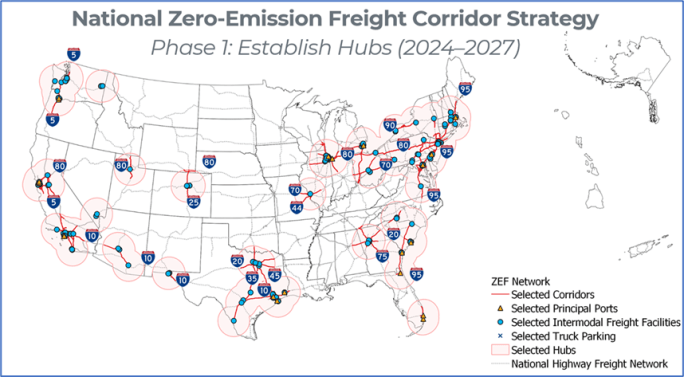
Phase 1 of the government's strategy will establish priority hubs for ZEV infrastructure based on freight volumes.
Source: Joint Office of Energy and Transportation
Phase 1: Hubs and Ports
The first phase recognizes that electric-truck range is one of the other main stumbling-blocks for heavy-duty ZEV adoption. Currently and for at least the next several years, most new electric trucks will be in regional operations that return to a set facility each night for charging.
Ad Loading...
This plan focuses near-term investments in urban areas where these trucks are being operated today. The strategy initially focuses on key freight hubs with a 100-mile radius in Phase 1, moving toward building out a complete ZEF network in Phase 4.
In Phase 1, a total of 12,000 miles (23% of the National Highway Freight Network) are prioritized as ZEF corridors, including I-5, I-10, I-25, I-75, I-80, I-95, and the Texas Triangle (I-10, I-45, and I-35).
Additionally, ZEF hubs in Phase 1 include the 100-mile freight ecosystems centered around key ports, such as the Port Authority of New York and New Jersey, Ports of Long Beach and Los Angeles, Port of San Diego, Ports of Seattle and Tacoma, Port of Miami, Houston Port Authority, and Port of Savannah.
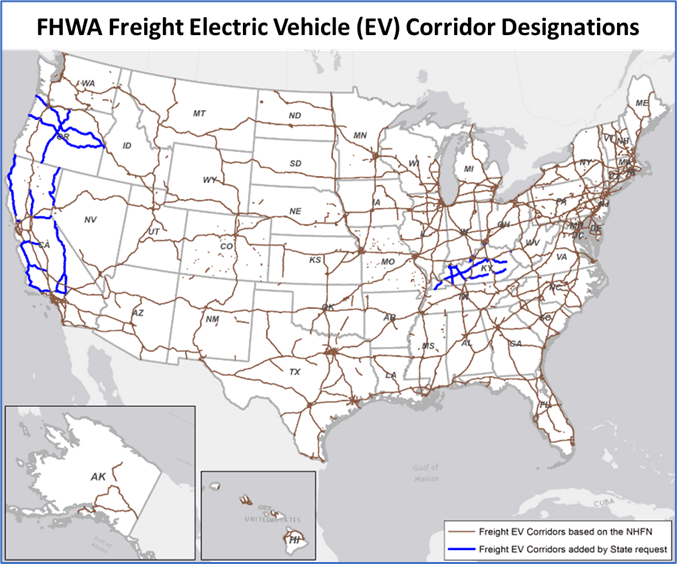
As part of the first phase, the Federal Highway Administration is announcing the designation of National EV Freight Corridors along the National Highway Freight Network and other key roadways. The designations are required by the Bipartisan Infrastructure Law.
Factors considered in deployment decisions include:
Ad Loading...
Corridor segment usage by freight volume.
Port usage by annual freight tonnage.
Projected zero-emission medium- and heavy-truck volumes.
Disproportionate environmental and air quality burden.
States with ZEV deployment-enabling policies.
“On the ground” planning through DOE’s commercial ZEV corridor planning grants.
The Federal Highway Administration is designating National EV Freight Corridors along the National Highway Freight Network and other key roadways.
Source: Joint Office of Energy and Transportation
Phase 2: Adding Hydrogen
Phase 2 expands prioritization of zero-emission freight corridor segments to connect key ZEF hubs from Phase 1.
Prioritizing the connection of key ZEF hubs will support private market efforts to build out ZEF infrastructure along I-5, serving all ports along the West Coast, I-10 from California to Florida through the Southwest, major segments of I-95 on the East Coast, I-80 through the Midwest, and I-70 from Pittsburgh to St. Louis, according to the plan.
In Phase 2, infrastructure buildout begins to expand beyond states that have adopted California’s Advanced Clean Truck rule or have already taken proactive steps to plan for zero-emission freight corridors.
In this phase, the government anticipates that medium-duty activity will likely remain battery-EV-dominant, with early introduction of hydrogen fuel cell electric truck technology for longer-distance travel.
Ad Loading...
Phase 2 also begins to see the construction and ramp-up of DOE’s Regional Clean Hydrogen Hubs. Operations expand with increased regional goods distribution (e.g., port drayage) and initial deployments of long-haul transportation.
Phased-In Approach to Recognize Realistic Technology Adoption, Market Dynamics
Clean transportation technology supporter Calstart issued a statement praising the way the plan “prioritizes a phased-in approach and has appropriately taken into account the speed at which electric charging infrastructure can be built at scale.”
By prioritizing launch areas based on industry concentration, funding levels, policy support, energy cost and grid readiness, the strategy directs implementing agencies to consider realistic technology adoption and market dynamics where increasing use of commercial zero-emission vehicles could be spurred by the economic and targeted buildout of necessary infrastructure.
The strategy is based on a focused buildout around freight and trucking return-to-base depot infrastructure, regional hub-to-hub corridors and national network nodes. This phased-in approach enables faster deployment, cost-effective implementation, strategic alignment and coordinated efforts between the public and private sectors.
"The National Zero-Emission Freight Corridor Strategy sets a clear pathway for accelerating the adoption of zero-emission medium and heavy-duty vehicles, which is in line with stringent Phase 3 vehicle standards," said Trisha Dello Iacono, head of policy at Calstart.
NATSO, the association representing truck stops and travel plazas, also praised the phased-in approach, as well as the recognition of the role of private investment.
“We are grateful that the Biden administration is recognizing the critical link between how freight moves today and the efficient build out of a nationwide network of charging stations for medium and heavy-duty trucks,” said David Fialkov, executive VP of government affairs for NATSO, in a statement.
"Directing states to adopt a phased approach that prioritizes investments along key freight corridors can harness the existing nationwide network of refueling locations along the Interstate Highway System and encourage investment in emerging refueling technology,” he explained.
"Many challenges exist to electrifying commercial trucks, including electricity generation and access, as well as the need for fuel retailers to generate a return on investment. We appreciate that the Biden administration has recognized some of these concerns.”
Ad Loading...
Preparing for the Future
The strategy will be reevaluated periodically to ensure that its goals and methodology reflect real-world economics, technological capabilities, market development, and community interests.
This will give it the flexibility to adjust expected timing and reflect private investment to decarbonize freight. The Joint Office intends to revise the strategy at least annually through engagement with the Joint Office’s Electric Vehicle Working Group, requests for information, public-private efforts such as DOE’s 21st Century Truck Partnership, and other opportunities for public engagement.
“Electric trucks are the future of the trucking industry,” said Jason Mathers, associate vice president for Environmental Defense Fund’s zero-emission trucks initiative. “Hundreds of fleets are operating these trucks today or have them on order.
"This plan prioritizes investments in charging infrastructure to match this path of growth. Today’s announcement meets this moment with a long-term plan that should give fleets the confidence to scale their electrification efforts and state policymakers a roadmap to support the zero-emission transition.”
Volvo’s updated D13 promises lower emissions without sacrificing performance or fuel economy. Take a closer look at what changed inside the engine in this HDT Spotlight video.
Energy Vision estimates fleets could recover the higher purchase price of an RNG-fueled Class 8 tractor in 1.3 to 2.8 years under current fuel-price scenarios.
Calstart is now Catalyst Mobility, reflecting the nonprofit’s growing national role in clean transportation, including zero-emission trucks, infrastructure and incentive programs.
Average U.S. diesel prices have climbed to nearly $6 a gallon, surpassing the 2022 record as tight refinery capacity and Middle East disruptions keep fuel costs elevated.
Fuel delivery depends on more than what happens at the injector. For fleet, maintenance and technical professionals, looking at the full path from pump to injector can provide useful context for understanding engine performance.
The Port Authority of New York and New Jersey announced millions in incentives for zero-emission drayage trucks, yard tractors, and new charging hubs near the port.
Why do battery-electric Class 8 trucks remain so expensive? A California bill headed to Gov. Gavin Newsom would give fleets and state agencies more visibility into what manufacturers charge.
Detroit isn’t starting from scratch to meet EPA 2027 diesel emissions standards. Its Gen 6 DD13 and DD15 engines keep much of today’s platform while updating the fuel and aftertreatment systems.
California, Oregon, Washington, British Columbia and Baja California are coordinating plans for truck charging and hydrogen fueling from Canada to Mexico.
Learn more about Kenworth's T880E battery-electric vocational truck at the Paccar Technical Center, including its range, applications, upfitting considerations, and PTO options, in this HDT Spotlight video.