




Navistar: LT Truck Sales Already 'Great,' Joint GM Project 'On Schedule'
SuperTruck and a pair of platooning rigs were also demonstrated at the company's proving grounds in Indiana on Wednesday.

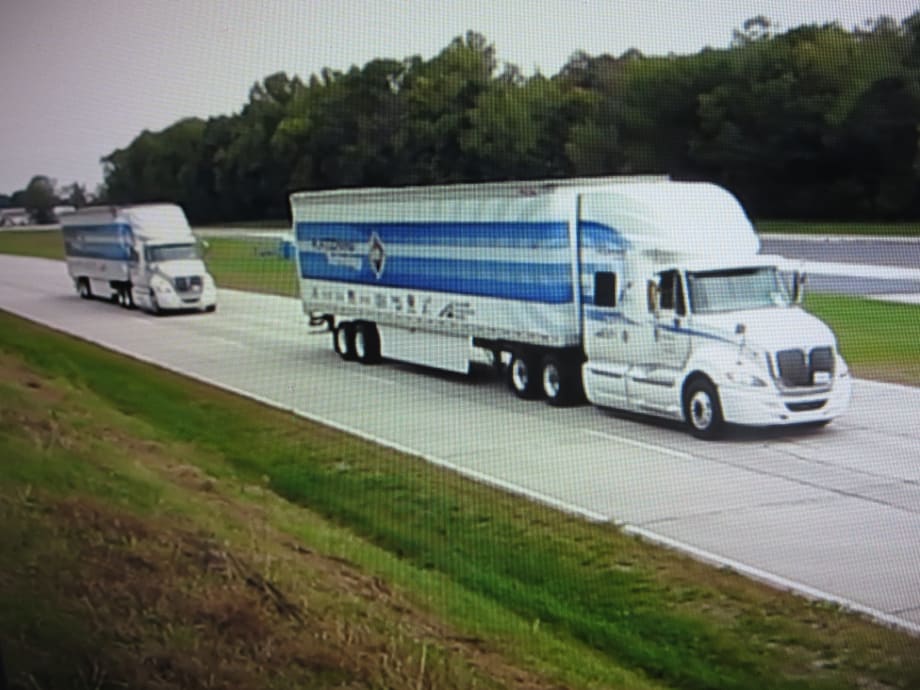
Navistar's platooning rigs stayed 15 to 30 meters apart during demonstration on the grounds' 3-mile oval track. Automated steering, also called "lateral control," is among the active features.
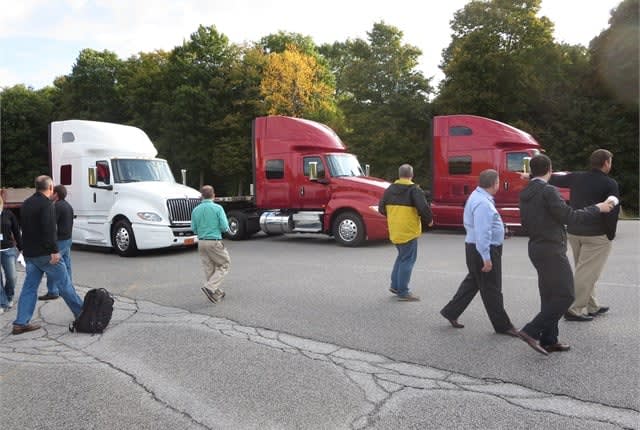
Reporters prepare for ride-and-drive demonstration of new LT tractors waiting nearby. Photos: Tom Berg
Order levels for Navistar International’s LT series are “absolutely great,” reflecting dealer and customer enthusiasm for the new highway trucks, said a company executive at a ride-and-drive demonstration at the firm’s proving grounds near South Bend, Indiana, on Oct. 11.
The LT, unveiled September 30 in Las Vegas, followed the February 1 introduction of the HX premium vocational model, for which “thousands” of orders are in hand, said Jeff Sass, senior vice president, sales and marketing.
Meanwhile, Navistar and General Motors are proceeding with development of a new series of Class 4 and 5 trucks, and the project is “on schedule and under budget,” he said. The trucks are due out in 2018 and will have International and Chevrolet versions using GM cabs on Navistar chassis, other sources said. Engines will include GM’s Duramax diesel.
Navistar execs also showed off their SuperTruck, built under federal Department of Energy sponsorship, and a pair of tractor-trailers engaged in platooning development with the Texas Transportation Institute, part of Texas A&M University. The platooning trucks have automated steering, called “lateral control” by engineers, as well as throttle and braking controlled by the lead vehicle as the two rigs proceed along a roadway.
LT, for Linehaul Transport, is a redesign of the nine-year-old ProStar using ideas gathered in interviews with about 400 drivers, Sass said. The LT’s exterior is more aerodynamic and the cab’s interior has extensive changes based on drivers’ suggestions.
“Everything we do today is based on the driver,” Sass said. Drivers are vital because of the ongoing shortage, and the cost of hiring and training a replacement driver is about $5,000, fleet executives have told Navistar people.
“Fleets have told us, ’If my drivers don’t want to drive your trucks, we’re not going to buy your trucks,’” related Denny Mooney, senior vice president, Global Product Development. Navistar has answered by building reliability into its current models and upgrading the ProStar into the more desirable LT.
The long-nose LT625 using Cummins' 2017 X15 diesel will begin production in November, and a medium-nose LT613 with Navistar’s own N13 engine will follow in April. Equivalent ProStars will be phased out as the new vehicles come on line.
Brief drives in three LT625 tractors showed exceptional quietness, smooth ride, good outward visibility, and pleasing design and convenient placement of gauges and controls. The drives were confined to the grounds’ 3-mile high-speed oval track, though reporters could take as many laps as time allowed. (A Quick Spin article will follow later on TruckingInfo.com and in Heavy Duty Trucking magazine.)
Only rides were allowed in the SuperTruck and the platooning rigs. The SuperTruck, called "CatalIST," is based on a futuristically streamlined ProStar pulling an extensively faired Great Dane van trailer. It has attained 13 mpg in highway cruising tests, Navistar has said. The tractor includes heat and kinetic energy recovery devices, while the trailer has three large solar panels on its roof.
An engine stop-start system works like those in hybrid cars, with the engine shutting down while the rig is stationary and restarting when the driver takes his foot off the brake pedal. During that time, HVAC continues functioning because the system is electric-powered, using energy stored during operation and from the solar panels. While coasting, the engine disconnects from the Eaton automated transmission and goes into idle to further conserve fuel.
The platooning demonstration had one rig leading and the other following with a gap of 15 to 30 meters (5o to 100 feet) between them. The second rig’s engine, brakes and steering were controlled by radio signals from the first tractor. The system works from a standstill to highway speeds; the second tractor’s driver placed his hands near the steering wheel, but not on it, throughout the demonstration.
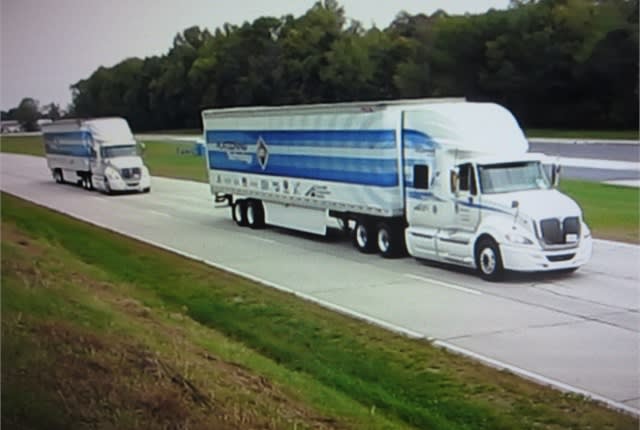
Navistar's platooning rigs stayed 15 to 30 meters apart during demonstration on the grounds' 3-mile oval track. Automated steering, also called "lateral control," is among the active features.
Automated steering, using an electric-over-hydraulic system from TRW Automotive, is unique to this project, they said, as others require drivers in the second rigs to steer while other functions are controlled from the lead tractor.
The second rig faithfully followed the first rig but wavered several feet left and right at times as the two rigs traveled along the track. Interference in signals from GPS satellites overhead was to blame, said the second rig’s driver, Navistar engineer Scott Smay. Steering control will be further refined as development continues.
Aside from that, today’s technology would allow platooning of trucks with no drivers in the second and subsequent tractors, TTI engineers said. Operational and regulatory hurdles remain before platooning could become routine, said Navistar executives in discussing the development.
More Fuel Smarts

Record Diesel Prices Squeeze Trucking Fleets
Average U.S. diesel prices have climbed to nearly $6 a gallon, surpassing the 2022 record as tight refinery capacity and Middle East disruptions keep fuel costs elevated.
Read More →
How Fuel Delivery Shapes Engine Performance
Fuel delivery depends on more than what happens at the injector. For fleet, maintenance and technical professionals, looking at the full path from pump to injector can provide useful context for understanding engine performance.
Read More →
East Coast Port Launches $45M Electric Truck Push
The Port Authority of New York and New Jersey announced millions in incentives for zero-emission drayage trucks, yard tractors, and new charging hubs near the port.
Read More →

California Bill Could Shed Light on Electric Truck Prices
Why do battery-electric Class 8 trucks remain so expensive? A California bill headed to Gov. Gavin Newsom would give fleets and state agencies more visibility into what manufacturers charge.
Read More →
Detroit Opens Orders for EPA 2027 Engines
Detroit isn’t starting from scratch to meet EPA 2027 diesel emissions standards. Its Gen 6 DD13 and DD15 engines keep much of today’s platform while updating the fuel and aftertreatment systems.
Read More →
Zero-Emission Truck Corridor Planned for West Coast
California, Oregon, Washington, British Columbia and Baja California are coordinating plans for truck charging and hydrogen fueling from Canada to Mexico.
Read More →
A Closer Look at Kenworth’s Electric T880E Vocational Truck [Video]
Learn more about Kenworth's T880E battery-electric vocational truck at the Paccar Technical Center, including its range, applications, upfitting considerations, and PTO options, in this HDT Spotlight video.
Read More →
Kenworth T880E Brings EV Power to Vocational Trucks
A closer look at the Kenworth T880E’s range, charging, powertrain and upfit options — and where fleets are showing the most interest.
Read More →
Jennie Abarca Is Proving Electric Trucks Can Do the Job
HDT Truck Fleet Innovator Jennie Abarca is building confidence in fleet electrification one load at a time while openly sharing the challenges she encounters along the way as a small-fleet owner.
Read More →
Cummins Adjusts 2027 Engine Rollout After EPA Proposal
The engine maker will gradually introduce its new Model Year 2027 diesel engines while continuing to offer current models during the transition, citing the EPA's proposed emissions rule changes.
Read More →