





Download HDT's special report, Building a Better Tire Program
NACFE Updates Low-Rolling-Resistance Tire Reports
The North American Council for Freight Efficiency has revised its Confidence Reports on low-rolling-resistance tires to reflect industry developments since they were published in 2015.
October 16, 2020
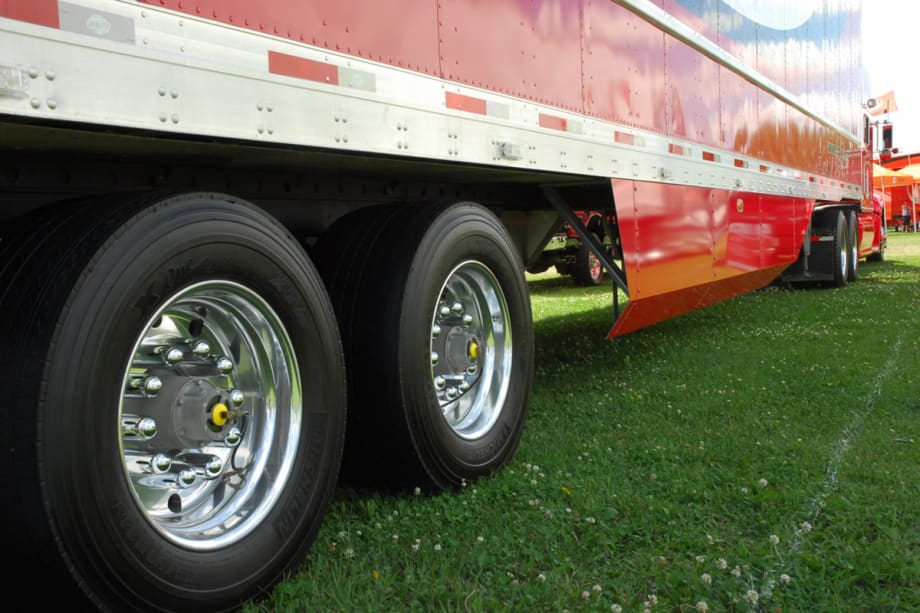
According to NACFE, low rolling resistance tires are now on more than 80% of new truck and trailers.
Photo: Jim Park
2 min to read
The North American Council for Freight Efficiency has revised its Confidence Reports on low-rolling-resistance tires to reflect industry developments since they were published in 2015. The reports include both dual configuration and wide-base tires.
Low-rolling-resistance tires are now on more than 80% of new truck and trailers, according to NACFE. With Greenhouse Gas Phase 2 regulations now in effect and tires recognized as one of the technologies that help achieve the goals set forth in the regulation, manufacturers will encourage fleets to spec low-rolling-resistance tires even when fuel prices are low and to switch to even lower rolling resistance tires as they become available.
“Even though the upfront costs of low rolling resistance tires may be higher, the cost of the fuel that a tire consumes due to its rolling resistance is five times greater than the initial purchase price of the tire,” according to Mike Roeth, NACFE’s executive director.
Higher fuel prices led to an increased interest in wide-base tires, but as dual tires with equivalent low rolling resistance were engineered, the interest in wide-base tires has decreased, according to the report. But fleets continue to be interested in low rolling resistance tires as a way to reduce operating costs.
The report provides fleets with best practices regarding low rolling resistance tires, noting that thorough maintenance is essential to get the best life and performance from these tires. In addition to the confidence matrix, which indicates the study team’s confidence in the investment case for low rolling resistance tires, the report also contains a decision guide and payback calculator.
More Equipment

How Volvo Updated Its D13 for EPA 2027 [Watch]
Volvo’s updated D13 promises lower emissions without sacrificing performance or fuel economy. Take a closer look at what changed inside the engine in this HDT Spotlight video.
Read More →
Michelin Tire Improves Efficiency and Durability for Regional Fleets
The Michelin X Multi Energy D2 is a regional haul drive tire engineered to help fleets improve fuel efficiency, durability and traction in demanding stop-and-go operations.
Read More →
ZF Expands Commercial Vehicle Push in North America
ZF is expanding its North American commercial-vehicle presence with new transmission applications, electrification, trailer technology and autonomous-driving systems.
Read More →
Tesla Wants a Self-Driving Semi. Are Cameras Enough?
Could Tesla’s camera-only autonomous driving technology work on an 80,000-pound Semi? In this commentary, HDT's Deborah Lockridge takes a look at Tesla, Cybercab, and how autonomous trucks see the road.
Read More →
Kodiak: Driverless Long-Haul Truck Launch on Track for 2026
Kodiak AI says its driverless long-haul safety case is 93% complete and it remains on track to begin commercial operations by year-end 2026.
Read More →
What DOT’s Automated Vehicle Strategy Means for Trucking
The U.S. Department of Transportation issued a new automated-vehicle strategy that outlines plans for driverless-truck regulations, cross-state freight corridors, and federal safety standards.
Read More →
East Coast Port Launches $45M Electric Truck Push
The Port Authority of New York and New Jersey announced millions in incentives for zero-emission drayage trucks, yard tractors, and new charging hubs near the port.
Read More →
PlusAI Going Public to Fund Autonomous Truck Launch
A SPAC deal could provide PlusAI with up to $300 million as it works toward a 2027 commercial launch of factory-built autonomous trucks.
Read More →
NHTSA Moves to Rewrite Truck Fuel-Economy Rules
The National Highway Traffic Safety Administration says it lacks authority to regulate medium- and heavy-duty truck engines separately from complete vehicles, but the existing standards have not yet been eliminated.
Read More →
Detroit Opens Orders for EPA 2027 Engines
Detroit isn’t starting from scratch to meet EPA 2027 diesel emissions standards. Its Gen 6 DD13 and DD15 engines keep much of today’s platform while updating the fuel and aftertreatment systems.
Read More →