




Related: Run on Less Shows How Regional-Haul Trucks Can Get Better Fuel Mileage
NACFE Sees Regional Haul Sparking Electric-Truck Movement
The North American Council for Freight Efficiency is focusing research into electric trucks on regional trucking operations, which are expected to be among the earliest commercial adopters of the equipment.
by John G. Smith
February 24, 2020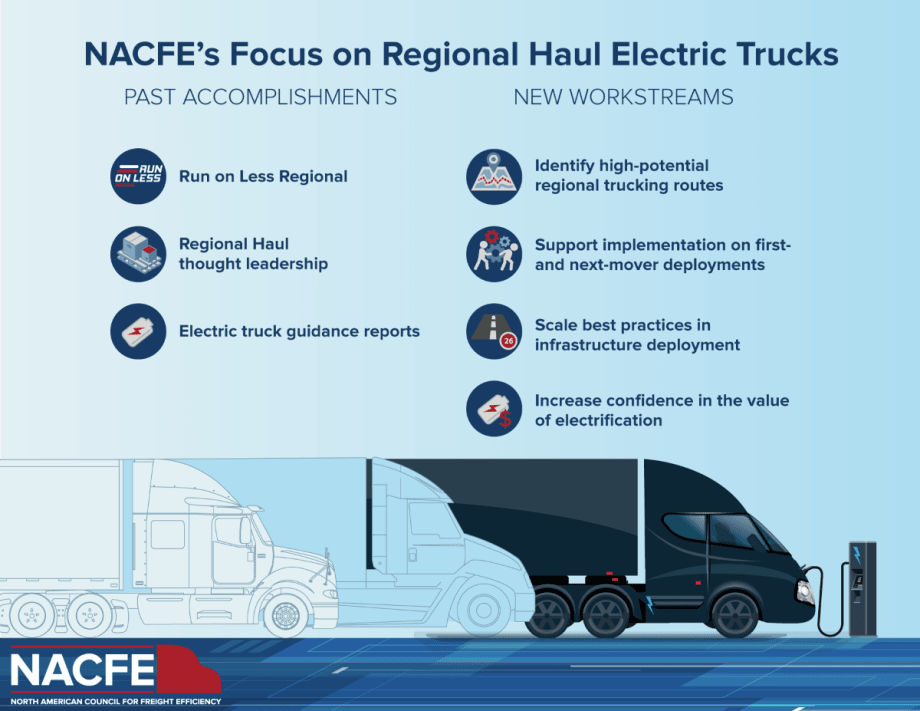
Some of the first research will involve identifying regional trucking routes with a high potential for electrification.
Image: NACFE
4 min to read
Upcoming North American Council for Freight Efficiency research into electric trucks will focus on regional trucking operations, which are expected to be among the earliest commercial adopters of the equipment.
“Our research has shown us that regional haul is an important segment of the trucking industry and also one that makes sense for electrification -- given its short-haul nature and return-to-base operation,” said NACFE Executive Director Mike Roeth, during a Feb. 23 briefing at the annual meeting of the American Trucking Associations’ Technology and Maintenance Council in Atlanta.
Picture trips that can be completed within a day’s drive and vehicle-charging that can be completed in a fleet yard. “This is a big sector, and we’re just starting to understand this regional haul part of trucking,” Roeth noted.
The three-year research project will also benefit from new funding through the nonprofit Hewlett Foundation and the ClimateWorks Foundation.
NACFE estimates that the U.S. has about 800,000 regional-haul tractors, which typically run about 65,000 miles a year. That accounts for 52 billion miles annually – about 10 times more than the annual miles traveled by transit buses or school buses.
Answering Question
Even one of North America’s largest fleets will benefit from the help.
“It’s really helpful for me to be able to rely on someone else in addition to my own team,” said Schneider Executive Vice President and CAO Rob Reich, who also serves as chairman of NACFE’s board. “What are all those questions that historically we’ve never had to think of?”
Some of the first research will involve identifying regional trucking routes with a high potential for electrification, supporting deployments outside of California, scaling best practices in infrastructure development for fleets and communities alike, and increasing confidence in the value of electrification.
The routes with the highest potential are not expected to be limited to travel distances alone. Many could leverage financial support from states or communities that are interested in zero emissions, or utilities that are looking to maximize economic development opportunities, Roeth said.
“There are so many benefits to these trucks that people are going to want to help to spur them along,” he said, referring to funding from California-based utilities as an example.
A Growing Segment
Regional hauling represents a growing share of North America’s trucking industry. Trends such as e-commerce, for example, have seen an increase in the number of warehouses and distribution centers located closer to end users. That leaves shorter trips between warehouses, distribution centers, and fulfillment centers to be completed.
This is not the council’s first look at battery-electric vehicles, of course. It all builds on related work such as the Run on Less Regional fuel-efficiency challenge, and Guidance Reports on electric trucks. Those publications have explored arguments for and against electric vehicles, applications for medium-duty trucks, charging needs, the opportunities for heavy-duty tractors, and a payback calculator already being used by fleets such as UPS and London-based Arrival.
The coming year alone will see workshops hosted during the Green Truck Summit held in conjunction with the NTEA Work Truck Show, at the annual meeting of the National Private Truck Council, and at ACT Expo.
Electric Vehicles Are Coming
Manufacturers are not yet taking orders and building electric vehicles in large volumes. But established OEMs will be placing test vehicles into customer's hands throughout 2020.
“The future,” said Roeth, “is coming fast.”
Plenty can be accomplished without establishing a national fast-charging network at truck stops across the country, he added. “We’ve got a lot of opportunities to crawl and walk here before we think about running.”
Granted, there are plenty of questions to be answered. Challenges range from dealing with brownouts to sourcing technicians. Charging still takes more time than filling a tank with diesel.
“We’re starting with an industry that actually has no footprint,” said Rick Mihelic, director – future technology studies. There are no electric vehicle technicians, or even established technical centers to train them. “All of that needs to have some seed money to get that started.”
But there are also opportunities to apply the lessons learned by those who were early adopters of compressed natural gas vehicles.
The CNG fleets didn’t benefit from the critical mass that is being realized with electric vehicles of other sizes, Mihelic said, using Tesla’s charging network as an example. “Now, you’re looking at electrifying airplanes. You’re looking at electrifying ships.”
Changes can even happen quicker than some people expect. Diesel-powered electric trains were a new idea in the 1940s, he observed. In just 20 years, they replaced all coal-fired trains.
“We’re right there at the start of that S curve [with electric vehicles],” he added.
More Equipment

How Volvo Updated Its D13 for EPA 2027 [Watch]
Volvo’s updated D13 promises lower emissions without sacrificing performance or fuel economy. Take a closer look at what changed inside the engine in this HDT Spotlight video.
Read More →
Michelin Tire Improves Efficiency and Durability for Regional Fleets
The Michelin X Multi Energy D2 is a regional haul drive tire engineered to help fleets improve fuel efficiency, durability and traction in demanding stop-and-go operations.
Read More →
ZF Expands Commercial Vehicle Push in North America
ZF is expanding its North American commercial-vehicle presence with new transmission applications, electrification, trailer technology and autonomous-driving systems.
Read More →
Tesla Wants a Self-Driving Semi. Are Cameras Enough?
Could Tesla’s camera-only autonomous driving technology work on an 80,000-pound Semi? In this commentary, HDT's Deborah Lockridge takes a look at Tesla, Cybercab, and how autonomous trucks see the road.
Read More →
Kodiak: Driverless Long-Haul Truck Launch on Track for 2026
Kodiak AI says its driverless long-haul safety case is 93% complete and it remains on track to begin commercial operations by year-end 2026.
Read More →
What DOT’s Automated Vehicle Strategy Means for Trucking
The U.S. Department of Transportation issued a new automated-vehicle strategy that outlines plans for driverless-truck regulations, cross-state freight corridors, and federal safety standards.
Read More →
East Coast Port Launches $45M Electric Truck Push
The Port Authority of New York and New Jersey announced millions in incentives for zero-emission drayage trucks, yard tractors, and new charging hubs near the port.
Read More →
PlusAI Going Public to Fund Autonomous Truck Launch
A SPAC deal could provide PlusAI with up to $300 million as it works toward a 2027 commercial launch of factory-built autonomous trucks.
Read More →
NHTSA Moves to Rewrite Truck Fuel-Economy Rules
The National Highway Traffic Safety Administration says it lacks authority to regulate medium- and heavy-duty truck engines separately from complete vehicles, but the existing standards have not yet been eliminated.
Read More →
Detroit Opens Orders for EPA 2027 Engines
Detroit isn’t starting from scratch to meet EPA 2027 diesel emissions standards. Its Gen 6 DD13 and DD15 engines keep much of today’s platform while updating the fuel and aftertreatment systems.
Read More →