





Related – Electric Trucks: Zap in the Pan?
Meritor CEO Predicts Electrified Future
“There is a sea change in our industry with regard to electrification of the drivetrain,” said Jay Craig, CEO of Meritor, at the North American Commercial Vehicle Show.
September 28, 2017
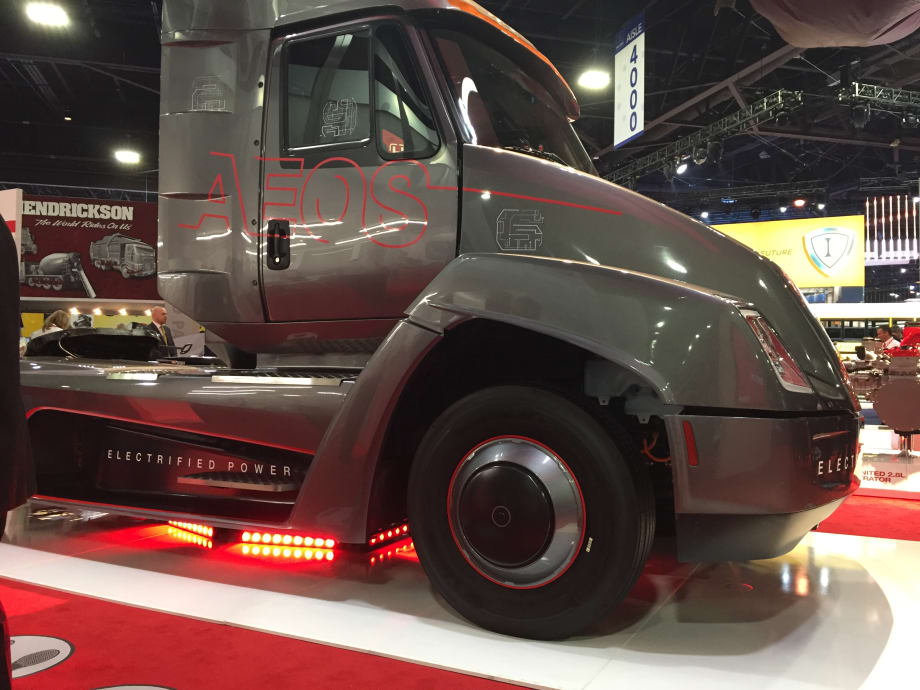
Cummins showed off its new electric concept truck at the NACV show. Photo: Deborah Lockridge
4 min to read
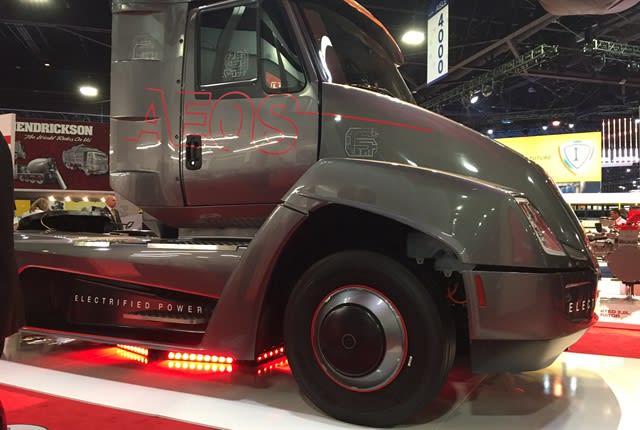
Cummins showed off its new electric concept truck at the NACV show.Photo: Deborah Lockridge
“There is a sea change in our industry with regard to electrification of the drivetrain,” said Jay Craig, CEO of Meritor, at the North American Commercial Vehicle Show. The actual percentage of medium- and heavy-duty vehicles that will be fully electric or hybrid electric by 2025, he said, is not as important as the surety that the number will be more than it is today.
Speaking to a room full of hundreds of trucking industry component suppliers at the Heavy Duty Manufacturers Association Breakfast & Briefing, Craig laid out three reasons he’s confident that electrified drivetrains will have an increasing place in the commercial vehicle industry.
The day before, Meritor had announced it will start testing an electric drivetrain for medium- and heavy-duty commercial vehicles next year.
Why Electric Vehicles are Coming
"Electrification has already begun," Craig said. China, he said, leads the world in electric trucks, with roughly 4% fully electric today. It’s expected that will increase to about 15% by 2025. “You may say 15% isn’t all the mjuch, but try to remember, they produce 800,000 commercial vehicles a year,” he said.
While other regions of the world are not as far ahead in adoption, he said, “I’m confident we will see much more rapid acceleration,” in part simply due to the sheer scale of development in China, which will drive down the cost of battery technology due to economies of scale.
In addition, he said, driven by the growth in China, those technologies are being proven. He noted that products from Jing-Jin Electric (JJE), which makes electric motors and drive assemblies for vehicles, also has a North American presence, with its products being used on the U.S. West Coast and in Europe, “and they have an excellent quality record.”
Craig also said that the commercial vehicle industry has even more reason to buy electrified drivetrains than passenger cars, and that is because for commercial fleet operations, purchase price is only part of the consideration. Yes, he said, the price for electric vehicles is higher up front, “but in this industry we look at payback, we look at usage.” Fewer moving parts that need to be repaired or replaced in electrified vehicles, he said, will help drive a favorable payback analysis.
“Six months ago we didn't read in the press all that many articles about electrification in the commercial vehicle industry,” he said. “Now there’s not a day that goes by with our industry publications of the general media that you don't see some article about electrification, whether ti's Nikola or Tesla or Cummins or Navistar – nearly every day you see an OE or a supplier or a new entrant to the market talking about electrification.”
Craig showed the audience a graph illustrating how long it took various technologies to reach 50 million users. It took the telephone 75 years. It took the Angry Birds game app 35 days. “I'm not here to argue that electrification in our industry is going to move as fast as Angry Birds,” Craig said,” but it’ll be a lot faster than the phone — maybe more like the Internet at 4 years or television at 13 years.
Beyond the Engine
The adoption of electrification, Craig said, will affect more than engine makers. Transmissions, for instance, will change dramatically. They only need two or three speeds, and they could move to a different part of the vehicle — the axle, the wheel end, or within the electric motor itself.
Brakes are another. With regenerative braking, the demands on the friction foundation brake are reduced significantly, Craig said. “They’re there for emergency stoping basically.” So they can be lighter and smaller, and the frequency of replacement will decline significantly.
“And for everyone who makes accessories you should think about electrification of those accessories that are now being driven off the engine, driven by belts,” he said, noting that Wabco and Bendix already are making electric air compressors.
And the chassis, he said, could be completely reconfigured. He showed a photo of a new electric van being tested by the UK’s Royal Mail, with a much lower chassis. Electric vehicles, he said, “create enormous freedom for creating a vehicle that’s most efficient for the user. Those in the chassis segment should be thinking more creatively about what they will look like in the future.”
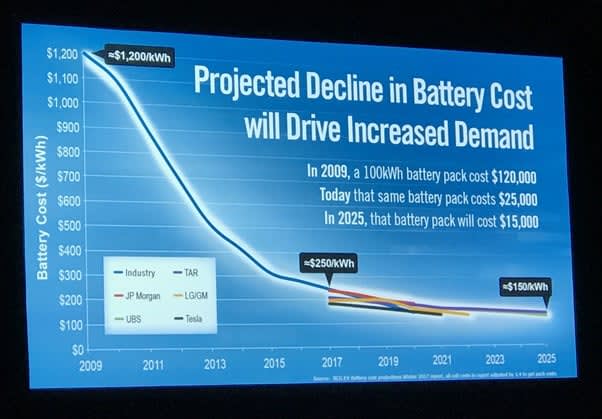
Lower battery costs are one reason Craig believes electric commercial vehicles are inevitable.
What to Watch
Craig pointed to three trends to watch that will drive more adoption of electrified powertrains in commercial vehicles.
Emissions — around the world, countries, states and even cities are enacting regulations limiting emissions. Some cities are even planning to ban vehicles driven only by internal combustion engines.
Battery costs — the batteries are the single most expensive component of an electric vehicle, Craig said, but those costs are rapidly coming down. Light vehicles already are starting to touch $150 per kilowatt-hour, and Craig said at that point, you’re looking at a break-even point of about two to two and a half years.
Weight — The weight of large banks of batteries is a problem in an industry where cargo capacity is a key factor in profitability. “Weight is starting to becoming [less of an] issue, as batteries become much more power dense, and there are new materials being brought into that industry right now.”
More Fuel Smarts

How Volvo Updated Its D13 for EPA 2027 [Watch]
Volvo’s updated D13 promises lower emissions without sacrificing performance or fuel economy. Take a closer look at what changed inside the engine in this HDT Spotlight video.
Read More →
Diesel Price Spike Shortens Payback for Natural Gas Trucks, Report Says
Energy Vision estimates fleets could recover the higher purchase price of an RNG-fueled Class 8 tractor in 1.3 to 2.8 years under current fuel-price scenarios.
Read More →
Calstart Becomes Catalyst Mobility, Reflecting Broader Focus
Calstart is now Catalyst Mobility, reflecting the nonprofit’s growing national role in clean transportation, including zero-emission trucks, infrastructure and incentive programs.
Read More →

Record Diesel Prices Squeeze Trucking Fleets
Average U.S. diesel prices have climbed to nearly $6 a gallon, surpassing the 2022 record as tight refinery capacity and Middle East disruptions keep fuel costs elevated.
Read More →
Sponsored•September 9, 2026
How Fuel Delivery Shapes Engine Performance
Fuel delivery depends on more than what happens at the injector. For fleet, maintenance and technical professionals, looking at the full path from pump to injector can provide useful context for understanding engine performance.
Read More →
East Coast Port Launches $45M Electric Truck Push
The Port Authority of New York and New Jersey announced millions in incentives for zero-emission drayage trucks, yard tractors, and new charging hubs near the port.
Read More →
California Bill Could Shed Light on Electric Truck Prices
Why do battery-electric Class 8 trucks remain so expensive? A California bill headed to Gov. Gavin Newsom would give fleets and state agencies more visibility into what manufacturers charge.
Read More →
Detroit Opens Orders for EPA 2027 Engines
Detroit isn’t starting from scratch to meet EPA 2027 diesel emissions standards. Its Gen 6 DD13 and DD15 engines keep much of today’s platform while updating the fuel and aftertreatment systems.
Read More →
Zero-Emission Truck Corridor Planned for West Coast
California, Oregon, Washington, British Columbia and Baja California are coordinating plans for truck charging and hydrogen fueling from Canada to Mexico.
Read More →
A Closer Look at Kenworth’s Electric T880E Vocational Truck [Video]
Learn more about Kenworth's T880E battery-electric vocational truck at the Paccar Technical Center, including its range, applications, upfitting considerations, and PTO options, in this HDT Spotlight video.
Read More →