





Read HDT's 2019 series, "Trucking Under the Influence."
Marijuana Use Top Finding in First Drug & Alcohol Clearinghouse Report
Positive tests for marijuana use far outpaced those for other drugs reported in the first few months of the Federal Motor Carrier Safety Administration Drug and Alcohol Clearinghouse.
June 11, 2020
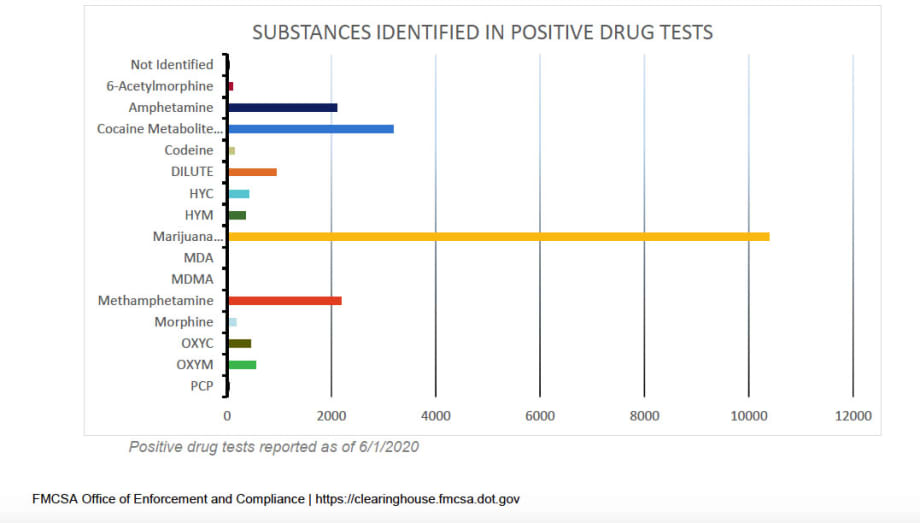
Marijuana far outpaced other types of drugs detected by tests reported to the clearinghouse.
Graph: FMCSA
4 min to read
Positive tests for marijuana use far outpaced those for other drugs reported in the first few months of the Federal Motor Carrier Safety Administration Drug and Alcohol Clearinghouse.
The first monthly report on the clearinghouse summarizes data reported to the Clearinghouse through May 2020. The report includes information on the number of clearinghouse registrations, queries conducted, violations reported, and drivers in the return-to-duty (RTD) process.
The clearinghouse went into effect in January. This electronic database tracks commercial driver’s license holders who have tested positive for prohibited drug or alcohol use, as well as refusals to take required drug tests, and other drug and alcohol violations, and those who have completed the return-to-duty process.
“The number of positive marijuana tests jumps off the page,” said Dave Osiecki, president and CEO of Scopelitis Transportation Consulting and a longtime trucking safety and regulatory expert. “It’s clearly the drug of choice among the small percentage of drug-using truck drivers. In fact, marijuana positives account for almost 50% of the positive tests reported to the Clearinghouse, and are three to four times greater than the number of cocaine positive tests (the second highest number of reported positives),” he said, noting that the numbers confirm the marijuana use findings of prior DOT studies.
There were 10,388 positive tests reported for marijuana, compared to 3,192 for cocaine, the next most common drug reported.
Lane Kidd, managing director of the Trucking Alliance, which advocates for hair testing for drug use among other safety initiatives, told HDT in an email, ”The Trucking Alliance supported the introduction of legislation that created the clearinghouse. Now the industry can see why. More importantly, once hair test failures are submitted to the clearinghouse, the numbers of drug test failures are going to go way up, and the industry can rid itself of thousands more of drug-impaired truck drivers. The industry will replace them with drug-free professional drivers who can make the highways safer for all of us."
Out of nearly 20,000 drivers that had at least one violation and thus were prohibited from driving until the return-to-duty process was complete, 989 were reported to have made it through the process, complete with a negative return-to-duty test. 15,682 had not even been reported as having started the return-to-duty process, according to the report.
Osiecki also pointed to the number of limited queries made by fleets thus far as “a great sign for safety. Fleets are not yet required to conduct limited queries on their current drivers, yet more than 350,000 limited queries have been made, demonstrating that many fleets are exceeding minimum compliance requirements.”
There are two types of queries motor carriers must make: full and limited. Full queries must be done at the pre-employment stage, while a limited query must be done at least once a year on each of a carrier’s drivers. Carriers have one year to begin running limited queries on drivers employed before Jan. 6, 2020.
In May alone, more than 65,000 limited queries were made, plus 85,000 full pre-employment queries and 3,400 full queries that were not pre-employment. (If a limited query shows a driver is in the database, a fleet may, with the driver’s permission, convert that into a full query to find out what that information is.)
Since the clearinghouse went live in January, more than 356,000 limited queries were made, more than 528,000 full pre-employment queries, and nearly 21,000 full queries that were not pre-employment.
There are nearly 115,000 employers registered in the clearinghouse and 35,532 owner-operators – numbers Osiecki said seem low. According to FMCSA’s latest Pocket Guide to Large Truck and Bus Statistics, as of December 2018, 560,809 interstate motor carriers and intrastate hazardous materials motor carriers had recent activity operating in the United States. And the Owner-Operator Independent Drivers Association estimates there are 350,000 owner-operators, although no one knows for sure how many of those are operating under their own authority.
The majority of owner-operators, OOIDA says, operate as leased owner-operators running under a larger motor carrier’s authority and as such participate in that motor carrier’s drug testing pool.
For owner-operators with their own authority, in a brochure for owner-operators, FMCSA explains that owner-operators are subject to the clearinghouse requirements for employers as well as those for drivers. That means owner-operators are required to conduct queries on themselves at least once a year. For drug and alcohol testing, owner-operators are required to work with at least one consortium/third-party administrator (C/TPA). They must register and designate their C/TPA(s) in the clearinghouse before those third-party/consortiums are allowed to access the clearinghouse on the owner-operator’s behalf.
More Safety & Compliance

From One Generation to the Next: How Mentorship Builds Safer Truck Drivers
After three decades in trucking, Harold Perry shares what he's learned about driver safety, mentorship, and helping the next generation build confidence behind the wheel.
Read More →
FMCSA Pauses Biennial-Update Enforcement Amid Motus Transition
Carriers whose updates were due on or after June 1 have more time, while FMCSA works to stabilize its new registration system and warns of phishing sites impersonating its new carrier registration system, Motus.
Read More →
ZF Expands Commercial Vehicle Push in North America
ZF is expanding its North American commercial-vehicle presence with new transmission applications, electrification, trailer technology and autonomous-driving systems.
Read More →
Truck Drivers Need More Than Another Alert
Fleets have more visibility into truck health, safety events, and driver activity than ever. The next challenge is turning all that information into useful guidance for the person who has to decide what to do next.
Read More →
Tesla Wants a Self-Driving Semi. Are Cameras Enough?
Could Tesla’s camera-only autonomous driving technology work on an 80,000-pound Semi? In this commentary, HDT's Deborah Lockridge takes a look at Tesla, Cybercab, and how autonomous trucks see the road.
Read More →
What DOT’s Automated Vehicle Strategy Means for Trucking
The U.S. Department of Transportation issued a new automated-vehicle strategy that outlines plans for driverless-truck regulations, cross-state freight corridors, and federal safety standards.
Read More →
NYC Expands Speed, Pedestrian Safety Tech Across Fleet
New York City is expanding intelligent speed assistance and pedestrian-alert systems across its municipal fleet, moving the technologies from pilot programs into vehicle procurement and retrofit requirements.
Read More →
FMCSA Removes 110 Truck Driver Training Schools from Certified ELDT List
Federal regulators also are targeting more than 160 additional training providers and launching a nationwide audit of third-party CDL skills testers as part of a broader crackdown on trucking fraud.
Read More →
Beyond DOT Compliance: What Makes a Trucking Fleet Truly Safe?
A trucking fleet can follow every rule and still make unsafe decisions. The real test comes when safety conflicts with freight, productivity, or cost.
Read More →
Hours of Service Pilot Programs: FMCSA Readies for 2027 Rollout
Two pilot programs could eventually reshape hours-of-service rules, giving truck drivers options to pause their 14-hour clock or use longer split sleeper rest periods.
Read More →