



Listen: Are Two AI Trucks Twice as Good as One?
Locomation's Çetin Meriçli explains why his company is taking a different approach to AI development and how he sees the technology eventually coming to market.
 MENU
MENU SEARCH
Locomation's Autonomous Relay Convoy system can dramatically reduce the greenhouse gas footprint, fuel consumption, and operating costs of transporting goods by truck, according to a recent report.
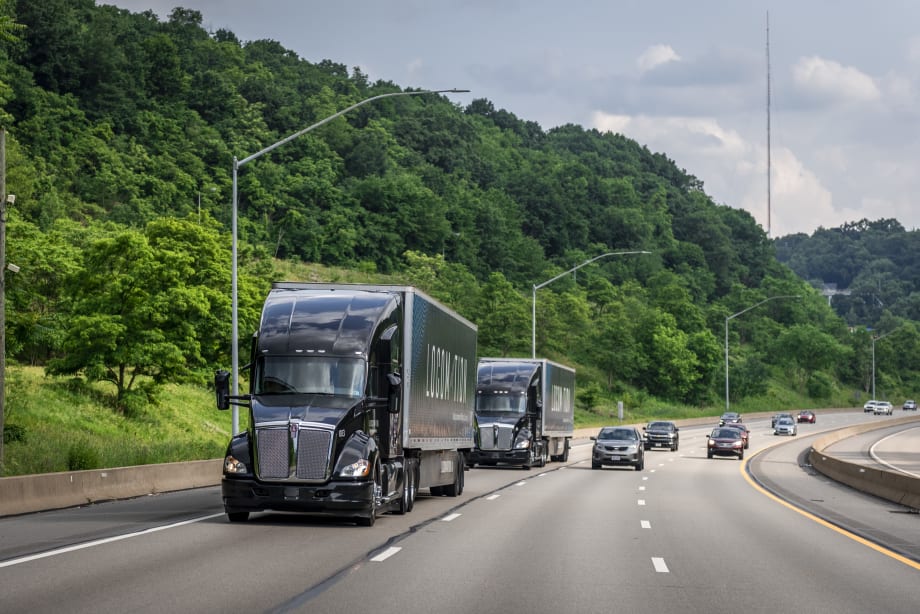
On average, a truck using Locomation’s Autonomous Relay Convoy system has a GHG footprint approximately 22% lower than a traditional truck and 18% lower than a truck using idle reduction or cooperative adaptive cruise control.
Photo: Locomation
Locomation said an independent evaluation found its Autonomous Relay Convoy system can dramatically reduce the greenhouse gas footprint, fuel consumption, and operating costs of transporting goods by truck.
Locomation’s ARC system consists of two-truck convoys that are electronically tethered. Its Human-Guided Autonomy solution enables one driver to operate the lead truck while a second driver rests in the follower truck, which is operating autonomously. Periodically, the trucks swap places to allow each driver to take turns leading and resting in compliance with federal hours of service regulations. This enables carriers to safely operate two trucks for 20-22 hours per day, delivering double the cargo, faster, and twice the distance.
The evaluation by Boundless Impact Research & Analytics concluded that compared to traditional Class 8 trucks, trucks equipped with Locomation’s technology would:
These conclusions are based on the ARC system’s ability to reduce truck idling by up to 90% and increase fuel efficiency by 8% on average. The savings for idling are compared to a truck idling without an auxiliary power unit. “The Boundless report found that Locomation's solution blew idle reduction technologies out of the water,” Locomation spokesman Sean Rushton told HDT.
Other autonomous truck companies can make the same claim to reduce idling, he explained, if they have a system to do the planning to optimize the shipments.
For instance, he cited one autonomous-truck company that has been quoted as saying they expect the equipment to be utilized 16 hours per day.
"In their scenario, compared to idling 13 hours per day, their trucks would idle 8 hours per day, a 21% improvement. Our improvement is a 46% improvement, a 2-times improvement. All autonomy providers can say they are eliminating emissions by utilizing the equipment more, but except for Locomation, they don’t have an approach on how to do it.”
In addition, he said, the Locomation technology enjoys fuel savings from platooning itself, which has been found to improve the air flow around the two-truck unit for better aerodynamics.
The environmental impact evaluation used a Life Cycle Assessment (LCA) method that assessed the Scope 1, 2, and 3 GHG emissions of Locomation’s ARC technology. LCAs are recognized as more rigorous than other reporting methods, according to the company.
Boundless researched and modeled the material, energy, and performance characteristics for Locomation’s ARC system based on detailed information provided by Locomation that described the material components and energy consumption impacts, and labor, and cost implications. At the core of the methodology is an LCA model for the transportation of goods by a long-haul Class 8 truck carrying 1 tonne of goods for 1 kilometer (tkm) on a highway.
Boundless awarded Locomation its highest possible score for positive environmental impact, a 10 out of 10 on per-unit impact.
“Locomation’s autonomous trucking system would offer a significant environmental improvement over other common fuel reduction technologies such as cooperative adaptive cruise control and idle-reduction technology,” said Boundless Director of Research Bret Strogen.
Locomation plans to routinely engage in commercial operations at scale in the United States with its ARC system starting in late 2022 with Wilson Logistics and following with PGT Trucking in 2023.

Volvo’s updated D13 promises lower emissions without sacrificing performance or fuel economy. Take a closer look at what changed inside the engine in this HDT Spotlight video.
Read More →
Energy Vision estimates fleets could recover the higher purchase price of an RNG-fueled Class 8 tractor in 1.3 to 2.8 years under current fuel-price scenarios.
Read More →
Calstart is now Catalyst Mobility, reflecting the nonprofit’s growing national role in clean transportation, including zero-emission trucks, infrastructure and incentive programs.
Read More →
Average U.S. diesel prices have climbed to nearly $6 a gallon, surpassing the 2022 record as tight refinery capacity and Middle East disruptions keep fuel costs elevated.
Read More →
Fuel delivery depends on more than what happens at the injector. For fleet, maintenance and technical professionals, looking at the full path from pump to injector can provide useful context for understanding engine performance.
Read More →
The Port Authority of New York and New Jersey announced millions in incentives for zero-emission drayage trucks, yard tractors, and new charging hubs near the port.
Read More →
Why do battery-electric Class 8 trucks remain so expensive? A California bill headed to Gov. Gavin Newsom would give fleets and state agencies more visibility into what manufacturers charge.
Read More →
Detroit isn’t starting from scratch to meet EPA 2027 diesel emissions standards. Its Gen 6 DD13 and DD15 engines keep much of today’s platform while updating the fuel and aftertreatment systems.
Read More →
California, Oregon, Washington, British Columbia and Baja California are coordinating plans for truck charging and hydrogen fueling from Canada to Mexico.
Read More →
Learn more about Kenworth's T880E battery-electric vocational truck at the Paccar Technical Center, including its range, applications, upfitting considerations, and PTO options, in this HDT Spotlight video.
Read More →