





Autonomous Convoy Developer Locomation Completes Initial Phase of Fleet Testing
Locomation Uses Automated Platoon for Food Bank Deliveries
Locomation recently tested its automated platooning technology in a project with government and turnpike officials to make a delivery run from Pennsylvania to Michigan.
October 28, 2020
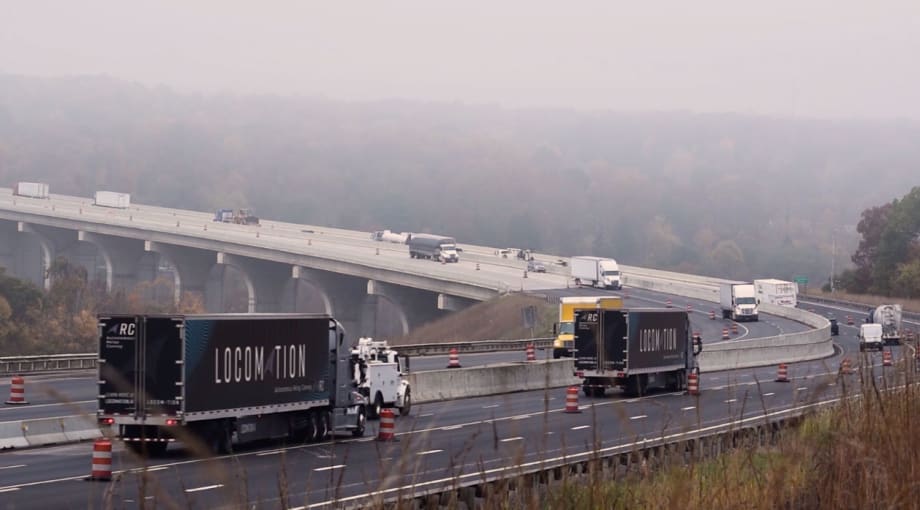
Locomation's automated convoy platoon made a delivery run from Pittsburgh, Pennsylania, through Ohio to Detroit, Michigan.
Screen capture from DriveOhio video
3 min to read
Locomation recently tested its automated platooning technology in a project with government and turnpike officials to make a delivery run from Pennsylvania to Michigan.
On Oct. 22, Locomation made a delivery run from Pittsburgh, Pennsylania, through Ohio via the Ohio Turnpike to Detroit, Michigan. Travelling more than 280 miles, the company made a delivery of groceries from the Greater Pittsburgh Community Foodbank to the Toledo Northwestern Ohio Foodbank and the Forgotten Harvest Food Bank in Detroit to help provide needed supplies for those put out of work by the COVID-19 pandemic and its economic fallout.
Truck platooning is the linking of two or more trucks in convoy using connectivity technology and automated driving support systems. These vehicles automatically maintain a set, close distance between each other when they are connected.
Locomation is developing a trucking technology platform to combine artificial-intelligence-driven autonomy with driver augmentation. During the demonstration, two platooning tractor-trailers were operated manually on surface streets. While on interstates and turnpikes, the lead truck was driven manually, while the driver of the following tractor-trailer engaged the vehicle’s platooning technology. This technology augments the driver’s capabilities and enables the vehicle to follow the lead vehicle in the platoon automatically. Both vehicles had an operator on board at all times. Locomation calls this kind of technology deployment an Autonomous Relay Convoy (ARC).
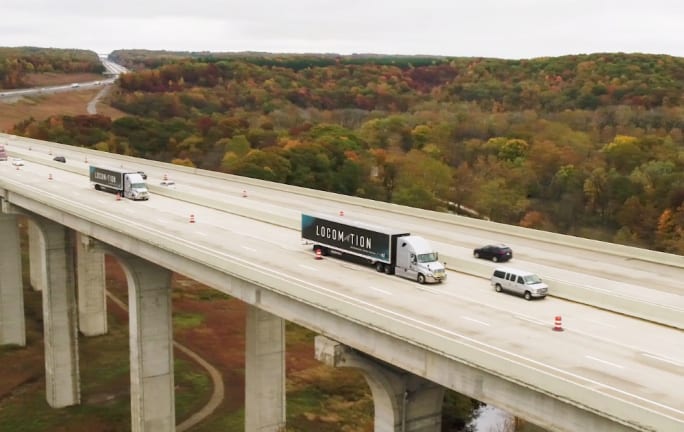
While on interstates and turnpikes, the lead truck was driven manually, while the driver of the following tractor-trailer engaged the vehicle’s platooning technology.
Screen capture from DriveOhio video
The demonstration was a project of the Smart Belt Coalition, made up of 12 organizations, including five transportation agencies and seven research and academic institutions, located throughout Michigan, Ohio, and Pennsylvania. Its purpose is to foster collaboration in research, testing, policy, standards development, deployments, outreach, and funding pursuits in the area of connected and automated vehicle technology as well as other innovations in the transportation industry.
“In Ohio, we are designing and deploying the transportation system of the 21st century,” said Ohio Gov. Mike DeWine. “Safety is our primary concern, and as smart mobility technologies mature, we believe these innovations will make our roads safer. Deployments like this one will help to inform future projects.”
The Ohio Department of Transportation and DriveOhio issued a request for information (RFI) in early March 2020, on behalf of all Smart Belt Coalition members, for companies willing to demonstrate truck platooning and/or automated driving operations through the three partner states on roadways operated by the five SBC agencies (ODOT, OTIC, Michigan Department of Transportation, Pennsylvania Department of Transportation, and the Pennsylvania Turnpike Commission). Through the RFI process, the coalition further engaged Locomation. This deployment is the successful conclusion of this RFI process.
This effort will result in a “lessons learned” document on the steps needed to facilitate a truck platooning and automated driving system operation across jurisdictional boundaries.
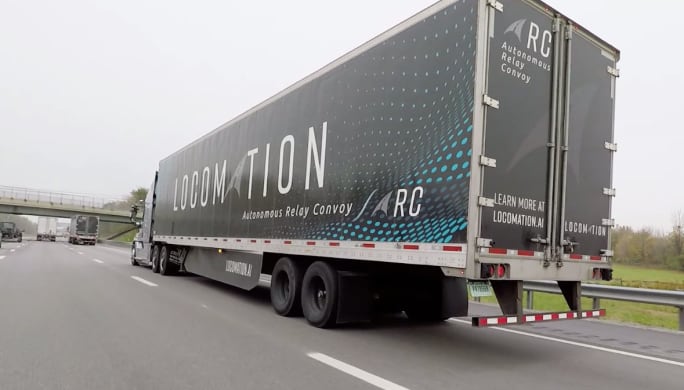
The demonstration was a project of the Smart Belt Coalition, made up of 12 organizations, including five transportation agencies and seven research and academic institutions, located throughout Michigan, Ohio, and Pennsylvania.
Screen capture from DriveOhio video
“Michigan has been at the forefront of developing mobility technologies of the future, and this demonstration follows others completed here to foster more research focused on safer ways to move freight,” said Michigan Transportation Director Paul C. Ajegba in a release.
"Many amazing things are happening in the automated vehicle space, and truck platooning is an example of that," said Pennyslvania Turnpike Commission CEO Mark Compton. "However, we seek to be strategic about these developments and above all, safe."
This project follows an eight-day pilot in August with Wilson Logistics that transported 14 commercial loads between Portland, Oregon and Nampa, Idaho.
More Equipment

How Volvo Updated Its D13 for EPA 2027 [Watch]
Volvo’s updated D13 promises lower emissions without sacrificing performance or fuel economy. Take a closer look at what changed inside the engine in this HDT Spotlight video.
Read More →
Michelin Tire Improves Efficiency and Durability for Regional Fleets
The Michelin X Multi Energy D2 is a regional haul drive tire engineered to help fleets improve fuel efficiency, durability and traction in demanding stop-and-go operations.
Read More →
ZF Expands Commercial Vehicle Push in North America
ZF is expanding its North American commercial-vehicle presence with new transmission applications, electrification, trailer technology and autonomous-driving systems.
Read More →
Tesla Wants a Self-Driving Semi. Are Cameras Enough?
Could Tesla’s camera-only autonomous driving technology work on an 80,000-pound Semi? In this commentary, HDT's Deborah Lockridge takes a look at Tesla, Cybercab, and how autonomous trucks see the road.
Read More →
Kodiak: Driverless Long-Haul Truck Launch on Track for 2026
Kodiak AI says its driverless long-haul safety case is 93% complete and it remains on track to begin commercial operations by year-end 2026.
Read More →
What DOT’s Automated Vehicle Strategy Means for Trucking
The U.S. Department of Transportation issued a new automated-vehicle strategy that outlines plans for driverless-truck regulations, cross-state freight corridors, and federal safety standards.
Read More →
East Coast Port Launches $45M Electric Truck Push
The Port Authority of New York and New Jersey announced millions in incentives for zero-emission drayage trucks, yard tractors, and new charging hubs near the port.
Read More →
PlusAI Going Public to Fund Autonomous Truck Launch
A SPAC deal could provide PlusAI with up to $300 million as it works toward a 2027 commercial launch of factory-built autonomous trucks.
Read More →
NHTSA Moves to Rewrite Truck Fuel-Economy Rules
The National Highway Traffic Safety Administration says it lacks authority to regulate medium- and heavy-duty truck engines separately from complete vehicles, but the existing standards have not yet been eliminated.
Read More →
Detroit Opens Orders for EPA 2027 Engines
Detroit isn’t starting from scratch to meet EPA 2027 diesel emissions standards. Its Gen 6 DD13 and DD15 engines keep much of today’s platform while updating the fuel and aftertreatment systems.
Read More →