





Related: Choosing Tires for On- and Off-Highway Applications
Link Introduces 105K Triton Tri-Drive Air Suspension
Link Manufacturing’s ultra-high-capacity Triton Tri-Drive Air Suspension is the latest addition to the company’s heavy vocational line.
May 14, 2019
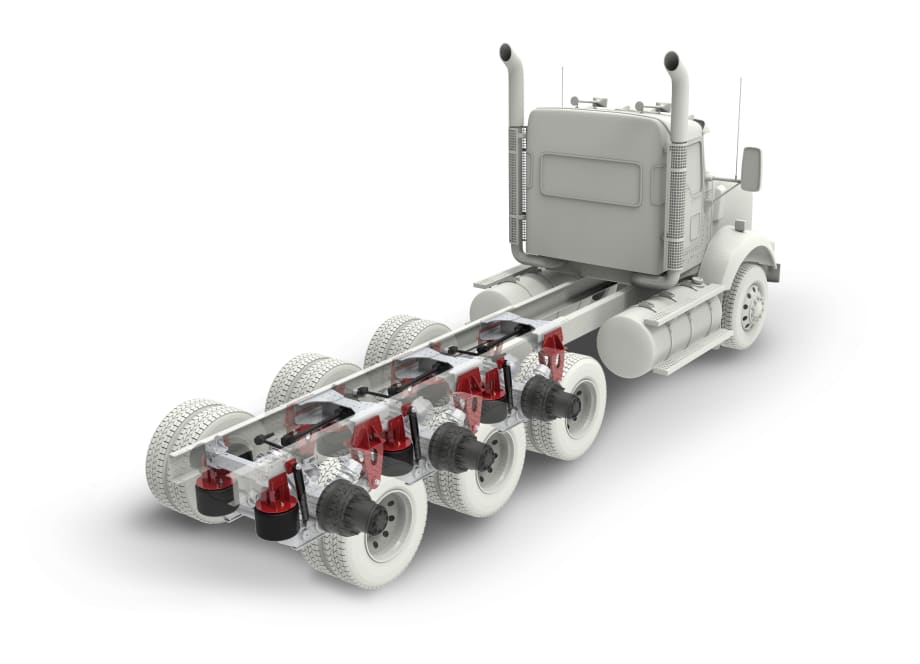
Triton Tri-Drive Air Suspensions are engineered for application flexibility and can be combined to provide a variety of vehicle carrying capacities
Image: Link Manufacturing
3 min to read
Link Manufacturing has delivered the first set of its new Triton Tri-Drive air suspensions. The company says they are the industry's first ultra-high-capacity tri-drive air suspensions engineered to be used in multi-axle configurations for heavy-haul and off-highway applications. Designed for traditional production line installation, Triton’s 105,000-pound carrying capacity gives OEMs a viable and efficient path to broaden their product offerings by increasing the load-bearing capabilities of existing vehicle platforms, the company said.
Triton Tri-Drive air suspensions are engineered for application flexibility and can be combined to provide a variety of vehicle carrying capacities, including 35,000-pound. single-drive, 70,000-pound dual-drive, and 105,000-pound tri-drive configurations. They are designed to seamlessly integrate with most major heavy-haul axle makes and models.
“Using our new Triton Tri-Drive air suspensions, OEMs will now have higher-capacity equipment to offer, giving them access to off-highway mining, quarry and logging markets they may not currently serve,” said Bill Ott, vice president of engineering for Link Manufacturing. “Our line of Air Link Suspensions have been 100 percent off-highway-rated for 25 years, giving us decades of practical engineering experience in that market space. The Triton Air Suspension is the byproduct of that experience.”
Ott explained that the Triton’s heavy-duty mounting system was another innovation born of the company’s off-highway experience. He noted that through customer feedback, many of the problems associated with other tri-drives have been engineered out of the Triton, making its traditional installation fast and simple.
The Triton mounting system features extra-wide weight-bearing brackets that provide yaw stability, for predictable and well-balanced handling. Ride quality is also enhanced by Triton’s high-mounted air springs and under-slung spring saddles, which allow plus or minus 4 inches of articulation, minimizing roll.
“Link’s experience in designing rugged military suspensions has also contributed to the development of the Triton Tri-Drive air suspension,” said Neil Mardell, manager – defense programs and heavy vocational products for Link. “Triton’s ability to articulate, providing maximum traction over the most punishing terrain, is partly the result of its highly advanced, military-grade beam design.”
Triton is also equipped with both longitudinal and lateral control rods that ensure proper axle tracking and alignment. Trailing beams are interconnected by a torsion bar, further improving ride stability. Unique dual-height control valves help the suspension maintain optimum ride height independent of load levels, and all units are fitted with heavy-duty shock absorbers.
All Triton suspensions are treated with Link’s exclusive Link-Koat self-healing metal treatment for corrosion resistance and rust protection, even when surfaces are exposed to excessive abrasion, harsh chemicals and other severe-duty environmental factors.
“For the end user, this suspension will improve the laden and unladen ride quality for the driver and the lifespan of the vehicle it serves,” Mardell said. “With Triton, users will enjoy the load-bearing capacity and roll stability of traditional steel spring suspensions, without the bone-jarring ride.”
“Drivers will also be able to traverse uneven off-highway topography much more swiftly, which means more loads hauled in each work cycle,” Ott added.
More Equipment

How Volvo Updated Its D13 for EPA 2027 [Watch]
Volvo’s updated D13 promises lower emissions without sacrificing performance or fuel economy. Take a closer look at what changed inside the engine in this HDT Spotlight video.
Read More →
Michelin Tire Improves Efficiency and Durability for Regional Fleets
The Michelin X Multi Energy D2 is a regional haul drive tire engineered to help fleets improve fuel efficiency, durability and traction in demanding stop-and-go operations.
Read More →
ZF Expands Commercial Vehicle Push in North America
ZF is expanding its North American commercial-vehicle presence with new transmission applications, electrification, trailer technology and autonomous-driving systems.
Read More →
Tesla Wants a Self-Driving Semi. Are Cameras Enough?
Could Tesla’s camera-only autonomous driving technology work on an 80,000-pound Semi? In this commentary, HDT's Deborah Lockridge takes a look at Tesla, Cybercab, and how autonomous trucks see the road.
Read More →
Kodiak: Driverless Long-Haul Truck Launch on Track for 2026
Kodiak AI says its driverless long-haul safety case is 93% complete and it remains on track to begin commercial operations by year-end 2026.
Read More →
What DOT’s Automated Vehicle Strategy Means for Trucking
The U.S. Department of Transportation issued a new automated-vehicle strategy that outlines plans for driverless-truck regulations, cross-state freight corridors, and federal safety standards.
Read More →
East Coast Port Launches $45M Electric Truck Push
The Port Authority of New York and New Jersey announced millions in incentives for zero-emission drayage trucks, yard tractors, and new charging hubs near the port.
Read More →
PlusAI Going Public to Fund Autonomous Truck Launch
A SPAC deal could provide PlusAI with up to $300 million as it works toward a 2027 commercial launch of factory-built autonomous trucks.
Read More →
NHTSA Moves to Rewrite Truck Fuel-Economy Rules
The National Highway Traffic Safety Administration says it lacks authority to regulate medium- and heavy-duty truck engines separately from complete vehicles, but the existing standards have not yet been eliminated.
Read More →
Detroit Opens Orders for EPA 2027 Engines
Detroit isn’t starting from scratch to meet EPA 2027 diesel emissions standards. Its Gen 6 DD13 and DD15 engines keep much of today’s platform while updating the fuel and aftertreatment systems.
Read More →