




Related: Is Displacement on Demand Coming to Heavy Duty Diesels?
Jacobs Partners with West Virginia University to Research Low-Emissions Engine Systems
Jacobs Vehicle Systems announced a collaboration with the Center for Alternative Fuels, Engine, and Emissions at West Virginia University to further define the benefits of the company's latest generation of diesel engine emissions technologies.
by Editorial Staff
February 27, 2019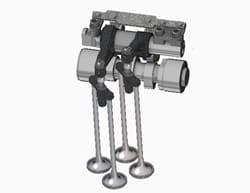
Jacobs’ Cylinder Deactivation system improves fuel economy by selectively preventing the intake and exhaust valves from opening on designated engine cylinders.
Photo: Jacob's Vehicle Systems
2 min to read
Jacobs Vehicle Systems announced a collaboration with the Center for Alternative Fuels, Engine, and Emissions at West Virginia University to further define the benefits of Jacobs’ Cylinder Deactivation and Early Exhaust Valve Opening systems on heavy-duty diesel engines for commercial vehicles.
Jacobs notes it has a long history of partnering with OEMs to provide commercial vehicle engine systems and says it will partner with the CAFEE engineering group to combine resources to further understand the full potential for CDA and EEVO in the market, with a focus on testing trucks in low load operation. The joint research team will use both the engine laboratories at Jacobs in Bloomfield, CT, and CAFEE in Morgantown, West Virginia.
Jacobs’ CDA, which was unveiled at the IAA Commercial Vehicle Show in Hannover, Germany, last fall, improves fuel economy by selectively preventing the intake and exhaust valves from opening on designated engine cylinders. When combined with the elimination of fuel injection, the engine operates with the fuel consumption of a smaller engine. Emissions are reduced, particularly at lower loads, because CDA achieves higher exhaust temperatures in the operating cylinders and makes it possible to maintain optimal after-treatment temperatures. Jacobs and CAFEE research groups will measure the fuel economy and engine operational improvements of CDA, including how to keep the aftertreatment system hot and to safely convert engine-out Nox and particulates, while quantifying the vibration characteristics of the engine in various deactivation modes.
Jacobs’ EEVO is a closely related engine system, which reduces emissions by opening the exhaust valve during the expansion or power stroke of the engine cylinder, which releases high energy expansion gasses directly to the aftertreatment system, allowing for faster warm-up of the selective catalytic reduction system. This enables the earliest possible conversion and removal of NOx emissions from the exhaust. Jacobs’ engineers will work closely with CAFEE counterparts to determine the benefits of EEVO in combination with rapid warm-up strategies, to ensure the aftreatment system is operational quickly, even in cold-start conditions.
As worldwide emissions are continually scrutinized and target markets such as California look to further reduce tailpipe NOx output, engine manufacturers need proven mechanisms and technologies that can keep the aftertreatment system hot and improve overall fuel economy," said Steve Ernest, vice president of engineering and business development at Jacobs Vehicle Systems.
More Equipment

How Volvo Updated Its D13 for EPA 2027 [Watch]
Volvo’s updated D13 promises lower emissions without sacrificing performance or fuel economy. Take a closer look at what changed inside the engine in this HDT Spotlight video.
Read More →
Michelin Tire Improves Efficiency and Durability for Regional Fleets
The Michelin X Multi Energy D2 is a regional haul drive tire engineered to help fleets improve fuel efficiency, durability and traction in demanding stop-and-go operations.
Read More →
ZF Expands Commercial Vehicle Push in North America
ZF is expanding its North American commercial-vehicle presence with new transmission applications, electrification, trailer technology and autonomous-driving systems.
Read More →
Tesla Wants a Self-Driving Semi. Are Cameras Enough?
Could Tesla’s camera-only autonomous driving technology work on an 80,000-pound Semi? In this commentary, HDT's Deborah Lockridge takes a look at Tesla, Cybercab, and how autonomous trucks see the road.
Read More →
Kodiak: Driverless Long-Haul Truck Launch on Track for 2026
Kodiak AI says its driverless long-haul safety case is 93% complete and it remains on track to begin commercial operations by year-end 2026.
Read More →
What DOT’s Automated Vehicle Strategy Means for Trucking
The U.S. Department of Transportation issued a new automated-vehicle strategy that outlines plans for driverless-truck regulations, cross-state freight corridors, and federal safety standards.
Read More →
East Coast Port Launches $45M Electric Truck Push
The Port Authority of New York and New Jersey announced millions in incentives for zero-emission drayage trucks, yard tractors, and new charging hubs near the port.
Read More →
PlusAI Going Public to Fund Autonomous Truck Launch
A SPAC deal could provide PlusAI with up to $300 million as it works toward a 2027 commercial launch of factory-built autonomous trucks.
Read More →
NHTSA Moves to Rewrite Truck Fuel-Economy Rules
The National Highway Traffic Safety Administration says it lacks authority to regulate medium- and heavy-duty truck engines separately from complete vehicles, but the existing standards have not yet been eliminated.
Read More →
Detroit Opens Orders for EPA 2027 Engines
Detroit isn’t starting from scratch to meet EPA 2027 diesel emissions standards. Its Gen 6 DD13 and DD15 engines keep much of today’s platform while updating the fuel and aftertreatment systems.
Read More →