



Intermodal Woes Challenge Logistics and Supply Chains
Intermodal freight transportation is booming, but port congestion and problems getting enough containers and chassis to the right place at the right time are snarling logistics.
 MENU
MENU SEARCH
Many trucking companies involved in intermodal and drayage operations are concerned that new duties on intermodal chassis and sub-assemblies coming from China are only making supply chain problems worse.
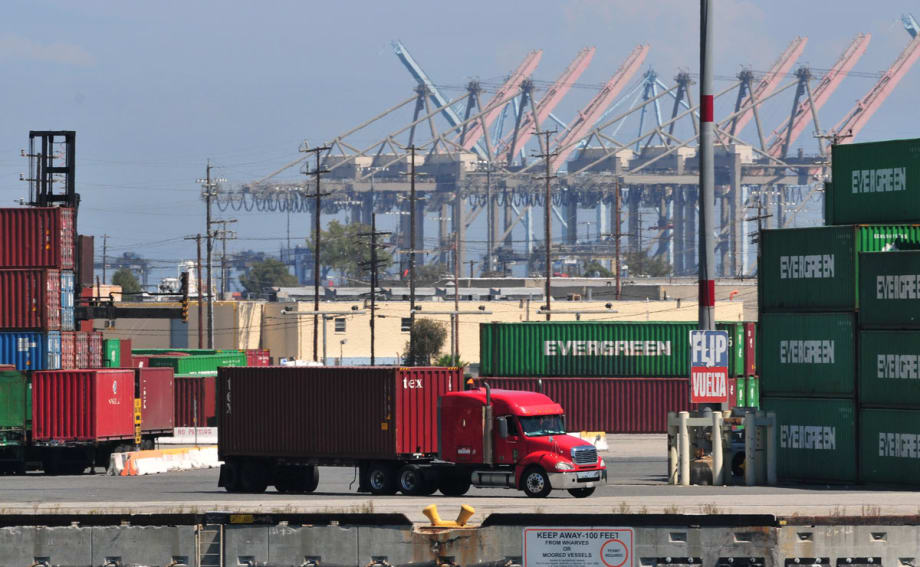
The Port of Long Beach has started trying to prioritize "dual moves," which could help address container chassis utilization problems.
Photo: Jim Park
Many trucking companies involved in intermodal and drayage operations are concerned that new duties on intermodal chassis and sub-assemblies coming from China are only making supply chain problems worse.
Last July, the Coalition of American Chassis Manufacturers petitioned the federal government, alleging that unfairly dumped and subsidized imports of Chinese chassis by CIMC Intermodal Equipment were hurting the domestic chassis manufacturing industry.
After researching the issue, including holding lengthy hearings, the Commerce Department and the International Trade Commission agreed with the coalition. As a result, chassis or sub-assemblies imported from China for the next five years will be subject to tariffs/duties that would add up to more than twice the value of the actual chassis itself.
The coalition that petitioned for the tariffs consisted of Cheetah Chassis Corp., Hercules Enterprises, Pitts Enterprises, Pratt Industries, and Stoughton Trailers.
Starting in 2016, CIMC Intermodal Equipment made a push to increase the availability of its offerings in North America. For the next few years, it brought in intermodal chassis and components from parent company CIMC Vehicles Group in China. At facilities in South Gate, California, and Emporia, Virginia, it inspected the full chassis and assembled some models from sub-assemblies before delivering them to customers.
The company had a record year in 2018, delivering 45,441 chassis. In 2019, as cargo volumes at local ports dipped, orders dropped 44% to 25,369 chassis.
Those record sales, alleged the petitioners, were far in excess of demand and reflected an attempt to rush product into the country before the imposition of new tariffs slapped on China by the Trump administration, according to the ITC’s preliminary report issued last fall.
CIE, however, said the imports were simply responding to increased demand in 2018. In fact, it pointed out that U.S. shipments of chassis from all sources increased in advance of the Section 301 tariffs on imports from China and declined after they went into effect.
CIE also argued that the domestic industry was unable or unwilling to satisfy U.S. demand for high-volume orders of chassis on flexible delivery schedules. Because CIE could, it got the business, it said.
However, the commission said, those arguments “do not explain the appreciable amount of sales that the domestic industry lost due to purchasers that expressly indicated they purchased [CIE’s] imports due to low prices.”
The Department of Commerce determined that Chinese chassis producers were being unfairly subsidized at a rate of 44.32%, according to a news release from the Wiley Rein law firm, which represented the coalition.
Based on that determination, the International Trade Commission is expected to issue a countervailing duty order, imposing duties on Chinese chassis and subassemblies at that 44.32% rate for a minimum of five years.
The Commerce Department also preliminarily determined that Chinese producers were dumping chassis and subassemblies into the U.S. at a margin of 188.05%. An antidumping duty at that rate is also expected, again, for at least five years.
In fact, that level of tariffs has already been in effect since the preliminary findings last fall, according to Robert DeFrancesco, counsel to the coalition and a partner in the International Trade Practice at the Wiley Rein law firm.
While CIE declined to comment for this story, it’s fair to assume that it would not be cost-effective for them to continue their previous business model of importing chassis and components from China. Although CIE started ramping up U.S.-based manufacturing last year, it’s unlikely that effort is to the point where CIE can make up for those imports.
And that’s a problem for trucking, say some.
We asked the American Trucking Associations, which includes the Intermodal Motor Carriers Conference, for its thoughts on the impact of this decision.
“ATA strongly believes in fair, free and equitable trade, and this ITC ruling is quite concerning,” spokesman Sean McNally responded in an email. “Our members are specifically concerned that this decision will have a negative impact on the availability and supply of chassis.”
Weston LaBar, executive director of the Harbor Trucking Association in California, is also concerned. His association represents Southern California port trucking companies, which are facing problems with chassis capacity as it is.
“Chassis utilization has been a problem from day one,” he told HDT in an interview. The southern California ports, and others, have seen record container imports in recent months, at the same time there’s a shortage of drivers and dock workers, resulting in severe congestion and delays.
The chassis situation could be improved with greater adoption of more efficient “dual moves,” where truckers take an empty container back into the terminal and pick up a full one. But in reality, there are a lot of one-way moves, meaning chassis running empty.
In addition, LaBar explained, there’s an appointment system where despite making an appointment to return a container several days in advance, truckers may find out the day of the appointment that the location isn’t accepting those empties after all. Those missed appointments just mean more inefficiencies and a need for more chassis.
In LaBar’s opinion, “The ITC really botched their decision, at a time when our industry is needing to inject more equipment, both for capacity and for folks trying to retire older equipment. Now people have to stretch out the useful life of existing equipment, which isn’t an ideal thing from a safety standpoint. And now we’ve created scarcity and increased the cost.”
For the southern California ports, he said, CIE is the local chassis provider.
“They provide the best chassis at a competitive price in our local market and always had the ability to supply them in a reasonable amount of time,” he said. The tariff decision “has created a situation where there are long lead times [for equipment from other manufacturers].
In addition, he said, although 60% of marine intermodal moves through the West Coast ports, the other chassis manufacturers are in other parts of the country.
“We have to pay thousands of dollars to transport chassis across the country – if we can get any,” he said, saying his members are hearing from chassis suppliers that it will be early 2022 before they can get chassis – if they can get a commitment.
It’s a “real stab in the heart,” said LaBar, who testified at the ITC hearing and called the decision short-sighted. “The timing couldn’t be worse.”
However, other chassis manufacturers say it’s the unfair competition that prevented domestic manufacturers from being able to increase production to meet those needs.
Jeff Sims, president of the Truck Trailer Manufacturers Association, told HDT that “the decision places all the chassis players on an even field for fair competition. Once the ruling is effective, domestic manufacturers may get more orders and be able to ramp up production to meet demand.”
DeFrancesco, the attorney for the petitioners, told HDT that the argument that the domestic chassis producers can’t meet the demand “didn’t cut ice at the commission hearing and I don’t think it should now.
“The leasing companies and trucking companies took advantage of Chinese chassis coming into the U.S. that were dumped and subsidized by 220%. They took all that volume and gave it to the Chinese and put what left of the U.S. industry on life support.”
As a result of orders shifting to the less-expensive Chinese chassis, he said, U.S. producers had to lay off workers and shut down plants.
“If you’re not giving volume to the industry, you can’t expect them to turn around and meet your needs at a moment's notice,” he said. "The commission properly concluded that this is evidence of the injury caused by the Chinese.
“Now the U.S. industry is doing everything they can to ramp up as quickly as they can and are able to sell their chassis at fairly traded prices that allow them to make a reasonable amount of return.”
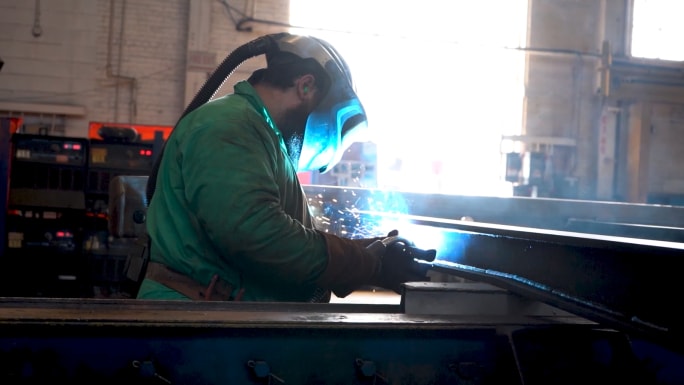
In a video on its website, Cheetah Chassis (a sister company to Strick) emphasizes its American manufacturing operations.
Video screenshot
For instance, in an April 29 news release, Stoughton Trailers announced that in wake of the trade decisions, it is hiring hundreds of assemblers, welders and supervisors at its Evansville, Wisconsin, plant as it ramps up the manufacturing of chassis products used to transport intermodal containers. The move is expected to bring the company’s employee total to an all-time high, it said.
"Stoughton Trailers was producing thousands of chassis annually at its Evansville plant until 2005, when Chinese manufacturers intensified the dumping chassis and single-handedly took the market," said Stoughton President and CEO Bob Wahlin in the release.
Stoughton said in the release that the Chinese were selling the entire chassis to U.S. companies for less than the cost of the steel in the frame alone, which devastated Stoughton’s chassis production and forced the company to close its Evansville facility for several years until it began to build other products at the facility. When it became evident last year that rulings in favor of U.S. manufacturers were likely, customers who previously bought Chinese chassis quickly became interested in Stoughton’s line, Wahlin said.
“When we received a very large order from a customer at the end of 2020, we geared up to make improvements to our production process and began recruiting workers,” he said. “We are hiring assemblers, welders, machine operators and supervisors. We’re also making all the subcomponents at our Stoughton Plant 5 to feed the Evansville assembly line. We’re investing in automation and other improvements to both plants, knowing that we will be in a competitive position to sell chassis for years to come.”
CIE declined to comment for this story, citing the fact that there are still final decisions and reports to be released.
However, as HDT previously reported, the company launched an effort more than a year ago to turn itself into a true U.S. manufacturer. In early 2020, already hit by tariffs on China steel, CIMC Intermodal Equipment rebranded itself as CIE Manufacturing and committed to developing U.S. manufacturing.
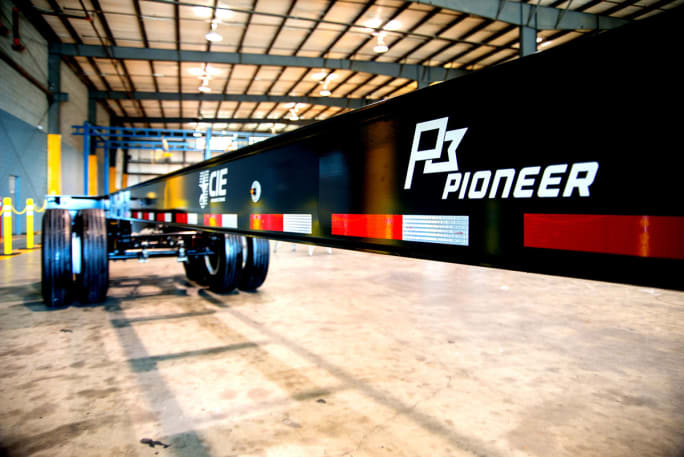
CIE Manufacturing last November said it had produced its first American-made chassis.
Photo: CIE
When the Trump administration tariffs were 10%, explained CEO Frank Sonzala in an interview with HDT at the time, customers absorbed the difference. But when those tariffs went to 25%, the company started losing orders.
“Our customers would have had to pay for five and get four,” he said.
Last fall, CIE announced that it had completed its first intermodal container chassis produced entirely in North America. The first of the Pioneer Chassis line was built at the newly expanded CIE Manufacturing Industrial Complex in Emporia, following a significant additional investment in property and equipment.
Sonzala told HDT at the time that there was about a 26,000-chassis backlog of demand, with customers being told their 2019 chassis orders wouldn’t get built until the fourth quarter of 2020. CIE’s South Gate and Emporia facilities each has capacity to build 100 chassis per day on a single shift, and a second shift could be added if needed, he said at the time, to address that demand.

Volvo’s updated D13 promises lower emissions without sacrificing performance or fuel economy. Take a closer look at what changed inside the engine in this HDT Spotlight video.
Read More →
The Michelin X Multi Energy D2 is a regional haul drive tire engineered to help fleets improve fuel efficiency, durability and traction in demanding stop-and-go operations.
Read More →
ZF is expanding its North American commercial-vehicle presence with new transmission applications, electrification, trailer technology and autonomous-driving systems.
Read More →
Could Tesla’s camera-only autonomous driving technology work on an 80,000-pound Semi? In this commentary, HDT's Deborah Lockridge takes a look at Tesla, Cybercab, and how autonomous trucks see the road.
Read More →
Kodiak AI says its driverless long-haul safety case is 93% complete and it remains on track to begin commercial operations by year-end 2026.
Read More →
The U.S. Department of Transportation issued a new automated-vehicle strategy that outlines plans for driverless-truck regulations, cross-state freight corridors, and federal safety standards.
Read More →
The Port Authority of New York and New Jersey announced millions in incentives for zero-emission drayage trucks, yard tractors, and new charging hubs near the port.
Read More →
A SPAC deal could provide PlusAI with up to $300 million as it works toward a 2027 commercial launch of factory-built autonomous trucks.
Read More →
The National Highway Traffic Safety Administration says it lacks authority to regulate medium- and heavy-duty truck engines separately from complete vehicles, but the existing standards have not yet been eliminated.
Read More →
Detroit isn’t starting from scratch to meet EPA 2027 diesel emissions standards. Its Gen 6 DD13 and DD15 engines keep much of today’s platform while updating the fuel and aftertreatment systems.
Read More →