





Zero-Emission Drayage Trucks Make Strides — but Big Barriers Remain
Import Cargo Slows Into Major Container Ports
Import cargo volume at the nation’s major intermodal container ports should see its usual end-of-year slowdown in November and December.
November 10, 2025
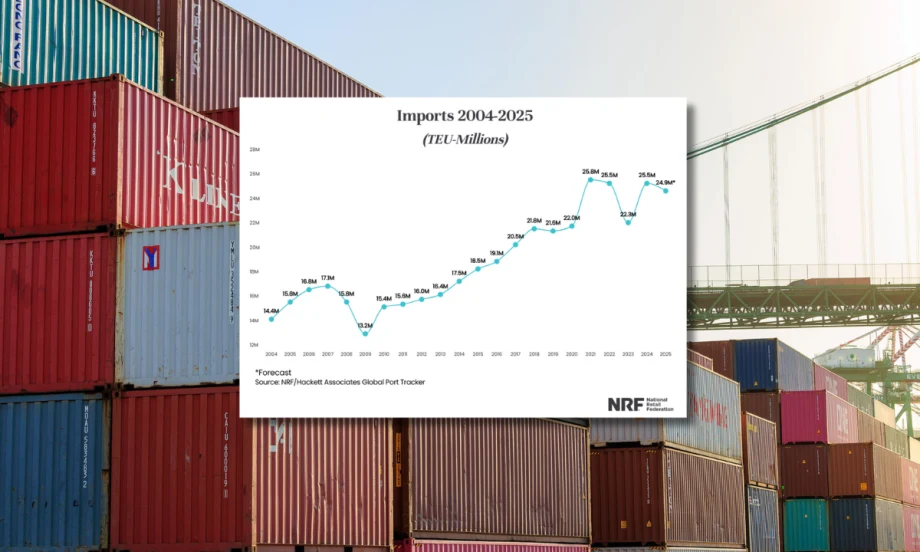
According to projections, December container imports are likely to be the slowest month since March 2023.
Credit:
NRF/Port of LA
3 min to read
With tariff uncertainty continuing but most holiday merchandise already in stores or warehouses, import cargo volume at the nation’s major container ports should see its usual end-of-year slowdown in November and December.
That’s according to the Global Port Tracker report released November 10 by the National Retail Federation and Hackett Associates.
“We’ve spent most of the year worried about the impact of tariffs on both inflation and the supply chain, but the holiday season is here and mitigation efforts appear to have paid off,” said NRF Vice President for Supply Chain and Customs Policy Jonathan Gold in a news release.
“Store shelves are well stocked and the effect on prices has been minimized, largely thanks to retailers taking steps like frontloading imports during times of low or delayed tariff increases or absorbing the costs themselves.”
Tariff Uncertainty Continues to Make Long-Term Planning Difficult
A 20% “fentanyl” tariff on China will be reduced to 10% on Nov. 10 and a twice-delayed significant increase in “reciprocal” tariffs on China that were set to take effect the same day has been delayed for a year.
An existing 10% reciprocal tariff on China imposed under the International Emergency Economic Powers Act remains in place, but the Supreme Court heard arguments Wednesday on the legality of tariffs under IEEPA.
Hackett Associates Founder Ben Hackett said on-again, off-again tariff policy has made long-term planning difficult for importers and ocean carriers alike.
“Our trade outlook is for a small decline in imports this year compared with 2024 and a further, larger decline in the first quarter of 2026.”
The developments come as NRF is forecasting that 2025 holiday sales will increase between 3.7% and 4.2% compared with 2024 to just over $1 trillion.
Current and Forecast Intermodal Import Numbers
U.S. ports covered by Global Port Tracker handled 2.1 million Twenty-Foot Equivalent Units — one 20-foot container or its equivalent — in September, the latest month for which final data is available. That was down 9.3% from August and down 7.4% year over year.
Ports have not yet reported numbers for October, but Global Port Tracker projected the month at 1.99 million TEU, down 11.5% year over year. November is forecast at 1.85 million TEU, down 14.4% year over year, and December is forecast at 1.75 million TEU, down 17.9%.
Following July’s peak of 2.39 million TEU, November and December would be the slowest months of the year. And December would be the slowest month since 1.62 million TEU in March 2023.
November and December are traditionally slow, but the large year-over-year declines are partly because imports in late 2024 were elevated by concerns over port strikes. In addition, this year’s tariff-driven frontloading pulled up late-year cargo.
The first half of 2025 totaled 12.53 million TEU, up 3.7% year over year. The full year is forecast at 24.9 million TEU, down 2.3% from 25.5 million TEU in 2024.
January 2026 is forecast at 1.98 million TEU, down 11.1% year over year; February at 1.85 million TEU, down 9%, and March at 1.79 million TEU, down 16.7%.
More Fleet Management

Kodiak Lines Up Fleets for Driverless Trucking
An agreement for 75 trucks, a new Texas freight lane, and progress on safety validation move Kodiak closer to its planned driverless highway launch.
Read More →
ITS Logistics Settles Religious Harassment Case
The Nevada-based logistics firm agreed to pay more than $396,000 to settle a religious harassment charge involving an employee's Jewish identity.
Read More →
Your Trucks Are Busy. That Doesn’t Mean They’re Winning.
High utilization doesn’t always mean strong margins. Looking beyond the current load can help fleets make better dispatch decisions and get more value from each truck’s time.
Read More →
Why This Trucking Recovery Is Different
Freight demand remains sluggish, but rising costs and tougher enforcement have taken enough capacity out of the market to change the outlook for motor carriers.
Read More →
Platform Science Adds Dispatch and Safety Tools
Four additions to PS Fleet help fleets monitor loads, manage driver coaching, share truck locations and adjust video system settings.
Read More →
PrePass Intelligence Mines Fleet Bypass, Toll and Safety Data
PrePass Intelligence helps fleets measure bypass savings, flag potential toll overcharges, and spot suspicious transactions by combining data from separate systems.
Read More →
Motive Adds AI Agents for Fleet Operations
New tools automate follow-up on fleet data, from maintenance work orders to driver alerts, with two-way voice conversations planned for later this year.
Read More →
Can You Beat Our Trucking Trivia Challenge?
Test your truck knowledge with 19 trivia questions from Heavy Duty Trucking Exchange. Can you keep up with the fleet pros?
Read More →
BeyondTrucks Adds Rules Checks to Dispatch
New Compatibility Engine checks driver qualifications, equipment requirements and fleet policies before loads are dispatched.
Read More →
Diesel Prices Hijack Trucking’s Worry List
ATRI’s annual survey finds cautious optimism about freight, but diesel costs, litigation, and insurance continue to squeeze fleets. Drivers have different priorities on several issues.
Read More →