





Related: Proposed Rule Would Require Automatic Emergency Braking, Stability Control
IIHS: Better Detection of Large Trucks Would Improve Front Crash Prevention
Research by the Insurance Institute for Highway Safety has found that most front crash prevention systems do not work as well at preventing crashes when the vehicle about to be impacted is small, like a motorcycle, or large like a medium- or heavy-duty truck.
January 26, 2024
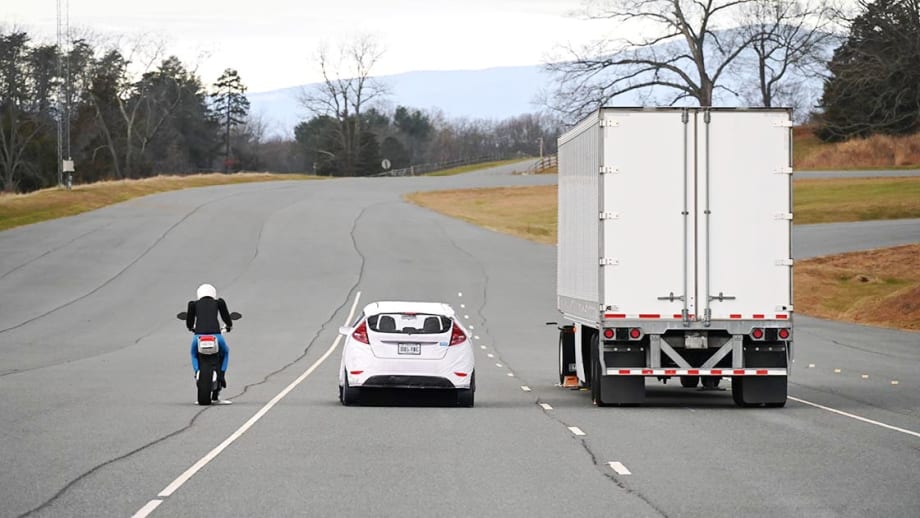
The Insurance Institute for Highway Safety reports front crash prevention systems, such as early warning and automatic emergency braking systems, do not work as well when the detection area is large, like a truck, or small, like a motorcycle.
Photo: IIHS
4 min to read
Front crash prevention systems aren’t as good at preventing crashes with large trucks and motorcycles as they are crashes with cars, two new studies from the Insurance Institute for Highway Safety show.
Most front crash prevention systems include forward collision warning and automatic emergency braking (AEB). Forward collision warning alerts the driver when a rear-end crash is imminent, and AEB automatically slams on the brakes if the driver fails to respond in time.
Reducing Truck Crashes
Today’s systems reduce rear-end crash rates with medium- or heavy-duty trucks by 38% and rear-end crash rates with motorcycles by 41%, compared with a 53% reduction in rear-end crash rates with other passenger vehicles, an IIHS study of more than 160,000 crashes found.
“These reductions are impressive for all vehicle types, but the safety benefits could be even larger if front crash prevention systems were as good at mitigating and preventing crashes with big trucks and motorcycles as they are with cars,” said Jessica Cicchino, IIHS vice president of research.
Specifically, such systems could prevent an additional 5,500 crashes a year with medium or heavy trucks and another 500 crashes with motorcycles.
Fatality Reduction
The effect on fatalities could be substantial too, according to IIHS. A medium- or heavy-truck or a motorcycle is struck by a passenger vehicle in about 43% of fatal rear-end crashes, even though another passenger vehicle is the struck vehicle in 97% of rear-end crashes overall, an earlier IIHS study showed.
“Motorcycles and large trucks present unique risks,” Cicchino said. “Large trucks are so massive that when a passenger vehicle hits one, it’s more likely to be fatal to the people inside the passenger vehicle. The height of large trucks can also result in dangerous underride crashes.”
Comparing Crash Rates
To determine how well today’s front crash prevention systems are addressing these crashes in the real world, Cicchino and IIHS Senior Research Scientist David Kidd compared police-reported rear-end crash rates for model year 2016 to 2020 passenger vehicles with and without AEB and forward collision warning when the struck vehicle was another passenger vehicle, a medium- or heavy-truck or a motorcycle. The crash data used were police-reported crashes during 2017 to 2021 in 18 U.S. states.
The researchers found that front crash prevention was associated with a 53% reduction in rear-end crashes involving another passenger vehicle, a 38% reduction in rear-end crashes with medium or heavy trucks, and a 41% reduction in rear-end crashes with motorcycles.
New Study Planned
When IIHS first began evaluating front crash prevention systems 10 years ago, few vehicles were equipped with forward collision warning or AEB, and even fewer systems qualified for an advanced or superior rating.
IIHS said now practically every new passenger vehicle has the feature thanks to a voluntary manufacturer commitment brokered by IIHS and the National Highway Traffic Safety Administration.
To make sure systems are equally adept at preventing crashes with large trucks and motorcycles and to address the large portion of rear-end crashes that happen at higher speeds, IIHS is conducting a new vehicle-to-vehicle front crash prevention evaluation, with plans to publish the first updated ratings early next year.
As part of that process, Kidd partnered with researchers from Transport Canada to gauge how various front crash prevention systems react to different vehicles and surrogate targets. In total, the two organizations examined how five 2021 and 2022 models from Acura, Subaru, Toyota, Volkswagen, and Volvo reacted to 12 different no passenger vehicles or surrogate targets and seven different passenger vehicles or surrogate targets. Anticipating the higher speeds of the future IIHS program, the researchers conducted the tests at 31 mph, 37 mph, and 44 mph.
“We’re pleased to be participating in this unique collaboration with IIHS, a leader in vehicle safety testing,” said Dr. Peter Burns, head of vehicle crash avoidance and human factors research at Transport Canada. “Transport Canada is committed to advancing road and vehicle safety in Canada and worldwide.”
In general, the study showed that front crash prevention systems aren’t as good at detecting other types of vehicles and surrogate targets as they are at detecting a standard passenger car target.
Large Vehicle Detection
“Extra-large vehicles are presumably easier to detect, but their dimensions appear to confuse the systems’ algorithms,” Kidd said.
When approaching the standard passenger car target, the test vehicles sounded forward collision warning alerts in about nine out of 10 trials. Results were statistically equivalent for most of the other target vehicles and surrogates, which included two other passenger car surrogates and a BMW X5 SUV, Ford F-250 pickup and Nissan Altima sedan among other vehicles.
In contrast, the test vehicles warned of impending collisions with a school bus, fire truck, tractor trailer and dry van trailer in fewer than eight out of 10 trials and in only about seven out of 10 trials with the two motorcycle targets.
“This research shows that front crash prevention testing programs need to use a variety of targets representing different vehicle types to ensure good performance in the real world,” Kidd said. “Our updated test will make use of the two standard motorcycle targets as well as a new passenger car target, and we’ll evaluate warning responses to a real tractor-trailer.”
More Safety & Compliance

FMCSA Pauses Biennial-Update Enforcement Amid Motus Transition
Carriers whose updates were due on or after June 1 have more time, while FMCSA works to stabilize its new registration system and warns of phishing sites impersonating its new carrier registration system, Motus.
Read More →
ZF Expands Commercial Vehicle Push in North America
ZF is expanding its North American commercial-vehicle presence with new transmission applications, electrification, trailer technology and autonomous-driving systems.
Read More →
Truck Drivers Need More Than Another Alert
Fleets have more visibility into truck health, safety events, and driver activity than ever. The next challenge is turning all that information into useful guidance for the person who has to decide what to do next.
Read More →
Tesla Wants a Self-Driving Semi. Are Cameras Enough?
Could Tesla’s camera-only autonomous driving technology work on an 80,000-pound Semi? In this commentary, HDT's Deborah Lockridge takes a look at Tesla, Cybercab, and how autonomous trucks see the road.
Read More →
What DOT’s Automated Vehicle Strategy Means for Trucking
The U.S. Department of Transportation issued a new automated-vehicle strategy that outlines plans for driverless-truck regulations, cross-state freight corridors, and federal safety standards.
Read More →
NYC Expands Speed, Pedestrian Safety Tech Across Fleet
New York City is expanding intelligent speed assistance and pedestrian-alert systems across its municipal fleet, moving the technologies from pilot programs into vehicle procurement and retrofit requirements.
Read More →
FMCSA Removes 110 Truck Driver Training Schools from Certified ELDT List
Federal regulators also are targeting more than 160 additional training providers and launching a nationwide audit of third-party CDL skills testers as part of a broader crackdown on trucking fraud.
Read More →
Beyond DOT Compliance: What Makes a Trucking Fleet Truly Safe?
A trucking fleet can follow every rule and still make unsafe decisions. The real test comes when safety conflicts with freight, productivity, or cost.
Read More →
Hours of Service Pilot Programs: FMCSA Readies for 2027 Rollout
Two pilot programs could eventually reshape hours-of-service rules, giving truck drivers options to pause their 14-hour clock or use longer split sleeper rest periods.
Read More →
New Guide Offers Pet Safety Tips for Truck Drivers
Hundreds of thousands of pets travel in truck cabs. A new safety guide from Volvo Trucks and the Center for Pet Safety offers practical advice for truck drivers who bring dogs and cats along for the ride.
Read More →