




Idealease to Offer International eMV Electric Trucks
At a customer event in Atlanta, Idealease outlined its plans to offer International electric trucks to fleets around the country.

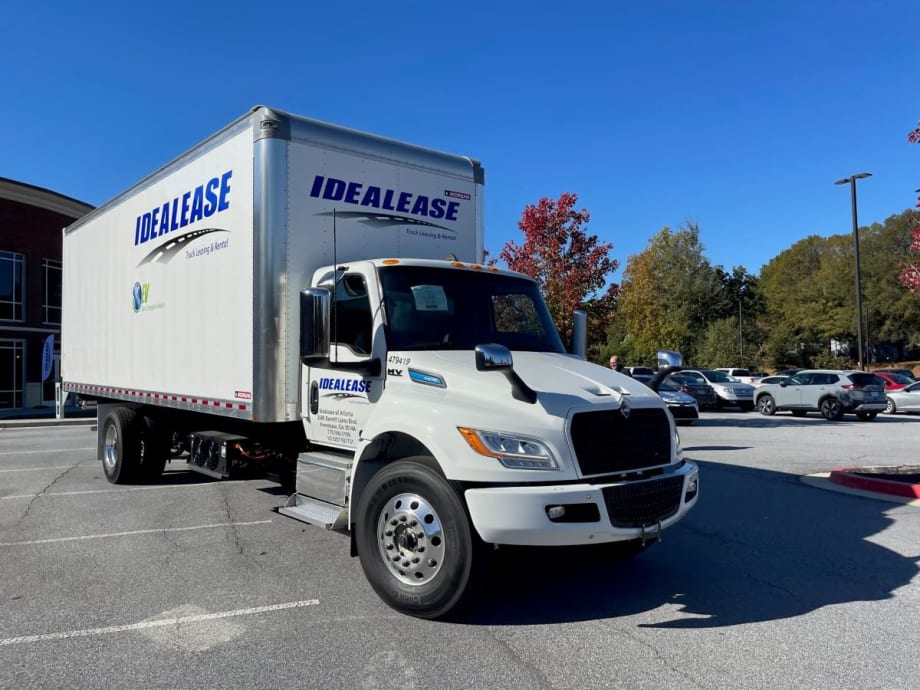
An International eMV electric truck heads out on a test drive during Idealease's customer event in Atlanta, Georgia, on Nov. 2nd.
Photo: Jack Roberts
Idealease is moving forward with a comprehensive assistance program to help its customers transition to electric trucks. That was the word at an Idealease Atlanta event on Nov. 2, where the company, alongside Navistar, presented its plans to help lease customers begin the process of planning for the acquistion and operation of electric trucks.
The event included an electric truck educational session for Idealease customers in the Atlanta area. In addition, Navistar provided a brand-new International eMV medium-duty electric box truck for ride and drives. For many of the attendees, it was their first time to see an electric truck up close – much less climb behind the wheel and drive one for themselves.
Lance Bertram, senior vice president, sales, marketing and distribution and chief revenue officer for Idealease told HDT in an exclusive interview during the ride and drives than until recently, Idealease has been hesitant to move into the electric truck space.
“But,” he added, “our customers dictate our actions. And we’ve had so many requests regarding electric trucks, we felt the time was right to get involved. We want to learn as much as we can about this new technology so that we can, in turn, educate our customers about what they have to offer.”
Application Sweet Spots for the Medium-Duty eMV Electric Truck
The eMV at the event was one of three new International electric trucks purchased by Idealease. Bertram said they’ll soon be showcased to customers all over the country.
“We want to help our customers understand what applications are the ‘sweet spot’ for these trucks,” he added. “They won’t work with every application out there. But they do work very well in certain ones and we want to make sure we have them available when our customers do decide to try them out for themselves.”
I asked Bertram what forces he sees shaping electric truck adoption now. He said that it comes down to three factors: A genuine desire from some fleets to help fight climate change, increasingly stringent government mandates, and growing customer demand for green shipping options.
“We have customers calling us and saying, ‘I need a clean energy philosophy! I’ve never had to have one of those before!’” Bertram quipped. “So we do see shippers forcing fleets into zero-emission trucks.”
But, he added, there’s also a sense of low-level panic out there among fleets as well.
“There is definitely a sense of fatalism out there when customers look at the current – and coming – California Air Resource Board and U.S. Environmental Protection Agency emissions mandates,” he said.
“Many fleets feel that sooner or later they’re going to be forced into electric trucks. And in CARB states now – soon totaling 16 in number – that’s certainly going to be the case. Fleets aren’t going to have a choice.”
Many fleets are looking at the upside of electric trucks, though, Bertram added. He feels there will be some serious upsides to owning and operating these trucks in the proper applications.
“My feeling is that electric trucks will give fleets a very attractive total cost of ownership proposition,” he said. “You’re not buying fuel, obviously. Maintenance costs will certainly be lower compared to diesel trucks.
"And my suspicion is that some fleets might get double the service life out of the electric truck chassis. That’s because once their first-life batteries wear out, you simply replace them with new batteries – which will probably be lighter by then and have more power density and range – and you’ve basically got a whole new service life for the truck."
Help Every Step of the Way
Bertram’s remarks built upon an earlier presentation by Jesus Sosa, sales manager, Western region for Navistar and commercial vehicle electrification expert with a background in electric utilities.
“Electric trucks aren’t for every customer,” Sosa said in his opening remarks. “But, at the same time, every fleet has a route that is perfect for an electric truck. So, the opportunity to learn about these trucks is there.”
One way Idealease will be doing this is with Naviatar’s self-contained, portable, charging stations. Mounted on a trailer, these systems can provide full, on-site charging virtually anywhere to help fleets learn the ins-and-outs of electric trucks.
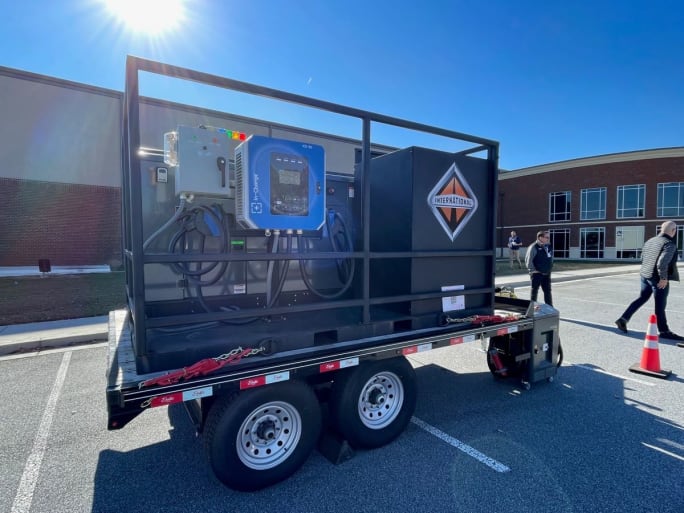
International's self-contained, portable, electric truck charging system will be a key tool used by Idealease to help its customers understand how to deploy electric trucks.
Photo: Jack Roberts
Additionally, Sosa said, Navistar has a dedicated electric infrastructure consulting division that will help fleets with every step of the electrification process. This includes route analysis, site selection and planning, negotiating with utility companies, obtaining incentives and grants all the way through to driver training and a dedicated dealer network to support the trucks.
“Electric trucks tend to be heavier because of the batteries, so it’s important to know your loads,” he said as an example. “We’ll also help you figure how and when to charge your trucks. Electrical rates are different at different times of the day. So, you need to understand peak demand charges and that rates fluctuate based on demand.”
Navistar has partnered with InCharge to offer its on-site charging system. And Sosa said that these can be set up to help manage rate fluctuations.
“If your trucks can charge overnight, and peak rates end at 9:00 p.m., that’s not a problem,” he explained. “If your driver’s shift ends at 5 p.m., they can plug the charger into the truck, but the system won’t actually start charging the truck until 9:05 p.m. – or whatever time you program it to. You can also override the scheduled charges if there’s an emergency or you need to put an immediate charge in a truck for some reason.”
Understanding BEV Battery Life and Range
Sosa also gave Idealease customers an overview of the International eMV ahead of the test drive portion of the day. The truck is powered by six 35 kW batteries and features three levels of regenerative braking, he explained. Its brake lights come on whenever the regenerative braking is active as a safety feature, he added.
The truck’s drive motor is mounted at the rear of the chassis, and the vehcile has an estimated single-charge range of 135 miles. The powertrain delivers 342 horsepower and 1,700 foot pounds of torque.
“That torque is instantaneous,” he added. “Which means that the truck performs the same whether empty or loaded.”
One key performance feature is the eMV’s active thermal management system, which Sosa said maintains proper battery temperatures at all times for optimal range and performance.
“Batteries like to be between 65 and 70 degrees Fahrenheit at all times,” he noted. “And our 135-mile range figure is based on a truck with either the air conditioner or heat on and the thermal management system operating. So that’s a ‘real world’ range estimate. In reality, the truck could go farther with those systems off. But that’s a proven performance figure that we’re comfortable relaying to fleets.”
In the first year of operation, Sosa cautioned, fleets can expect to see truck battery life degrade by 3%. Every year after that, the battery will degrade an additional 1%.
"After five years, you might be getting only 110 miles of range per charge from the truck," he explained. "So fleets may have to adjust operations based on battery life. But, it is our belief at Navistar that the next generation of batteries being developed now will be lighter, more energy dense and offer even better range. So when you replace those batteries around the five-year mark, it's possible you'll see the performance of the truck improve beyond what it was capable of when new."
In response to customer queries from the audience, Sosa noted that customers can order an eMV today and have production begin on the vehicle in 90 days. "And that's a lot quicker than getting a diesel truck right now," he noted.
More Fleet Management

Color Match Smarter: Tools That Restore & Perform
For fleet managers and collision repair professionals keeping heavy-duty trucks on the road, getting the color right the first time isn't just about appearance — it's about efficiency, turnaround time, and bottom-line results. Discover how today's digital color tools are transforming the repair process from guesswork to precision.
Read More →
FMCSA Pauses Biennial-Update Enforcement Amid Motus Transition
Carriers whose updates were due on or after June 1 have more time, while FMCSA works to stabilize its new registration system and warns of phishing sites impersonating its new carrier registration system, Motus.
Read More →
2026 Blueprint for Countering Smarter Supply Chain Theft
Cargo theft is no longer just the cost of doing business. It's a multi-billion-dollar criminal enterprise exploiting vulnerabilities across your fleet, drivers, and supply chain.
Read More →


How Telematics Improves Visibility, Control, and Performance in Refrigerated Fleets
Explore how telematics help refrigerated fleets improve visibility, uptime, efficiency, compliance, and cargo protection across connected cold chain operations.
Read More →
What the U.S.-Canada Trade War Means for Trucking
Escalating U.S.-Canada tariffs could disrupt cross-border freight, reduce truck volumes, raise costs, and create new uncertainty for carriers on both sides of the border.
Read More →
What Are Trucking’s Top Concerns for 2026?
The American Transportation Research Institute wants to know what's worrying trucking fleet managers, drivers, and other stakeholders in its annual Industry Issues survey.
Read More →
American Trucking Associations Looks for a New Leader
ATA President and CEO Chris Spear abruptly left his job at the association on August 21, at a pivotal time for the trucking industry.
Read More →
Public Wi-Fi Cybersecurity Risks: How Truck Drivers and Fleets Can Protect Their Data
Public Wi-Fi can expose truck drivers and fleets to credential theft, malware, and other cyber threats. Here’s how to reduce the risk on the road.
Read More →
For Nicky Cupp, Fleet Innovation Starts With Frustration
HDT Truck Fleet Innovator Nicky Cupp turns everyday pain points at Fraley & Schilling into opportunities for better technology and smarter processes.
Read More →
Adam Buttgenbach’s Approach to Electric Trucks: Start With Where They Fit
HDT Truck Fleet Innovator Adam Buttgenbach helped PepsiCo build one of North America’s largest EV fleets by focusing on where electric trucks make operational sense.
Read More →