




House Pair Invoke Reagan to Promote Fuel Tax Hike
A bipartisan pair of House Representatives invoked the spirit of conservative champion Ronald Reagan to push for a fuel tax increase to revive the Highway Trust Fund. Reps. Earl Blumenauer, D-Ore., and Tom Petri, R-Wisc., called for passage of a bill to raise the tax and quoted from Reagan’s 1982 call to do the same.

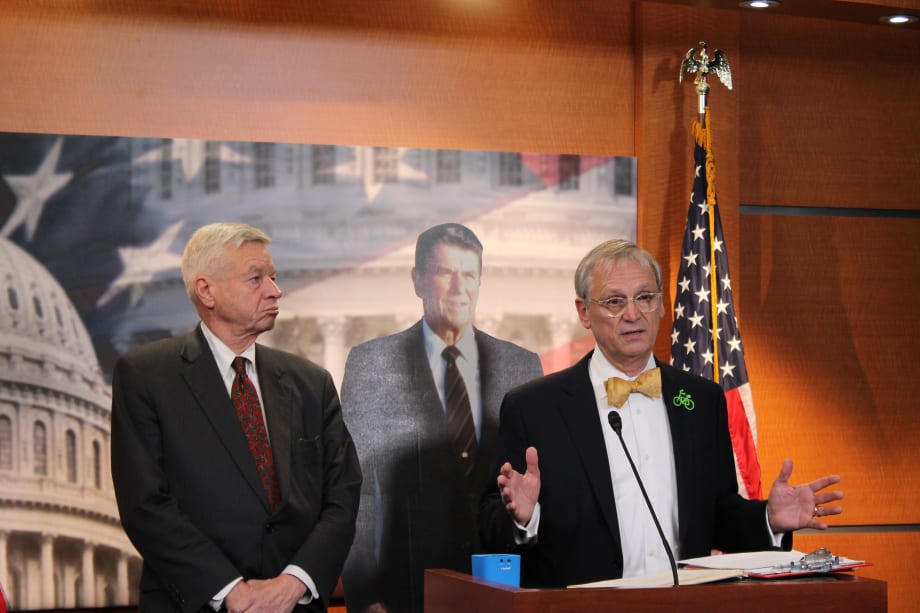
Reps. Earl Blumenauer, D-Ore., (right) and Tom Petri, R-Wis., called for passage of a bill to raise the tax and quoted from Reagan’s call to do the same.
Reps. Earl Blumenauer, D-Ore., (right) and Tom Petri, R-Wis., called for passage of a bill to raise the tax and quoted from Reagan’s call to do the same.
A bipartisan pair of House Representatives invoked the spirit of conservative champion Ronald Reagan to push for a fuel tax increase to revive the Highway Trust Fund.
Reps. Earl Blumenauer, D-Ore., and Tom Petri, R-Wis., called for passage of a bill to raise the tax and quoted from Reagan’s call to do the same.
“We simply cannot allow this magnificent [Interstate] system to deteriorate beyond repair,” Reagan said in 1982 in a radio address on the need for the tax hike. “Common sense tells us that it’ll cost a lot less to keep the system we have in good repair than to let it crumble and then have to start all over again. Good tax policy decrees that wherever possible a fee for a service should be assessed against those who directly benefit from that service.”
Less than two months later Reagan signed the Surface Transportation Assistance Act of 1982, which raised the gasoline tax from 4 cents to 9 cents a gallon.
Blumenauer has introduced a bill that would raise gasoline and diesel taxes by 15 cents over three years and index it to inflation.
Petri, who is retiring from Congress this year, said he is cosponsoring Blumenauer’s bill “because we need a first-rate transportation system and the responsible thing to do is pay for it.”
American Trucking Associations joined a chorus of support for the bill.
“Underinvestment in highways is an enormous burden on the trucking industry, raising the cost of moving freight and undermining the reliability of a logistics system that is critical to our nation’s competitiveness,” said ATA President and CEO Bill Graves in a statement.
“ATA continues its call for additional investment in highway projects made possible by this new revenue will significantly improve the safety, reliability and efficiency of the trucking industry, to the benefit of all Americans.”
There is some support for a fuel tax hike in the Senate – Democrat Tom Carper of Delaware is a proponent – but it would be a heavy lift in this lame duck session of Congress. The tax committees have not held hearings and Congress is struggling even to pass funding legislation for federal programs through the rest of the fiscal year.
More Fleet Management

Color Match Smarter: Tools That Restore & Perform
For fleet managers and collision repair professionals keeping heavy-duty trucks on the road, getting the color right the first time isn't just about appearance — it's about efficiency, turnaround time, and bottom-line results. Discover how today's digital color tools are transforming the repair process from guesswork to precision.
Read More →
FMCSA Pauses Biennial-Update Enforcement Amid Motus Transition
Carriers whose updates were due on or after June 1 have more time, while FMCSA works to stabilize its new registration system and warns of phishing sites impersonating its new carrier registration system, Motus.
Read More →
2026 Blueprint for Countering Smarter Supply Chain Theft
Cargo theft is no longer just the cost of doing business. It's a multi-billion-dollar criminal enterprise exploiting vulnerabilities across your fleet, drivers, and supply chain.
Read More →


How Telematics Improves Visibility, Control, and Performance in Refrigerated Fleets
Explore how telematics help refrigerated fleets improve visibility, uptime, efficiency, compliance, and cargo protection across connected cold chain operations.
Read More →
What the U.S.-Canada Trade War Means for Trucking
Escalating U.S.-Canada tariffs could disrupt cross-border freight, reduce truck volumes, raise costs, and create new uncertainty for carriers on both sides of the border.
Read More →
What Are Trucking’s Top Concerns for 2026?
The American Transportation Research Institute wants to know what's worrying trucking fleet managers, drivers, and other stakeholders in its annual Industry Issues survey.
Read More →
American Trucking Associations Looks for a New Leader
ATA President and CEO Chris Spear abruptly left his job at the association on August 21, at a pivotal time for the trucking industry.
Read More →
Public Wi-Fi Cybersecurity Risks: How Truck Drivers and Fleets Can Protect Their Data
Public Wi-Fi can expose truck drivers and fleets to credential theft, malware, and other cyber threats. Here’s how to reduce the risk on the road.
Read More →
For Nicky Cupp, Fleet Innovation Starts With Frustration
HDT Truck Fleet Innovator Nicky Cupp turns everyday pain points at Fraley & Schilling into opportunities for better technology and smarter processes.
Read More →
Adam Buttgenbach’s Approach to Electric Trucks: Start With Where They Fit
HDT Truck Fleet Innovator Adam Buttgenbach helped PepsiCo build one of North America’s largest EV fleets by focusing on where electric trucks make operational sense.
Read More →