




Higher Rates on Spot Market Affect Broker Use
Carriers are continuing to move away from the use of brokers, although not as much as in 2011, according to Transport Capital Partners
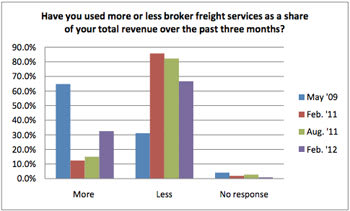
In light of small rate increases and the challenge of renegotiating accessorials, more carriers are moving to brokers to find higher rates on the spot market.
Carriers are continuing to move away from the use of brokers, although not as much as in 2011, according to Transport Capital Partners.
In TCP's First Quarter 2012 Business Expectations Survey, carriers were asked if they have used more or less broker freight services as a share of their total revenue during the past three months. In both February and August of 2011, the percentage of carriers using more or less broker freight services was similar - around 12% to 15% for those using more and around 82% to 86% for those using less.
The number of carriers indicating they are using more broker freight services has doubled, from 15% in August 2011 to almost 33% in February of 2012. Likewise, 67% of carriers surveyed said that they were using less brokers.
"Load boards are indicating that spot freight rates in lanes are above long term rates and that the first quarter seasonal slowness may also have induced carriers to seek broker loads to keep drivers and equipment busy," says Richard Mikes, TCP partner.
More large carriers ($25 million or more in revenue) are using brokers than smaller carriers, but there is not a large difference - 34% of larger carriers versus 28% of smaller carriers.
According to Lana Batts, TCP partner: "While some carriers might use brokers to increase freight, TCP believes that most of these carriers are attracted to the spot market due to higher rates."
Despite the increase in the use of brokers, the amount of freight that makes up a carrier's total revenue is still relatively small, with 47% indicating it is less than 5%. Larger carriers seem to be taking more advantage of spot market rates than smaller carriers. "This trend, if continued, challenges thoughts by many observers that smaller carriers predominate in broker use," says Mikes.
"In a period of tightening capacity however, the slightest change in the spot market can adversely affect a shipper's ability to attract capacity. Historically, contract rates have been significantly lower than the spot market in times of tightening capacity," says Batts.
More Fleet Management

Nomination Deadline Extended for HDT Emerging Leaders
Just a few more days to nominate accomplished trucking fleet professionals under 40 who are making an impact and helping lead the industry forward for the HDT Emerging Leaders award. Deadline extended to October 20!
Read More →
What Will ATA’s New Leader Bring to Trucking's Table?
Incoming President and CEO Mark Colson’s record in Alabama offers clues about his priorities and approach following Chris Spear’s abrupt departure as the head of the American Trucking Associations.
Read More →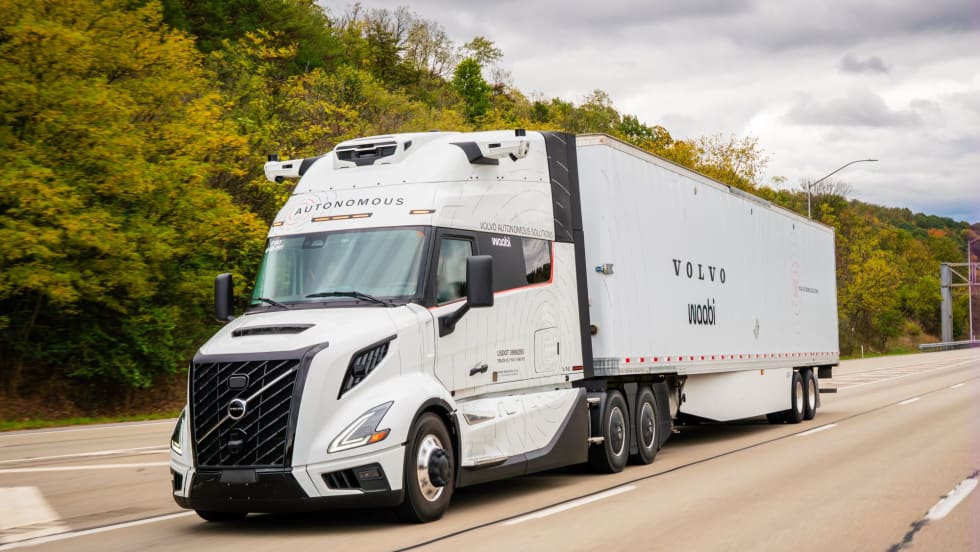
Volvo, Waabi Start Commercial Autonomous Operations in Texas
Volvo VNL Autonomous trucks, powered by the Waabi Driver, are hauling freight directly to third-party facilities for a customer in Texas.
Read More →
Samsara Launches Custom AI Agent Builder
Agent Studio lets fleets create AI tools for hours-of-service monitoring, reporting and driver support, including agents that communicate by phone.
Read More →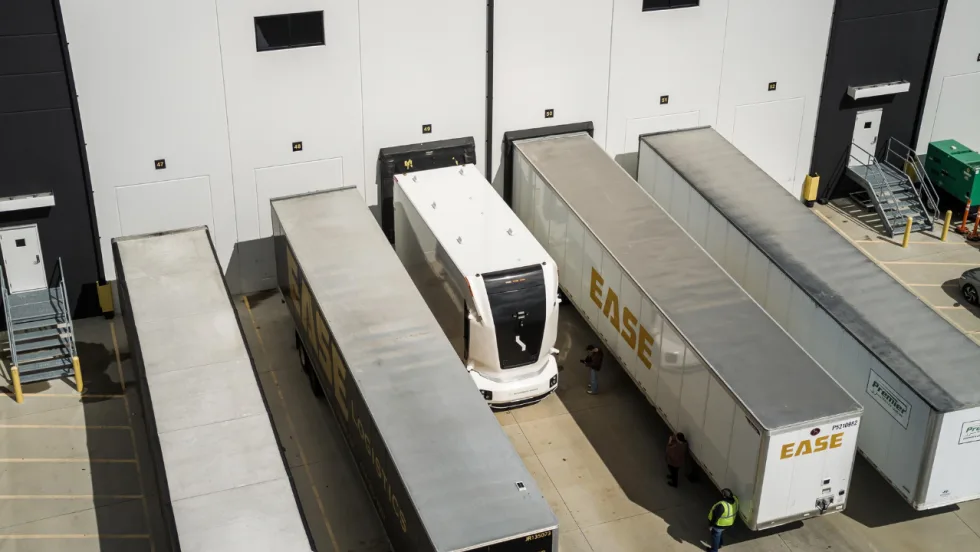
Einride Driverless Electric Trucks Begin Daily Freight Operations in Ohio
Two cabless electric trucks are hauling freight between EASE Logistics facilities in Marysville, Ohio, as part of a multi-state truck automation project.
Read More →
Geotab Links Fleet Card to Vehicle Data
The new card combines fuel discounts with telematics-based purchase controls. Geotab’s analysis also points to potential savings from choosing lower-priced fuel stops.
Read More →
How MFA Helps Protect Trucking Fleets
Multi-factor authentication adds protection when passwords are stolen. Here’s how it works and where fleets should start.
Read More →
How Better Freight Data Helps Trucking Teams Get Ahead of Disruption
Trucking and logistics teams have plenty of data. The problem is getting the right information in front of the right people soon enough to act. Better-connected data can help teams spot trouble earlier and make smarter decisions before small problems become big ones.
Read More →
Trimble: Taking Artificial Intelligence in Trucking Beyond Faster Tasks
At Insight 2026, Trimble executives argued that fleets may need to redesign workflows to get more from AI as it introduced new products and enhancements. AI’s value will depend on how fleets combine automation with their people's knowledge.
Read More →
Build a bulletproof fleet: Uniting ELDs and dash cams for total compliance
An ELD can prove compliance, but it cannot always prove what happened on the road. Discover how uniting accurate ELD data with AI-powered dash cam video can help your fleet strengthen compliance, defend against liability, protect drivers and reduce operational costs.
Read More →