




Harvard Researchers Study Potential Sleep Apnea Screening Tool
Researchers from Harvard Medical School and Harvard School of Public Health investigated a new type of screening tool to identify drivers at high risk for obstructive sleep apnea
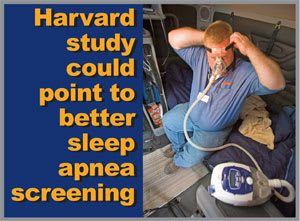
Researchers from Harvard Medical School and Harvard School of Public Health investigated a new type of screening tool to identify drivers at high risk for obstructive sleep apnea.
The study findings were published online by the Journal of Occupational and Environmental Medicine.
The psychomotor vigilance test is a 10-minute test of attention, alertness, and reaction time. The test, which can be accomplished within a short office visit, requires only brief instruction, is performed on portable, handheld computers, and its output can be quickly read and interpreted.
As the major predominant risk factor for OSA is obesity, the prevalence of OSA among commercial drivers, where as many as 40-50% are obese, is considerably higher than in the general population, say the researchers.
"Our goal is to develop objective screening methods beyond obesity for obstructive sleep apnea to be used in occupational health settings," said the study's senior author, Stefanos N. Kales, division chief and medical director of Employee and Industrial Medicine at Cambridge Health Alliance, where the study was conducted.
"Subjective reports of excessive daytime sleepiness are notoriously unreliable, especially during fitness-for-work examinations, and obesity in isolation as a screen has generated resistance from many drivers," Kales said.
In the study, commercial drivers and emergency responders undergoing occupational examinations took a 10-minute PVT and were instructed to achieve their fastest possible reaction times. Participants with discrete patterns of delayed reaction times were categorized as "microsleepers." Among 193 male participants, 15 microsleepers, 8%, were identified. Microsleepers were significantly more obese than other participants.
The abnormal alertness and reaction time patterns detected by PVT were found almost exclusively among obese men whose body composition puts them at high risk for OSA. The PVT seems to detect people likely to suffer from excessive daytime sleepiness based on other research, which has suggested that longer lapses in reaction time are highly likely to identify drivers experiencing eye closure, as opposed to simple distraction from the test. Eye closures while on task are consistent with microsleepers.
"This novel use of the PVT is extremely promising as a potential, 10-minute frontline check for sleepiness accomplished at professional drivers' federally mandated licensing exams," said Kales.
If the method and reaction time criteria are refined and validated in this setting, the PVT can be used to identify drivers needing urgent sleep evaluation before being qualified to continue as commercial drivers.
This is not the first time Kales has researched truck drivers and sleep apnea. A study published in 2009 studied more than 450 commercial drivers and concluded that drivers who suffer from obstructive sleep apnea frequently underreport symptoms and diagnoses and often do not follow through with sleep study referrals and sleep apnea treatment.
For more information: journals.lww.com
More Safety & Compliance
A Camera Isn't a Safety Program. Here's What Brokers Are Screening for Now
Footage alone may not be enough to pass broker vetting processes. Here's what counts as a defensible safety program now.
Read More →
Marijuana and Trucking’s Drug-Testing Dilemma
Marijuana is getting stronger, laws are changing, and drug tests still can’t reliably establish impairment. What does that mean for truck drivers and the fleets that employ them?
Read More →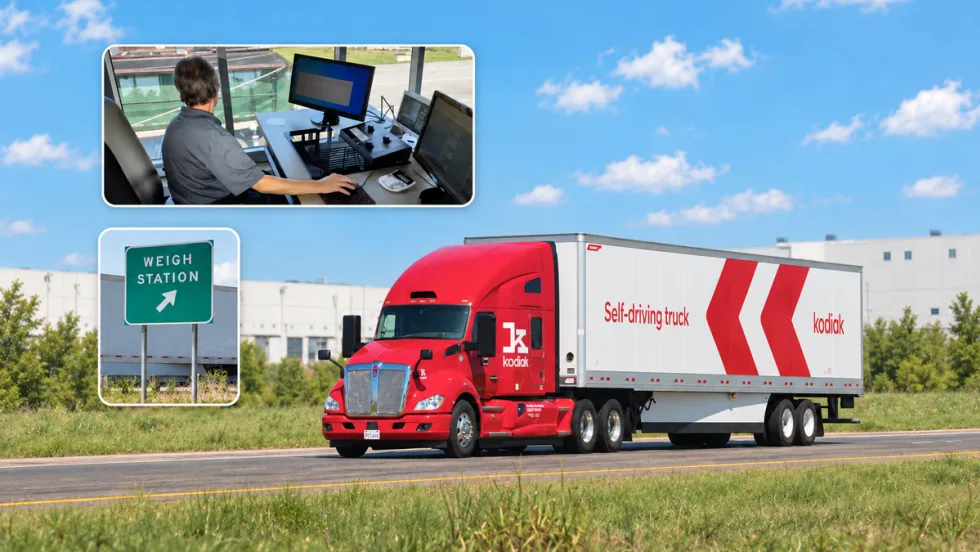
PrePass, Kodiak Connect Driverless Trucks to Roadside Enforcement
The system will allow enforcement agencies to verify Enhanced Inspection information and decide whether Kodiak’s autonomous trucks can bypass roadside screening sites.
Read More →

From One Generation to the Next: How Mentorship Builds Safer Truck Drivers
After three decades in trucking, Harold Perry shares what he's learned about driver safety, mentorship, and helping the next generation build confidence behind the wheel.
Read More →
FMCSA Pauses Biennial-Update Enforcement Amid Motus Transition
Carriers whose updates were due on or after June 1 have more time, while FMCSA works to stabilize its new registration system and warns of phishing sites impersonating its new carrier registration system, Motus.
Read More →
ZF Expands Commercial Vehicle Push in North America
ZF is expanding its North American commercial-vehicle presence with new transmission applications, electrification, trailer technology and autonomous-driving systems.
Read More →
Truck Drivers Need More Than Another Alert
Fleets have more visibility into truck health, safety events, and driver activity than ever. The next challenge is turning all that information into useful guidance for the person who has to decide what to do next.
Read More →
Tesla Wants a Self-Driving Semi. Are Cameras Enough?
Could Tesla’s camera-only autonomous driving technology work on an 80,000-pound Semi? In this commentary, HDT's Deborah Lockridge takes a look at Tesla, Cybercab, and how autonomous trucks see the road.
Read More →
What DOT’s Automated Vehicle Strategy Means for Trucking
The U.S. Department of Transportation issued a new automated-vehicle strategy that outlines plans for driverless-truck regulations, cross-state freight corridors, and federal safety standards.
Read More →
NYC Expands Speed, Pedestrian Safety Tech Across Fleet
New York City is expanding intelligent speed assistance and pedestrian-alert systems across its municipal fleet, moving the technologies from pilot programs into vehicle procurement and retrofit requirements.
Read More →