




GAO Reviews Benefits, Costs of Vehicle-to-Vehicle Communications
A vehicle-to-vehicle wireless network could improve safety by communicating warnings, but the benefits depend on broad deployment and acceptance by the public.


A vehicle-to-vehicle wireless network could improve safety by communicating warnings, but the benefits depend on broad deployment and acceptance by the public.
That’s the message from the Government Accountability Office, in its analysis of ongoing research into V2V communications.
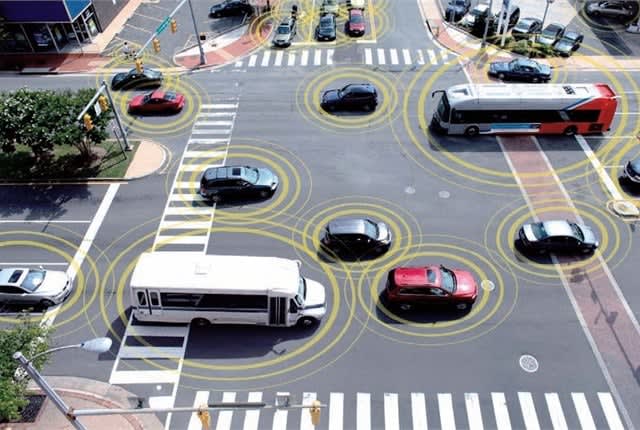
As a field test of V2V communications in Michigan nears conclusion, the National Highway Traffic Safety Administration is considering what to do next. Among its options: a proposal to require V2V communications equipment on new vehicles.
The leaders of the House Committee on Science, Space and Technology, as well as transportation legislators, asked GAO for an analysis of V2V technology and testing.
In its Nov. 1 report, the agency said researchers and the auto industry anticipate significant safety benefits from V2V. But the benefits will depend on the technology being broadly deployed, and on drivers responding properly to the warnings they receive.
V2V communications can transmit information on speed and location to warn drivers of an impending collision or the need to slow down.
Experts say these wireless warnings can provide a quantum leap in highway safety.
The Department of Transportation estimates that V2V and vehicle-to-infrastructure communications can reduce non-impaired heavy truck crashes by more than 70%.
The technology is being tested in a variety of settings, including a large field study conducted by the Department of Transportation and the University of Michigan Transportation Institute.
That study is due to be wrapped up by February, but GAO said deployment depends on what NHTSA decides to do. That decision is expected before the end of the year.
GAO reports that deployment must overcome a number of challenges.
More work needs to be done to ensure that V2V technical and management framework provides security, the agency said. Also, questions about the radio-frequency spectrum that the system uses must be resolved: if the spectrum is to be shared with other users, that cannot impair the performance of V2V technology.
Other questions: will drivers respond properly to the warning messages they receive, what are the liability issues and what about privacy.
“DOT is collaborating with automobile manufacturers and others to find potential technical and policy solutions to these challenges,” the agency said.
GAO also said that automobile companies say it is hard to estimate V2V component costs at this stage because there are too many unknowns, such as the size of the market.
The agency warned that while the component costs may not be much in relation to the cost of the vehicle, the operational costs of providing security could be significant. And it is not clear who would pay for the security – consumers, manufacturers or the government.
More Fleet Management

Kodiak Lines Up Fleets for Driverless Trucking
An agreement for 75 trucks, a new Texas freight lane, and progress on safety validation move Kodiak closer to its planned driverless highway launch.
Read More →
ITS Logistics Settles Religious Harassment Case
The Nevada-based logistics firm agreed to pay more than $396,000 to settle a religious harassment charge involving an employee's Jewish identity.
Read More →
Your Trucks Are Busy. That Doesn’t Mean They’re Winning.
High utilization doesn’t always mean strong margins. Looking beyond the current load can help fleets make better dispatch decisions and get more value from each truck’s time.
Read More →
Why This Trucking Recovery Is Different
Freight demand remains sluggish, but rising costs and tougher enforcement have taken enough capacity out of the market to change the outlook for motor carriers.
Read More →
Platform Science Adds Dispatch and Safety Tools
Four additions to PS Fleet help fleets monitor loads, manage driver coaching, share truck locations and adjust video system settings.
Read More →
PrePass Intelligence Mines Fleet Bypass, Toll and Safety Data
PrePass Intelligence helps fleets measure bypass savings, flag potential toll overcharges, and spot suspicious transactions by combining data from separate systems.
Read More →
Motive Adds AI Agents for Fleet Operations
New tools automate follow-up on fleet data, from maintenance work orders to driver alerts, with two-way voice conversations planned for later this year.
Read More →
Can You Beat Our Trucking Trivia Challenge?
Test your truck knowledge with 19 trivia questions from Heavy Duty Trucking Exchange. Can you keep up with the fleet pros?
Read More →
BeyondTrucks Adds Rules Checks to Dispatch
New Compatibility Engine checks driver qualifications, equipment requirements and fleet policies before loads are dispatched.
Read More →
Diesel Prices Hijack Trucking’s Worry List
ATRI’s annual survey finds cautious optimism about freight, but diesel costs, litigation, and insurance continue to squeeze fleets. Drivers have different priorities on several issues.
Read More →