





Commentary: What’s Behind High Fuel Prices?
Fuel, Oil Prices Expected to Remain Volatile
“This is a bit of an interlude in what is going to be a stormy, stormy path the rest of this year and into 2023 as well,” said Tom Kloza of OPIS.
July 12, 2022

Tom Kloza, global head of energy analysis for the Oil Price Information Service.
Credit:
HDT/Canva graphic
6 min to read
Diesel and gasoline prices have dropped from record highs, but Tom Kloza of the Oil Price Information Service says you can expect prices to remain volatile. “This is a bit of an interlude in what is going to be a stormy, stormy path the rest of this year and into 2023 as well,” he said in an OPIS webinar on July 12.
He said diesel has been “probably the most challenging environment of all. We saw diesel prices go above $6 in some cases. I would not bet those … are over.”
Inventories of diesel and other distillate stocks are low, Kloza noted, particularly in some areas of the country such as the Northeast.
“Watch diesel prices in the next six months. They could go absolutely parabolic in a replay of what we saw in March and April.”
A look at the news headlines is an indication of just how uncertain the global energy markets are. On the same day, as the New York Times reported that oil prices fell below $100 a barrel on a weaker global economic outlook, Yahoo Finance Live featured an interview with Neal Dingmann, Truist's managing director of energy research, predicting that a supply shortfall resulting from a ban on Russia’s natural gas could bump crude prices “well over $150” per barrel.
At midday on July 12, the price of West Texas Intermediate crude had dropped 7.8% to $96.01 a barrel. Oil prices rose to more than $120 a barrel last winter after Russia invaded Ukraine.
Diesel, Gasoline Prices Drop
On-highway diesel fuel prices averaged $5.568 nationally as of July 11, according to figures from the Department of Energy, down 10.7 cents from the previous week, although up $2.23 from a year ago.
The highest prices were in California at $6.665, up $2.478 from a year ago but down 11.4 cents from the previous week. The West Coast is the only region reporting prices averaging over $6 per gallon.
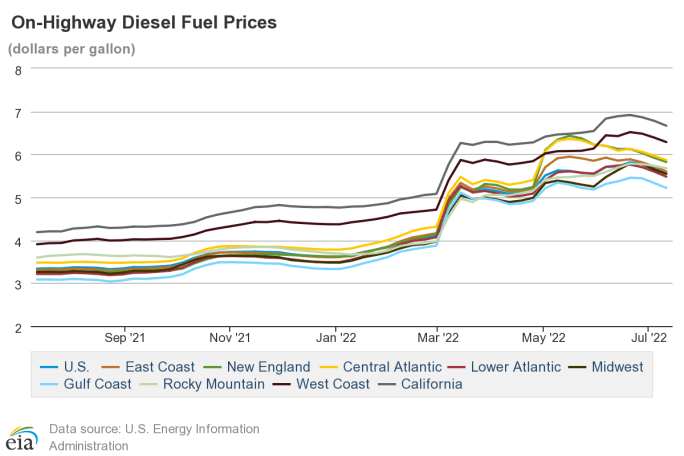
Diesel prices have started trending downward, but that may not last.
Source: DOE Energy Information Administration
The Energy Information Administration’s short term energy outlook released July 12 reported that U.S. diesel prices averaged $4.91 per gal in the first half of 2022, up from $3.06 in the first half of last year. EIA forecasts diesel prices will average $4.73 per gallon for the year and $4.07 per gallon in 2023.
U.S. regular gasoline retail prices averaged $4.11 per gallon in the first half of 2022, up from $2.78 in the first half of last year. It forecasts gasoline prices will average $4.05 per gallon in 2022 and $3.57 per gal in 2023.
The spot price of Brent crude oil averaged $71 per barrel in 2021, and EIA forecasts an average $104 per barrel in 2022 and $94 in 2023.
But the EIA noted that the outlook is “subject to heightened uncertainty resulting from a variety of factors,” including Russia’s invasion of Ukraine, the uncertainty of economic forecasts, how sanctions affect Russia’s oil production, the production decisions of OPEC+, and how fast U.S. production of oil and natural gas ramps up.
Why Are Oil and Fuel Prices So Uncertain?
Kloza outlined “crosswinds galore,” or factors that could cause oil and fuel prices to go up or down. “My leaning right now, in an uncomfortably challenging year, is the items that can create substantial uplift in the price of fuel outnumbers those that can create downdrafts.”
Recession: Kloza said he believes the market has already “baked in” a mild recession. If we don’t have a recession, oil and fuel prices could rise. If we have a worse recession, that will make demand fall and prices will also fall. New COVID-19 variants in China and other countries have led to lockdowns and lower demand.
Strategic Petroleum Reserve: “If not for SPR sales, we would have seen crude oil go to $145, $150,” he said. However, the SPR is at its lowest level since January 1987.
U.S. production: “It’s coming on,” he said, projecting 13.4 to 14 million barrels a day next year in U.S. production. The EIA projects U.S. refineries will average 94% utilization in the third quarter of 2022, as oil companies work to cash in on high wholesale margins. “Although we expect that refinery utilization will be at or near the highest levels in the past five years, operable U.S. refinery capacity has fallen by about 1 million barrels per day,” said the EIA report. “As a result, we do not expect U.S. refinery output of products to reach its highest level in the past five years.”
Hurricane season: A hurricane season better or worse than expected could push fuel prices lower or higher.
Russia: “The biggest wild card,” Kloza said, “is what will a desperate Vladimir Putin do?” So far, sanctions on Russian oil have not proved as successful as the West had hoped. “Russian output has been surprisingly high,” he said, as Russian sends its oil and gas to other countries such as China, India, and even Brazil and other parts of Latin America.
“If we wake up one morning and there’s a regime change in Russia, it will be a major pivoting point for the energy crisis — and this is a crisis, make no mistake.”
What Can the White House Do?
Kloza believes the Biden administration’s proposed fuel tax holiday is dead. “I do think you’ll see some state tax holidays, which could juice up demand,” he said – noting that in his state, Florida, that tax holiday will come in October, just before the election.
EPA waivers are another tool in the White House tool box, which Kloza said we could see, especially in the wake of a hurricane.
Pressure and/or incentives from the government to restart refineries is another option.
“There’s a lot of red tape that could be cut by the Biden Administration,” he said. While we’ve missed the gasoline season, he said, it could be in effect in time to affect distillate production for winter. “Now I’ve heard nothing about that. But it could happen. You also could see some entities to try to keep the refineries in Houston from closing …not so much resurrect the dead refineries but keep refineries that look like they’re going to be needed through 2023.”
Another solution being pushed by the White House is price caps on Russian oil, which Kloza called “a real long shot for the Biden Administration,” pointing out that a lot of Russian energy is just being “shifted from Europe, which is at war with Russia, through proxy, to China, India, and other developing countries.”
U.S. Treasury Secretary Janet Yellen was scheduled to discuss implementation of the U.S. price cap proposal with Japan's Finance Minister during their July 12 meeting. The global price of oil could surge to around $140 per barrel if a proposed price cap on Russian oil is not adopted, along with sanction exemptions that would allow shipments below that price, a senior U.S. Treasury official told Reuters. The goal is to set the price at a level that covers Russia's marginal cost of production so Moscow is incentivized to continue exporting oil, but not high enough to allow it to fund its war against Ukraine.
More Fuel Smarts

How Volvo Updated Its D13 for EPA 2027 [Watch]
Volvo’s updated D13 promises lower emissions without sacrificing performance or fuel economy. Take a closer look at what changed inside the engine in this HDT Spotlight video.
Read More →
Diesel Price Spike Shortens Payback for Natural Gas Trucks, Report Says
Energy Vision estimates fleets could recover the higher purchase price of an RNG-fueled Class 8 tractor in 1.3 to 2.8 years under current fuel-price scenarios.
Read More →
Calstart Becomes Catalyst Mobility, Reflecting Broader Focus
Calstart is now Catalyst Mobility, reflecting the nonprofit’s growing national role in clean transportation, including zero-emission trucks, infrastructure and incentive programs.
Read More →

Record Diesel Prices Squeeze Trucking Fleets
Average U.S. diesel prices have climbed to nearly $6 a gallon, surpassing the 2022 record as tight refinery capacity and Middle East disruptions keep fuel costs elevated.
Read More →
Sponsored•September 9, 2026
How Fuel Delivery Shapes Engine Performance
Fuel delivery depends on more than what happens at the injector. For fleet, maintenance and technical professionals, looking at the full path from pump to injector can provide useful context for understanding engine performance.
Read More →
East Coast Port Launches $45M Electric Truck Push
The Port Authority of New York and New Jersey announced millions in incentives for zero-emission drayage trucks, yard tractors, and new charging hubs near the port.
Read More →
California Bill Could Shed Light on Electric Truck Prices
Why do battery-electric Class 8 trucks remain so expensive? A California bill headed to Gov. Gavin Newsom would give fleets and state agencies more visibility into what manufacturers charge.
Read More →
Detroit Opens Orders for EPA 2027 Engines
Detroit isn’t starting from scratch to meet EPA 2027 diesel emissions standards. Its Gen 6 DD13 and DD15 engines keep much of today’s platform while updating the fuel and aftertreatment systems.
Read More →
Zero-Emission Truck Corridor Planned for West Coast
California, Oregon, Washington, British Columbia and Baja California are coordinating plans for truck charging and hydrogen fueling from Canada to Mexico.
Read More →
A Closer Look at Kenworth’s Electric T880E Vocational Truck [Video]
Learn more about Kenworth's T880E battery-electric vocational truck at the Paccar Technical Center, including its range, applications, upfitting considerations, and PTO options, in this HDT Spotlight video.
Read More →