





Also of interest: 5 Steps to Fleet Fuel-Purchasing Savings
Freight Market in 2025: Gradual Improvement, Says FTR
Look for 2025 to be a year for moderate improvements in freight rates and more stable diesel prices, predict the analyst at FTR Freight Intelligence.
January 9, 2025

FTR Freight Intelligence offered its forecast for freight in 2025.
Image: HDT Graphic
5 min to read
Look for 2025 to be a year for moderate improvements in freight rates and more stable diesel prices, predict the analyst at FTR Freight Intelligence.
In a January 9 webinar, FTR VP of Trucking Avery Vise went over some of the economic and industry numbers and FTR's expectations for this year and next.
Gross Domestic Product, the broad measure of economic growth, is just below the growth seen in 2023 and similar to pre-pandemic levels, he said.
FTR filters the data to create its own version of GDP to better reflect the growth that affects freight, which it calls the GDP Goods Transport Sector. For instance, imports are a negative factor in GDP calculations, but they generate freight so are counted as positive in FTR’s numbers.
“We’re looking at a stronger environment, not only what we see in GDP, but also in what we’ve seen over the last couple of years," Vise said.
2023 showed barely any growth over 2022, but 2024 was solid, he said, as are FTR’s predictions for 2025 and 2026.
“They don’t match what we saw in 2017 and 2018 but they are still solid.”
Inflation remains sticky, with recent increases despite efforts to control it.
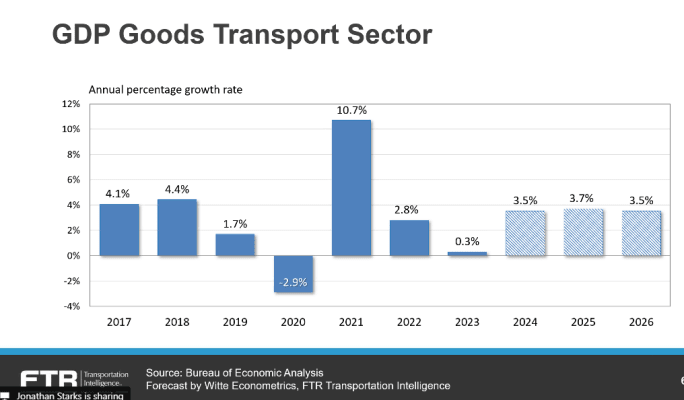
FTR's GDP Goods Transport Sector filters gross domestic product data to better reflect how it affects freight.
Source: FTR
Durable Goods and Industrial Production
Durable goods spending is driving consumer spending, but the rub there for trucking, explained Vise, is that a lot of the growth is in computer software, which is downloaded from the internet and never sees the inside of a truck.
Industrial production finished 2024 pretty much flat over the previous year, with manufacturing showing weakness. FTR doesn’t expect it to generate a significant amount of new freight.
“The overall truck freight market has been really pretty stagnant for quite a while,” Vise said.
“We're expecting to see overall truck freight volume up around a percentage point year over year [in 2025]. Doesn't sound like much, but 2024 was up only two tenths of a percent.”
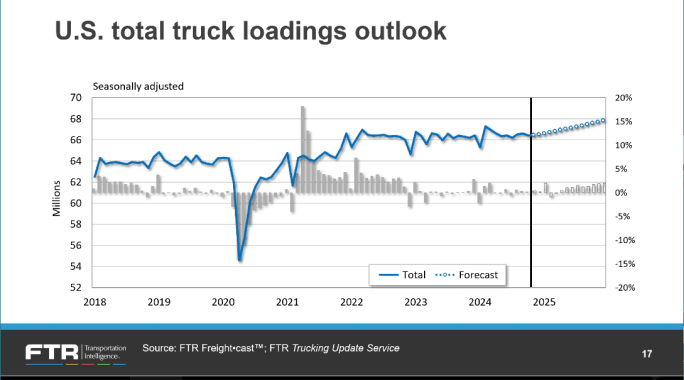
Gradual improvement in truck freight is expected in 2025.
Source: FTR
Will We See Tighter Truckload Capacity?
But what about capacity? Tighter capacity would mean higher rates. Well, that doesn’t look like it’s going to fall as much as many have been hoping.
Looking at new carrier entrants, motor carriers exiting the industry, and trucking employment data, Vise said, “based on the official data we have as of today, we clearly have more drivers than we had before the pandemic.”
But hold on – as Vise explained in his column for HDT last month, the current labor numbers are based on monthly estimates. More accurate numbers come from the Quarterly Census of Employment and Wages (QCEW), which takes longer to compile, so capacity likely is somewhat tighter than the numbers suggest.
Vise turned to FTR’s statistics for the Class 8 truck population and active truck utilization for more capacity insights.
According to FTR’s estimate, there hasn’t been much of a change in the Class 8 truck population since the beginning of 2023.
“So we really expect the change in the market to come from changes in the freight environment, not really changes from capacity," Vise explained.
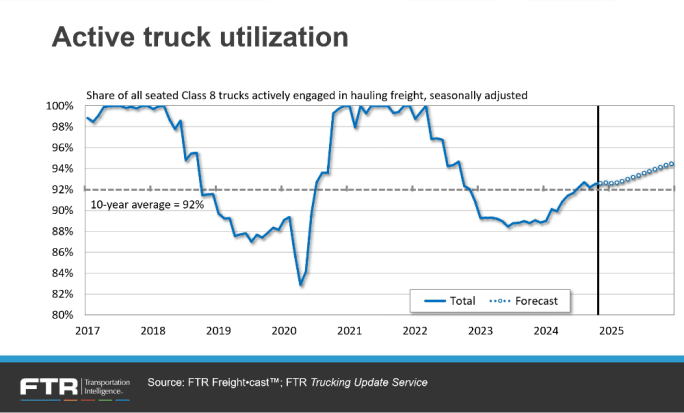
FTR's active truck utilization numbers show while freight capacity is tightening, it's nowhere near the tight capacity we saw a few years ago.
Source: FTR
Active Truck Utilization: Good News, Bad News
“But when we kind of put that all together in what we call active truck utilization, by looking at both freight demand and capacity, we have some good news and bad news for carriers.”
The good news for carriers is that utilization has clearly improved over the previous year, when it was pretty much in a trough for an entire year.
“The bad news is that really it has stalled out, based on our calculations.
“We do expect utilization to start improving from a carrier perspective around the beginning of the second quarter, and see a steady gain there.
"But as you look at that curve, even by the end of next year, you're only looking at utilization of around 94, 95%, which is not anywhere near what we were seeing during 2021, during 2018 and so on.
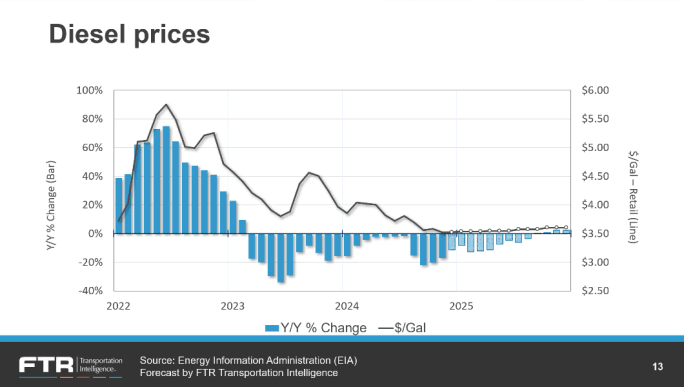
Among the good news for motor carriers is a stabilization of diesel prices.
Source: FTR
What Does All That Mean for Trucking Freight Rates?
“So it will lead to a stronger rate environment, but not a big run up, certainly not one like we saw in 2020 or during 2021," Vise said.
FTR foresees a steadily improving truckload spot rate market, about a 5.5-6% increase in spot rates over the course of 2025.
"Nothing to get overly excited about,” Vise said, “but certainly welcome from a carrier perspective.”
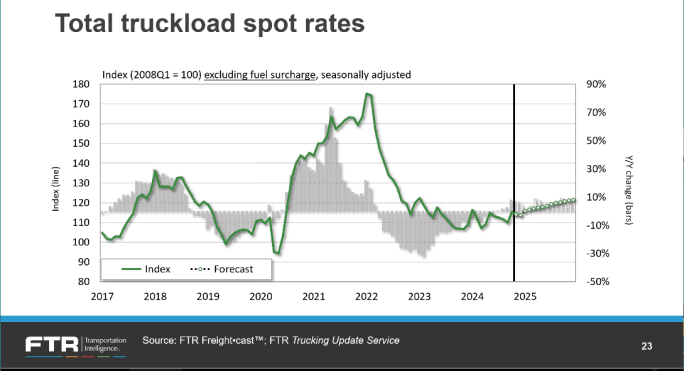
Truckload spot rates are gradually improving.
Source: FTR
On the contract side, “It appears that truckload contract rates have bottomed out,” Vise said.
In a few more months, FTR expects contract rates to start moving upward. By the end of the year, he said, we should see at least a 5% year-over-year increase, which translates into a total contract rate increase in the FTR forecast of just over about 2%.
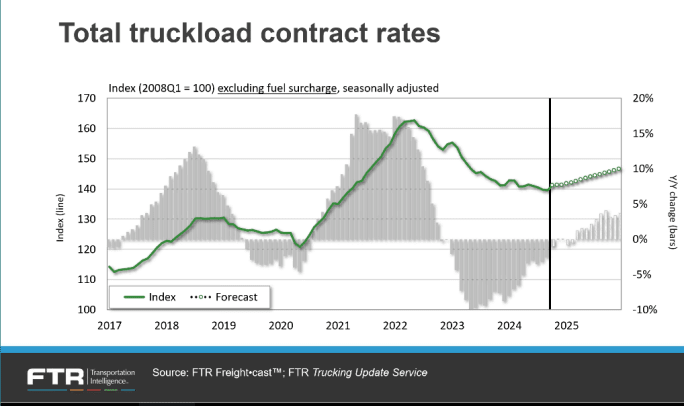
FTR expects contract rates to improve in 2025.
Source: FTR
What About Tariffs?
President-Elect Trump has been clear about his plans to implement new tariffs on imported goods.
Tariffs could impact imports and potentially lead to increased domestic production, but significant changes in domestic manufacturing capacity are unlikely in the near term.
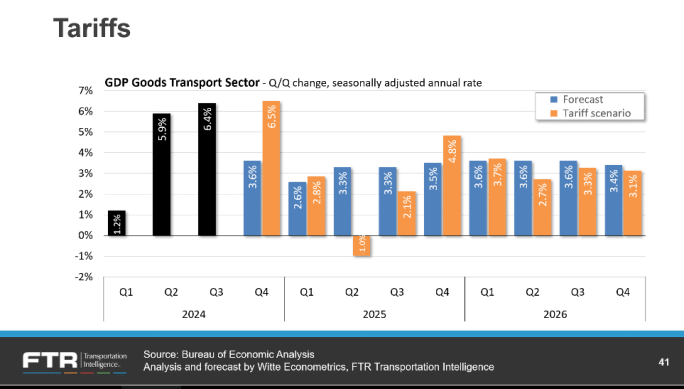
Tariffs are a wild card at the moment, but could result in short-term disruptions.
Source: FTR
At this point, we don’t have any details on exactly what products or countries tariffs will be levied on. But in general, Vise said, “A broad-based tariff regime is going to affect imports, and secondarily exports” as other countries implement retaliatory tariffs.
Another potential effect of tariffs is an increase in inflation, Vise said, “because those costs have to go somewhere. They have to either be eaten up in margin, or they have to be passed along to consumers.”
More Fleet Management

Sponsored•September 16, 2026
Color Match Smarter: Tools That Restore & Perform
For fleet managers and collision repair professionals keeping heavy-duty trucks on the road, getting the color right the first time isn't just about appearance — it's about efficiency, turnaround time, and bottom-line results. Discover how today's digital color tools are transforming the repair process from guesswork to precision.
Read More →
FMCSA Pauses Biennial-Update Enforcement Amid Motus Transition
Carriers whose updates were due on or after June 1 have more time, while FMCSA works to stabilize its new registration system and warns of phishing sites impersonating its new carrier registration system, Motus.
Read More →
Sponsored•September 14, 2026
2026 Blueprint for Countering Smarter Supply Chain Theft
Cargo theft is no longer just the cost of doing business. It's a multi-billion-dollar criminal enterprise exploiting vulnerabilities across your fleet, drivers, and supply chain.
Read More →


Sponsored•September 1, 2026
How Telematics Improves Visibility, Control, and Performance in Refrigerated Fleets
Explore how telematics help refrigerated fleets improve visibility, uptime, efficiency, compliance, and cargo protection across connected cold chain operations.
Read More →
What the U.S.-Canada Trade War Means for Trucking
Escalating U.S.-Canada tariffs could disrupt cross-border freight, reduce truck volumes, raise costs, and create new uncertainty for carriers on both sides of the border.
Read More →
What Are Trucking’s Top Concerns for 2026?
The American Transportation Research Institute wants to know what's worrying trucking fleet managers, drivers, and other stakeholders in its annual Industry Issues survey.
Read More →
American Trucking Associations Looks for a New Leader
ATA President and CEO Chris Spear abruptly left his job at the association on August 21, at a pivotal time for the trucking industry.
Read More →
Public Wi-Fi Cybersecurity Risks: How Truck Drivers and Fleets Can Protect Their Data
Public Wi-Fi can expose truck drivers and fleets to credential theft, malware, and other cyber threats. Here’s how to reduce the risk on the road.
Read More →
For Nicky Cupp, Fleet Innovation Starts With Frustration
HDT Truck Fleet Innovator Nicky Cupp turns everyday pain points at Fraley & Schilling into opportunities for better technology and smarter processes.
Read More →
Adam Buttgenbach’s Approach to Electric Trucks: Start With Where They Fit
HDT Truck Fleet Innovator Adam Buttgenbach helped PepsiCo build one of North America’s largest EV fleets by focusing on where electric trucks make operational sense.
Read More →