





Drayage Truckers Face Freight Surge as Imports Rise Due to Threats of Tariffs and Dockworker Strike
Port Strike That Threatened Supply Chain Likely Averted
It looks like a potential strike by dockworkers at East Coast and Gulf Coast ports has likely been averted. While it still must be ratified, the deal is good news for trucking operators and others in the supply chain who have been worried about the potential effects of a strike.
January 9, 2025
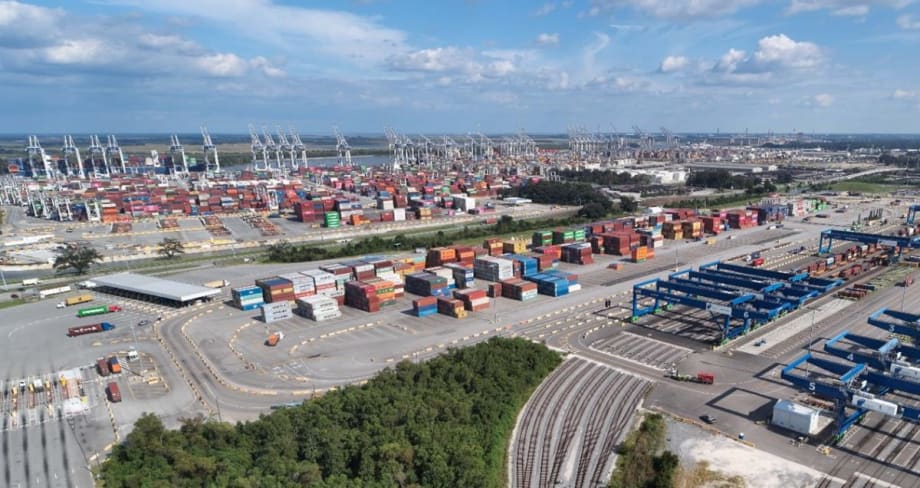
Despite the three-day strike in October, the Georgia Ports Authority reported container traffic was up 10% for the month.
Photo: Georgia Ports Authority
5 min to read
It looks like a potential strike by dockworkers at East Coast and Gulf Coast ports has likely been averted. While it still must be ratified, the deal is good news for trucking operators and others in the supply chain who have been worried about the potential effects of a strike.
The International Longshoremen’s Association and United States Maritime Alliance announced late Wednesday they have reached a tentative agreement for a new six-year Master Contract. The agreement avoids a port strike that was set to begin at midnight, January 15, when the current agreement expired.
The two sides agreed to continue to operate under the current contract until the union can meet with its full Wage Scale Committee and schedule a ratification vote, and USMX members can ratify the terms of the final contract.
The six-year contract expired on Sept. 30 last year and was extended until Jan. 15 following a three-day strike in October, allowing the two sides to continue to work out issues with port automation.
The agreement covers more than 20,000 dockworkers working at 14 major U.S. ports along the East Coast and Gulf Coast.
“This agreement protects current ILA jobs and establishes a framework for implementing technologies that will create more jobs while modernizing East and Gulf coast ports – making them safer and more efficient, and creating the capacity they need to keep our supply chains strong,” the union said in a statement.
Details of the new tentative agreement will not be released to allow ILA rank-and-file-members and USMX members to review and approve the final document.
Effect of a Port Strike on the U.S. Economy
The East and Gulf Coast ports handle more than half of U.S. container traffic. Some companies have been accelerated imports so containers arrived before the 15th. Shippers also diverted some shipments through West Coast ports, whose workers belong to another union.
The National Retail Federation released a statement applauding the deal.
“Providing certainty with a new contract and avoiding further disruptions is paramount to ensure retail goods arrive in a timely manner for consumers,” said the NRF. “The agreement will also pave the way for much-needed modernization efforts, which are essential for future growth at these ports and the overall resiliency of our nation’s supply chain.”
In December, NRF sent a letter signed by more than 260 groups to the parties urging them to return to the negotiation table.
What Issues Were the Source of Port-ILA Disagreement?
The big sticking point in renewing the contract has been the use of automation at the ports, which dockworkers say threatens jobs, but port officials say are vital to modernize the ports.
At issue is the use of semi-automated rail-mounted gantry cranes (RMGs), according to the ILA’s website.
“The ILA is not against progress, innovation, or modernization — but we cannot support technology that jeopardizes jobs, threatens national security, and puts the future of the workforce at risk,” it said.
The U.S. Maritime Alliance in a December statement emphasized the “port operations must evolve, and embracing modern technology is critical to this evolution. It means improving performance to move more cargo more efficiently through existing facilities - advancements that are crucial for U.S. workers, consumers, and companies.
“Due to the lack of available new land in most ports, the only way for U.S. East and Gulf Coast ports to handle more volume is to densify terminals – enabling the movement of more cargo through their existing footprints,” USMX explained.
“USMX is not, nor has it ever been, seeking to eliminate jobs, but to simply implement and maintain the use of equipment and technology already allowed under the current contract agreements and already widely in use, including at some USMX ports.”
The New York Times reported that a person briefed on the talks, who was not authorized to speak publicly, said the International Longshoremen’s Association had guarantees that jobs would be added when automated equipment was added at a port. The employers, this person said, got language in the contract that will give them a more straightforward path for introducing automated machinery.
Could Port Automation be Vulnerable to Cyberattacks?
The union also raised concerns about how automation could create cybersecurity risks.
“Ports rely on interconnected systems that are highly vulnerable to cyberattacks,” the ILA explained on its website. “A single ‘glitch’ can halt operations, as we’ve already seen with recent shutdowns at major ports.”
It cited a recent gate system glitch at a major South Atlantic port that shut down the terminal entirely, preventing trucks from being processed for hours.
“Imagine if a foreign adversary, like China, exploited these vulnerabilities and hacked our port systems. With ports increasingly dependent on automation and green energy technologies, an attack could cripple the U.S. economy overnight. This isn’t hypothetical—it’s a new form of warfare that we are not prepared to defend against.”
What Does The Port Agreement Say About Trump's Labor Policy?
The ILA credited President-Elect Trump as a key factor in reaching the agreement.
Harold J. Daggett, International President of the ILA, cites a face-to-face meeting he had with President-Elect Donald Trump at Mar-a-Lago in Florida on December 12, joined by his son and ILA Executive Vice President Dennis A. Daggett, as the chief reason the ILA was able to win protections against automation for his 85,000 members, and negotiate a tentative Master Contract Agreement.
“According to the ILA, Trump’s vocal support of workers over the ravages of automated terminals was a shot ‘heard round the world," said the attorneys at Scopeltis in an email alert.
"It remains to be seen whether Trump’s support on this particular issue is a harbinger of the President-Elect’s overall labor policy.”
More Fleet Management

Why Private Fleets Are Taking More Freight
Private fleets are putting their own trucks on demanding customers and high-cost lanes as companies seek greater control over service, costs, and capacity.
Read More →
Sponsored•September 16, 2026
Color Match Smarter: Tools That Restore & Perform
For fleet managers and collision repair professionals keeping heavy-duty trucks on the road, getting the color right the first time isn't just about appearance — it's about efficiency, turnaround time, and bottom-line results. Discover how today's digital color tools are transforming the repair process from guesswork to precision.
Read More →
FMCSA Pauses Biennial-Update Enforcement Amid Motus Transition
Carriers whose updates were due on or after June 1 have more time, while FMCSA works to stabilize its new registration system and warns of phishing sites impersonating its new carrier registration system, Motus.
Read More →


Sponsored•September 14, 2026
2026 Blueprint for Countering Smarter Supply Chain Theft
Cargo theft is no longer just the cost of doing business. It's a multi-billion-dollar criminal enterprise exploiting vulnerabilities across your fleet, drivers, and supply chain.
Read More →
Sponsored•September 1, 2026
How Telematics Improves Visibility, Control, and Performance in Refrigerated Fleets
Explore how telematics help refrigerated fleets improve visibility, uptime, efficiency, compliance, and cargo protection across connected cold chain operations.
Read More →
What the U.S.-Canada Trade War Means for Trucking
Escalating U.S.-Canada tariffs could disrupt cross-border freight, reduce truck volumes, raise costs, and create new uncertainty for carriers on both sides of the border.
Read More →
What Are Trucking’s Top Concerns for 2026?
The American Transportation Research Institute wants to know what's worrying trucking fleet managers, drivers, and other stakeholders in its annual Industry Issues survey.
Read More →
American Trucking Associations Looks for a New Leader
ATA President and CEO Chris Spear abruptly left his job at the association on August 21, at a pivotal time for the trucking industry.
Read More →
Public Wi-Fi Cybersecurity Risks: How Truck Drivers and Fleets Can Protect Their Data
Public Wi-Fi can expose truck drivers and fleets to credential theft, malware, and other cyber threats. Here’s how to reduce the risk on the road.
Read More →
For Nicky Cupp, Fleet Innovation Starts With Frustration
HDT Truck Fleet Innovator Nicky Cupp turns everyday pain points at Fraley & Schilling into opportunities for better technology and smarter processes.
Read More →