





"Having been in the administration, I can tell you I think everybody just ignores what Congress says."
FMCSA Regulatory Agenda: Hurry Up and Wait
Former FMCSA Administrator Annette Sandberg told attendees at the FTR Conference that most of FMCSA'S current rulemaking workload is on hold until after Acting Administrator Scott Darling is confirmed as the Agency's next Administrator.
September 17, 2015
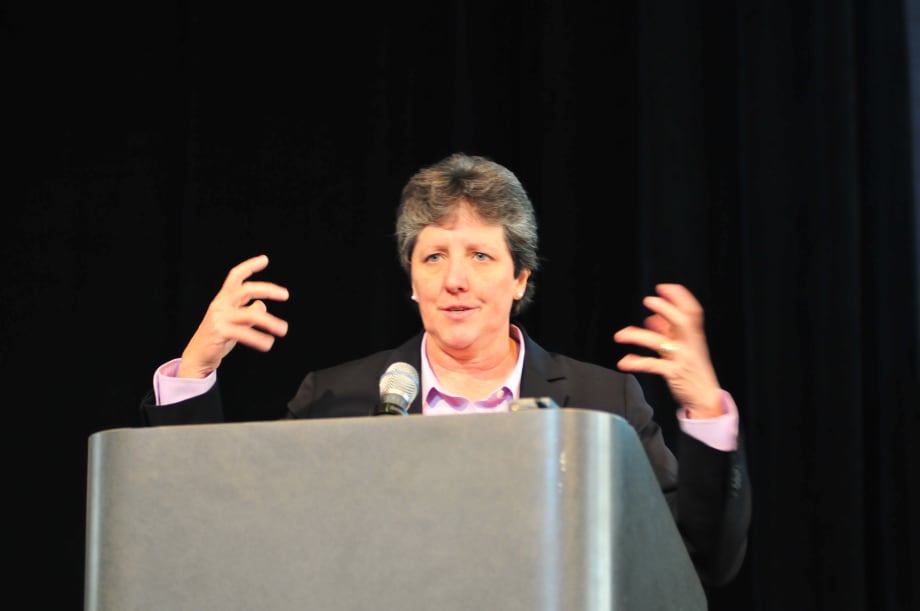
Former FMCSA Administrator Annette Sandberg speaking at the FTR Conference in Indianapolis on Wednesday. Photo by Jim Park
4 min to read
Former FMCSAAdministrator Annette Sandberg speaking at the FTR Conference in Indianapolis on Wednesday. Photo by Jim Park
INDIANAPOLIS -- With close to a dozen significant rulemakings currently in the regulatory pipeline, the Federal Motor Carrier Safety Administration has pushed back all but two of the rules. The reason for the delay, suspects Annette Sandberg, a former FMCSA administrator now in a private consulting business, is the pending confirmation hearing of current acting Administrator Scott Darling.
"Until his confirmation hearing is held, I seriously doubt the agency is going to take action on any of these," Sandberg said on Wednesday at the FTR Conference in Indianapolis, Ind. "They need to get him confirmed, and if anything controversial happens they know he'll never get confirmed. I think that's why they have been pushed back to at least October."
Sandberg said a decision on the controversial hours of service restart provisions will likely suffer the same fate.
"I'd be shocked if they did anything or they made any changes until Darling's confirmation goes through," she said. "And there's a chance that some members of the Senate may hold his confirmation on the promise that he not change some of these things if he does get confirmed.
"We don't know when the confirmation hearings will be held, but I think that's clearly in play with some of these regulations and studies."
To underscore the tenuousness of the current regulatory schedule, Sandberg told attendees that she finished her presentation on the Friday before the conference, and sure enough, the morning of the conference the dates had changed again.
"As of [Wednesday] morning, dates for all the regulations except one have slid," Sandberg said.
The Drug and Alcohol Clearinghouse rule, one the industry has been waiting a long time for, was supposed to be done by January 2016. As of September 16, the rule has been pushed back until March 2016.
The rule would require all carriers and drug testing providers to put all of their test results into a national database. Before a carrier hires a driver, it would have to check the database for a previous positive test. The rule would close a loophole where a driver, who may have applied to a carrier but wasn't hired because of a positive test, can omit that application and test from the employment record because technically he or she was never employed by that carrier.
"It has slid by two months so far," Sandberg says. "And it will probably slide again. This is something industry really wanted, and it's surprising that FMCSA is taking so long to get this done."
A rule that would force an increase in the minimum amount of insurance a carrier must maintain is in limbo as well. Following a huge backlash from industry on the proposal, FMCSA did an Advanced Notice of Proposed Rulemaking, which gave it the opportunity to collect some real data to determine whether the increase was warranted or not.
"Since the agency announced the ANPRM in February of this year, the rule has just been sitting there," she said. "If you look at the regulatory agenda, they don't have any dates for this particular rule, which probably means they are still analyzing the data.
"On top of that, if you look at all the other regulations they have in play right now, I think other rules have moved to the top of the priority list and this one has fallen to the bottom," Sandberg added.
The big and long-awaited rule on electronic logging devices was supposed to be out at the end of this month, but Sandberg says Darling made some comments at the Commercial Vehicle Safety Alliance conference earlier this week hinting that the rule was going to slide.
"Sure enough, the regulatory update that came out [Wednesday] morning showed it won't be out until October," said Sandberg.
The Entry Level Driver Training rule, which was mandated by Congress, was due out two years ago.
"Having been in the administration, I can tell you I think everybody just ignores what Congress says," Sandberg said. "And clearly the agency does as well, since this rule is clearly not done. That NPRM is scheduled for November 15 of this year, so that one has slid by about a month."
And one of the more significant initiatives, the Prohibition of Coercion rule, which should be of interest to brokers and shippers as well as carriers, is now delayed until the end of October as well.
The only two that appear to be on track are the Speed Limiter rule and the Safety Fitness Determination rule.
The speed limiter rule seems to be on track for late September, and Sandberg said she thinks FMCSA is still on track with that one.
"Once they accept comments, the rulemaking will close," she says. "That one should be a fairly easy push for FMCSA and I anticipate we'll see a final rule before the end of next year."
Last year at this same conference, Sandberg predicted that the departure of Federal Motor Carrier Safety Administrator Anne Ferro would slow down the pace of new regulations coming out of the agency, and that If the administration nominated a replacement, the pace would slow until that person is confirmed.
More Fleet Management

Why Private Fleets Are Taking More Freight
Private fleets are putting their own trucks on demanding customers and high-cost lanes as companies seek greater control over service, costs, and capacity.
Read More →
Sponsored•September 16, 2026
Color Match Smarter: Tools That Restore & Perform
For fleet managers and collision repair professionals keeping heavy-duty trucks on the road, getting the color right the first time isn't just about appearance — it's about efficiency, turnaround time, and bottom-line results. Discover how today's digital color tools are transforming the repair process from guesswork to precision.
Read More →
FMCSA Pauses Biennial-Update Enforcement Amid Motus Transition
Carriers whose updates were due on or after June 1 have more time, while FMCSA works to stabilize its new registration system and warns of phishing sites impersonating its new carrier registration system, Motus.
Read More →


Sponsored•September 14, 2026
2026 Blueprint for Countering Smarter Supply Chain Theft
Cargo theft is no longer just the cost of doing business. It's a multi-billion-dollar criminal enterprise exploiting vulnerabilities across your fleet, drivers, and supply chain.
Read More →
Sponsored•September 1, 2026
How Telematics Improves Visibility, Control, and Performance in Refrigerated Fleets
Explore how telematics help refrigerated fleets improve visibility, uptime, efficiency, compliance, and cargo protection across connected cold chain operations.
Read More →
What the U.S.-Canada Trade War Means for Trucking
Escalating U.S.-Canada tariffs could disrupt cross-border freight, reduce truck volumes, raise costs, and create new uncertainty for carriers on both sides of the border.
Read More →
What Are Trucking’s Top Concerns for 2026?
The American Transportation Research Institute wants to know what's worrying trucking fleet managers, drivers, and other stakeholders in its annual Industry Issues survey.
Read More →
American Trucking Associations Looks for a New Leader
ATA President and CEO Chris Spear abruptly left his job at the association on August 21, at a pivotal time for the trucking industry.
Read More →
Public Wi-Fi Cybersecurity Risks: How Truck Drivers and Fleets Can Protect Their Data
Public Wi-Fi can expose truck drivers and fleets to credential theft, malware, and other cyber threats. Here’s how to reduce the risk on the road.
Read More →
For Nicky Cupp, Fleet Innovation Starts With Frustration
HDT Truck Fleet Innovator Nicky Cupp turns everyday pain points at Fraley & Schilling into opportunities for better technology and smarter processes.
Read More →