




Former Administrator Predicts Temporary Rulemaking Slowdown
Annette Sandberg, a former FMCSA Administrator turned consultant, on what will happen with pending safety rules and some troubling tactics the administration is using.

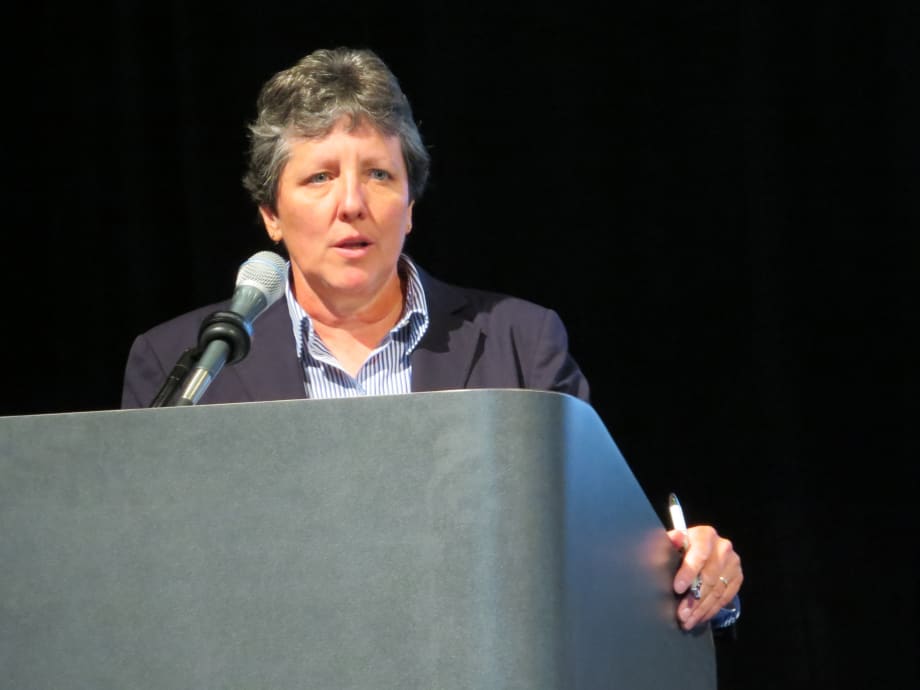
Annette Sandberg speaks at FTR Transportation Conference. (Photo: Deborah Lockridge)
Annette Sandberg speaks at FTR Transportation Conference.(Photo: Deborah Lockridge)
INDIANAPOLIS -- The recent departure of Federal Motor Carrier Safety Administrator Anne Ferro will slow down the pace of new regulations coming out of the agency, and if a successor is proposed soon it could slow things even more, predicted Annette Sandberg, a former agency administrator herself and now owner of TransSafe Consulting.
"Having an acting administrator (agency chief counsel Scott Darling) slows things down a bit," she said, speaking at the FTR 2014 Transportation Conference here. If the administration nominates a replacement, she said, the pace will slow until that person is confirmed. "If a name comes out soon, I suspect we won't see much before the end of the year, especially anything controversial."
For instance, she said, new proposed rules on minimum insurance requirements were scheduled to come out this month, but as this is a fairly controversial issue, she expects that wil be delayed.
And one that already has been delayed many times is one requiring entry-level driver training. This was called for in the MAP-21 highway bill, but Sandberg said the negotiated rulemaking recently announced is essentially another way of the agency kicking the can down the road because they're not sure what to do with the controversial proposal.
Meanwhile, the regulatory proposal that draws the most questions, Sandberg said, is the mandatory electronic logging devices rule, for which the comment period closed in July.
"This is one Congress has been trying to encourage agency to get out by January, but I think that's a very aggressive schedule given the number of comments, and a number of technical issues brought up in the comments."
In the meantime, she said, the FMCSA is already applying some heavy-handed tactics to "encourage" carriers to adopt ELDs.
"I've spent most of my time this year working with carriers that have not adopted e logs and they suddenly undergo an audit from the FMCSA focused on hours of service compliance. If they have any kind of GPS on trucks it's easy to prove a false log case pretty quickly, so the agency will give a proposed conditional rating -- and the only way they can get it upgraded is if they agree to implement electronic logs."
In the last 60 days, she says, that has accelerated, with the agency requiring carriers to implement ELDs within 90 days.
Another rule that keeps getting delayed but that the agency has found a way to address is that of screening for sleep apnea.
FMCSA originally intended to address the issue of drivers with sleep apnea through a "guidance," but after an industry outcry and Congressional attention it announced it would go through the rulemaking progress. Nevertheless, Sandberg said, it is affecting the industry already through the certified medical examiner registration process.
"If you look at the medical protocols the agency released to these providers, you'll see instructions for when they should require drivers to do sleep apnea testing. We're seeing a significant spike in the apnea testing among these drivers."
There also are a couple of rules that are already in effect or scheduled to go into effect that are causing or will cause headaches for some carriers.
For instance, she said, carriers with their own truck driver training schools will be affected when new learner's permit/CDL regulations go into effect next July. Those rules require learner's permits and CDLs to be issued in a driver's home state. Because many of these large carrier schools bring drivers in from out of state, that will be a problem for some.
Another one affecting larger carriers is the recent rule regarding carriers that have a pattern or practice of willfully violating safety regulations.
Sandberg says she has worked with some very large carriers who have multiple trucking companies under one umbrella. "The agency has said if they find problems at one of those carriers they can apply the violations across all of them."
And one recent proposed rule could cause serious headaches because FMCSA is farming out the enforcement to the Occupational Health & Safety Administration.
FMCSA recently signed an agreement with OSHA to handle enforcement of the proposed rule about driver coercion.
OSHA already has been much more aggressive in targeting motor carriers, Sandberg noted. However, OSHA personnel don't necessarily understand some of the regulations regarding truck drivers.
She gave an example of a carrier she consults for who recently had an OSHA investigator demand they the company hire a driver who had scored positive on a drug test for his previous employer.
"I was dumbfounded," Sandberg said. When asked why, the OSHA investigator said he thought the previous carrier had lied about the positive drug test.
"I said, that's an issue you need to take up with the previous carrier. The regulations say we cannot hire this driver," she said. After 90 days of going round and round with this OSHA official, she said, "I finally had to call the FMCSA office in Chicago and have them explain the rules."
More Drivers

From One Generation to the Next: How Mentorship Builds Safer Truck Drivers
After three decades in trucking, Harold Perry shares what he's learned about driver safety, mentorship, and helping the next generation build confidence behind the wheel.
Read More →
Truck Drivers Need More Than Another Alert
Fleets have more visibility into truck health, safety events, and driver activity than ever. The next challenge is turning all that information into useful guidance for the person who has to decide what to do next.
Read More →
FMCSA Removes 110 Truck Driver Training Schools from Certified ELDT List
Federal regulators also are targeting more than 160 additional training providers and launching a nationwide audit of third-party CDL skills testers as part of a broader crackdown on trucking fraud.
Read More →
Hours of Service Pilot Programs: FMCSA Readies for 2027 Rollout
Two pilot programs could eventually reshape hours-of-service rules, giving truck drivers options to pause their 14-hour clock or use longer split sleeper rest periods.
Read More →
Medical Cards, English Proficiency Reshape Roadcheck Violations
Medical-card violations jumped to the top of the driver out-of-service list during CVSA’s 2026 International Roadcheck, while English-language proficiency violations appeared among the leading violations for the first time.
Read More →
Driver Trust Can Make or Break the Success of Fleet Safety Technology
New Teletrac Navman research suggests that onboarding, transparency about driver data, and positive feedback can play a significant role in how commercial drivers respond to safety and coaching technology.
Read More →
EEOC Sues KLLM Over Alleged Sex Discrimination in Driver Training
KLLM is facing a federal sex-discrimination lawsuit over policies the EEOC alleges put female truck driver trainees at a disadvantage.
Read More →
FMCSA Moves to Codify English Language Requirements for Commercial Drivers
By changing regulations on English-language proficiency requirements for commercial drivers, rather than relying on a guidance memo, the FMCSA said future administrations won't be able to walk back the Trump administration's stricter enforcement with just a memo.
Read More →
Drivers Put Western Star Trucks to the Test at Star Nation Experience
Watch to get an inside look at the Western Star trucks, technology, and community behind the Star Nation Experience 2026!
Read More →
Trump Administration Looks to Put More Veterans Behind the Wheel
The Freedom Haulers program pulls together existing and expanded programs at several federal agencies to recruit veterans to drive commercial heavy-duty trucks and cut the red tape for them to get a CDL, training, and employment.
Read More →