




FMCSA Proposes Guidance for Sleep Apnea
The Federal Motor Carrier Safety Administration is proposing tougher standards for sleep apnea evaluation. The agency is adopting the recommendations of two advisory panels, one from the medical community and one representing industry, enforcement, labor and safety advocacy interests, for how medical examiners should evaluate the condition
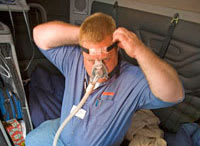
Proposed recommendations will provide guidance to DOT examiners on sleep apnea, but the panels see this as an interim step toward a comprehensive rule.
The Federal Motor Carrier Safety Administration is proposing tougher standards for sleep apnea evaluation. The agency is adopting the recommendations of two advisory panels, one from the medical community and one representing industry, enforcement, labor and safety advocacy interests, for how medical examiners should evaluate the condition.
The panels say the agency should tell medical examiners that drivers with a body mass index of 35 or more must be evaluated for sleep apnea. In a Federal Register notice posted today, the agency asks for comments on this and a number of additional recommendations concerning apnea screening, evaluation and treatment.
The recommendations will provide guidance to examiners, but the panels see this as an interim step toward a comprehensive rule.
The guidance includes conditions which should trigger immediate disqualification of a driver, such as falling asleep while driving or having a fatigue-related crash, pending evaluation and treatment for sleep apnea. The examiner could approve a 60-day conditional card during evaluation and treatment.
The two panels are the agency's Medical Review Board, a panel of five physicians who advise the agency on medical issues, and the Motor Carrier Safety Advisory Committee
The Medical Review Board has long been pushing stricter regulatory standards for sleep apnea. In 2008 the Board recommended that the agency require all drivers to be screened for obstructive sleep apnea, a significant change from the current rules that do not explicitly require testing and treatment.
The selection of a body mass index of 35 as a trigger for screening arose from research that shows BMI, a measurement of body fat based on height and weight, is a primary indicator that a person may have sleep apnea.
The higher the BMI, the greater the likelihood of sleep apnea. There are other indicators, such as middle age and male gender, but BMI would be an effective tool for medical examiners to make the initial screening, the Board found.
Examiners need a prescriptive BMI number, said Benjamin Hoffman, chairman of the Medical Review Board, at a conference last December. A BMI of 35 is a reliable indicator of sleep apnea, he said.
Members of the Board say sleep apnea can lead to chronic fatigue, which in turn causes performance problems such as slowed reaction time, lapses of attention and distractibility.
The crash risk for a person with sleep apnea is 242% greater than a person without the disorder, according to Charles Czeisler, professor of sleep medicine at Harvard Medical School.
Understanding of the problem is not widespread in the trucking industry, but awareness is growing and a number of carriers have implemented groundbreaking programs to screen drivers for apnea and treat them if they have it.
Schneider National, for instance, has put in place a program that produced a 30% reduction in crash rates and a 48% reduction in the median cost of crashes. The kicker has been a savings of $539 per driver per month in health care costs, according to senior safety VP Don Osterberg at a sleep apnea conference in 2010.
Treatment for the disorder is typically handled with a nighttime sleep-aid device that provides continuous positive airway pressure, called CPAP for short.
Related Stories:
41% of Australian Truck Drivers Have Sleep Apnea, Study Says,4/4/2012
Advisory Panels Urge Tougher Screening for Sleep Apnea, 12/8/2011
More Drivers

From One Generation to the Next: How Mentorship Builds Safer Truck Drivers
After three decades in trucking, Harold Perry shares what he's learned about driver safety, mentorship, and helping the next generation build confidence behind the wheel.
Read More →
Truck Drivers Need More Than Another Alert
Fleets have more visibility into truck health, safety events, and driver activity than ever. The next challenge is turning all that information into useful guidance for the person who has to decide what to do next.
Read More →
FMCSA Removes 110 Truck Driver Training Schools from Certified ELDT List
Federal regulators also are targeting more than 160 additional training providers and launching a nationwide audit of third-party CDL skills testers as part of a broader crackdown on trucking fraud.
Read More →
Hours of Service Pilot Programs: FMCSA Readies for 2027 Rollout
Two pilot programs could eventually reshape hours-of-service rules, giving truck drivers options to pause their 14-hour clock or use longer split sleeper rest periods.
Read More →
Medical Cards, English Proficiency Reshape Roadcheck Violations
Medical-card violations jumped to the top of the driver out-of-service list during CVSA’s 2026 International Roadcheck, while English-language proficiency violations appeared among the leading violations for the first time.
Read More →
Driver Trust Can Make or Break the Success of Fleet Safety Technology
New Teletrac Navman research suggests that onboarding, transparency about driver data, and positive feedback can play a significant role in how commercial drivers respond to safety and coaching technology.
Read More →
EEOC Sues KLLM Over Alleged Sex Discrimination in Driver Training
KLLM is facing a federal sex-discrimination lawsuit over policies the EEOC alleges put female truck driver trainees at a disadvantage.
Read More →
FMCSA Moves to Codify English Language Requirements for Commercial Drivers
By changing regulations on English-language proficiency requirements for commercial drivers, rather than relying on a guidance memo, the FMCSA said future administrations won't be able to walk back the Trump administration's stricter enforcement with just a memo.
Read More →
Drivers Put Western Star Trucks to the Test at Star Nation Experience
Watch to get an inside look at the Western Star trucks, technology, and community behind the Star Nation Experience 2026!
Read More →
Trump Administration Looks to Put More Veterans Behind the Wheel
The Freedom Haulers program pulls together existing and expanded programs at several federal agencies to recruit veterans to drive commercial heavy-duty trucks and cut the red tape for them to get a CDL, training, and employment.
Read More →