




Fleets Manage Costs as Freight Hauling Demand Grows
Transportation company chief financial officers across the U.S. are seeing more business opportunities despite rising costs and regulatory challenges, according to a recent survey by GE Capital.
Transportation company chief financial officers across the U.S. are seeing more business opportunities despite rising costs and regulatory challenges, according to a recent survey by GE Capital.
GE Capital surveyed approximately 500 chief financial officers of mid-market companies in seven industries across the U.S., including transportation, in the first quarter of 2012. Survey topics included current views on economic conditions in the U.S., commercial credit and lending conditions, business and energy costs and other operational issues.
Results show that transportation company CFOs are the most optimistic out of the groups of CFOs surveyed in the seven different industries, with 47% of them predicting an increase in their company's profit margins. Specific business opportunities cited in the survey include customer acquisition and growing average revenue per loaded mile (both at 59%), and increasing tonnage volume from existing customers (57%). Despite this relative optimism in a slow economy, transportation fleets face a number of challenges.
Out of the group of transportation company CFOs surveyed, 67% are most concerned about the impact of fuel price volatility on their business, and 59% are most concerned with safety-related issues. In terms of outlook, 47% of CFOs predict an increase in their company's profit margins. In addition, 59% see business opportunities in acquiring new customers and increasing the average revenue brought in per loaded mile.
To learn what factors are driving these concerns, we spoke with GE Capital's Dan Clark, president and general manager of its Transportation Financial Services group, and John Conkin, senior vice president of sales for the same group.
Some of the challenges facing transportation fleets today involve finding ways to keep up with freight demand while facing rising costs. Volatile fuel prices, an aging and shrinking driver workforce and higher acquisition costs for buying new equipment are all factors affecting costs. As the economy slowly recovers, the opportunities are there for the taking, but managing costs to ensure profitability is a key concern.
"In the survey, 61% of CFOs said they thought their cost structure is going to go up," Conkin says. "They're looking at a tidal wave of increased expenses. You've got the volatility of fuel costs. There is nowhere it can go but up."
To manage costs, Clark says that the companies are putting pricing discipline into practice more than they did during other periods across business cycles during the past 10 years.
"They're making sure that the surcharges on fuel are stable. They're not bending," Clark explains. "A lot of times during 2005 through 2007, there were surcharges, but they were more lenient on how they were calculated."
Ensuring every mile is profitable is another focus for transportation fleets, Clark says.
"They're getting much smarter on their backhauls," he says. "They're hiring not only drivers but also salespeople to go out and work on backhauls to fill deadhead miles with freight. That's important because of not only the miles they lose [with deadhead miles] but they also aren't getting the surcharge on the cost of fuel."
Clark says fleets will drop the bottom 10% of contracts that aren't profitable and Conkin agreed with his assessment.
"They look at every lane," Conkin adds. "There is really nothing that's sacred. If they're not profitable, then they're willing to walk away from it."
GE Capital's Clark says one way fleets are making their routes more profitable is use routing and dispatch software.
"They're looking at using computer programs to get the most efficient use of their lanes," Clark says. "Before, they would have a dispatcher looking at a route, but now the software lets them leverage the whole fleet rather than just make one-off changes to a truck's route."
Another issue is the cost of new trucks and equipment. GE Capital says fleets that analyze the total costs associated with them don't only see downsides, though.
"Everybody is getting sticker shock," Clark says. "They're thinking, 'Do I have to pay that much for a new truck?' They're running the economics of it, though, and they're finding out they're better off with newer equipment. It helps them retain drivers and results in less downtime."
Clark also notes how new trucks and equipment can help drive down costs, as mentioned previously. He says that 68% of companies say they expect to buy more equipment in the next 12 months, largely because of increased demand for hauling freight and the maintenance-related expenses associated with aging truck fleets.
"The net cost may work out so it's cheaper to have new equipment," he says. "New engines are getting better mileage in most cases, for example. The combo of reduced maintenance and fuel costs reduces the net costs of buying new equipment."
Another major issue is driver retention amidst an aging driver population and a stricter regulatory environment. Clark says 80% of the transportation respondents to GE Capital's survey are planning to hire in the next 12 months.
"The truck driving population continues to age," he says. "There is a peel off of drivers. They have to find ways to keep truck driving as a career. If you think about it, there aren't that many parents that want their children to grow up to be truck drivers. It's a culture change. The length of haul is a big part of that."
The U.S. Department of Transportation's Compliance, Safety, and Accountability scores are moving drivers out of the available pool, making driver retention more difficult for companies.
"The CSA rules are obviously another issue," Clark says. "There is another pool of drivers that are leaving. Before, they had a CSA score that was unmeasured. Unsafe drivers would bounce from one place to another. There was no way to assess whether a driver was a good driver or not."
GE's Conkin said to ensure that drivers are safe, and keep their CSA scores in line, fleets are paying more attention to the people they're hiring, are offering bonuses to drivers for ensuring good safety records, and are using electronic onboard recorders.
"Now they're starting to look at trucks involved in accidents and clarify what exactly happened," Clark says. "How did that happen? They're trying to get more information to be as accurate as possible."
Although the economy is improving, Clark says it's improving on a regional basis, explaining that interest in specific industries is creating additional demand for hauling freight.
"California continues to be weak as far as the transportation business goes," Clark says. "Texas and Louisiana have been pretty solid right now, both because the economy is a little better, but also because oil and gas is moving. I think if you look across the country, while most of it is good, from a freight standpoint, regions with energy production in their areas are getting an extra boost. You get an ancillary economic impact from solid energy production going on there. If you get away from the headline news, and to the people hauling the freight, it's not great, but it's running along at a good pace."
Greg Basich is web editor for HDT sister publication Work Truckmagazine.
More Fleet Management

What the U.S.-Canada Trade War Means for Trucking
Escalating U.S.-Canada tariffs could disrupt cross-border freight, reduce truck volumes, raise costs, and create new uncertainty for carriers on both sides of the border.
Read More →
What Are Trucking’s Top Concerns for 2026?
The American Transportation Research Institute wants to know what's worrying trucking fleet managers, drivers, and other stakeholders in its annual Industry Issues survey.
Read More →
American Trucking Associations Looks for a New Leader
ATA President and CEO Chris Spear abruptly left his job at the association on August 21, at a pivotal time for the trucking industry.
Read More →
Public Wi-Fi Cybersecurity Risks: How Truck Drivers and Fleets Can Protect Their Data
Public Wi-Fi can expose truck drivers and fleets to credential theft, malware, and other cyber threats. Here’s how to reduce the risk on the road.
Read More →
For Nicky Cupp, Fleet Innovation Starts With Frustration
HDT Truck Fleet Innovator Nicky Cupp turns everyday pain points at Fraley & Schilling into opportunities for better technology and smarter processes.
Read More →
Adam Buttgenbach’s Approach to Electric Trucks: Start With Where They Fit
HDT Truck Fleet Innovator Adam Buttgenbach helped PepsiCo build one of North America’s largest EV fleets by focusing on where electric trucks make operational sense.
Read More →
Deen Albert: Let Automation Do the Math, People Make the Decisions
HDT Truck Fleet Innovator Deen Albert makes sure people are still at the heart of operations at Grand Island Express, even while adopting artificial intelligence tools. AI-assisted dispatch helped boost revenue 25% with the same number of trucks.
Read More →
Trimble’s New AI Agent Takes Aim at Fleet Back-Office Busywork
Arc Agent works across Trimble TMS products to automate repetitive tasks such as freight orders, maintenance, invoices, fuel costs and more.
Read More →
How HDT’s 2026 Truck Fleet Innovators Are Rethinking Fleet Operations
Meet five trucking leaders who are challenging assumptions, solving operational problems, and putting innovative ideas to work.
Read More →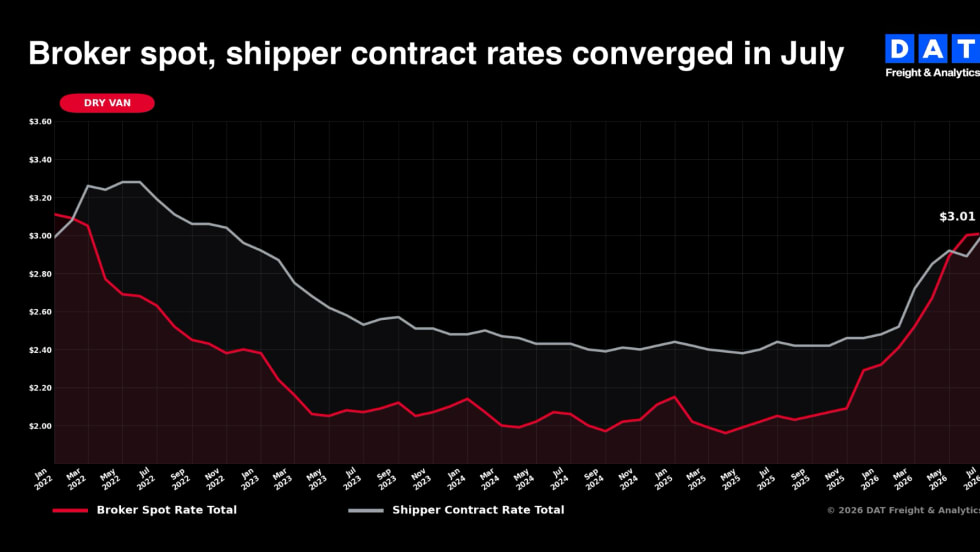
Tight Trucking Capacity Pushes Rates Higher Even as Freight Volumes Fall
“Spot rates moving ahead of contract rates have historically signaled a tightening market, but we haven’t seen a capacity-driven market quite like this one,” said DAT's Dean Croke.
Read More →