




Fleet Survey Shows Driver Shortage Continues to Impact Equipment Buying Plans
A quarterly survey of a varied panel of trucking fleets finds continued strong plans to buy more trucks, especially among larger fleets, and among private fleets looking to address capacity and rate issues – but those truck orders are in many cases about other things than adding capacity, because drivers continue to be in short supply.


A quarterly survey of a varied panel of trucking fleets finds continued strong plans to buy more trucks, especially among larger fleets, and among private fleets looking to address capacity and rate issues – but those truck orders are in many cases about other things than adding capacity, because drivers continue to be in short supply.
The second quarter Fleet Sentiment Report by CK Commercial Vehicle Research reports that its buying index, tracked since 2008, while not at peak, is "rolling along at a nice solid clip with a 117.8 reading." The index tracks both how many fleets are planning purchases of medium- and heavy-duty trucks and trailers, as well as the volume of those planned orders.
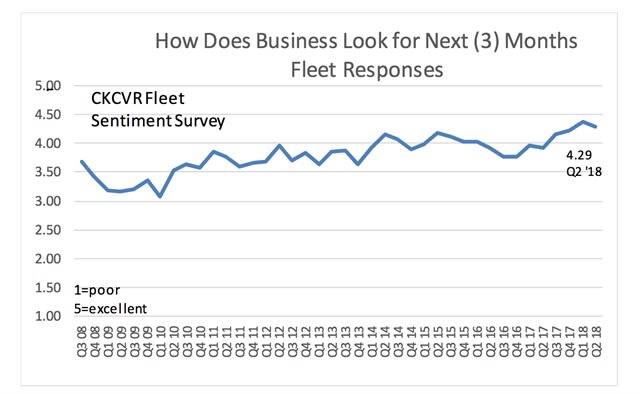
In addition, CKCVR’s “How’s Business” rating reflects the positive outlook for carriers. The survey asks, “Considering all the factors that impact your company, on a scale of 1-5 (with being poor and 5 being excellent) in your opinion, what is the overall outlook for your fleet in the next three months?” After setting a record during the January survey, the reading fell a bit in Q2, but still remains at a high 4.29 on a scale of 1-5.
Basically, the same percentage of survey participants that planned to purchase trucks during the first quarter plan to place orders during Q2. So far in 2018, larger fleets are tending to place orders more than the smaller fleets.
Private fleets are definitely active in purchasing new equipment. While they made up 32% of the reporting group, they represented 37% of the fleets that are planning to place orders. Comments from the private fleets mentioned the increasing rates from common carriers as a strong incentive for them to increase their own fleet. The capacity problem plays into that as well, as company brands are impacted (negatively) by any delivery problems.
Some of the other reasons fleets cited for their equipment-buying plans included:
Newer trucks are more reliable, and more uptime means more productivity and essentially more capacity
New trucks help recruit and retain drivers
The new tax law has freed up some capital
Booming economy and good business environment for fleets
Locking in build slots in a “hot” order climate
Concern about getting ahead of rising equipment prices
Better fuel economy
However, for most of the fleets planning to buy in the survey, those equipment purchase plans for Q2 do not include many units for ‘straight-up’ capacity additions – that is, adding equipment to their population of vehicles. That doesn’t take into account how many fleets are using newer, more productive equipment to add hauling capacity.
Fleets had, up to a point, been adding trailers to increase their capacity (more drop and hook, etc.), CKCVR notes, but “based on what our fleets are reporting – now the majority of fleets are designating most, if not all, of their equipment purchases to replacement.”
That's because there aren't enough drivers to put behind the wheel. Fleets in the survey continue to say they would add more capacity if they had more drivers; there’s plenty of freight to haul. The percentage of fleets in the survey who indicate they have a driver shortage has now gone over 70% for the first time. In addition, the fleets that say they have a driver shortage – almost 75% – now need them to fill current seats. Three quarters also indicate they can’t grow because drivers are not available.
More Drivers

Truck Drivers Need More Than Another Alert
Fleets have more visibility into truck health, safety events, and driver activity than ever. The next challenge is turning all that information into useful guidance for the person who has to decide what to do next.
Read More →
FMCSA Removes 110 Truck Driver Training Schools from Certified ELDT List
Federal regulators also are targeting more than 160 additional training providers and launching a nationwide audit of third-party CDL skills testers as part of a broader crackdown on trucking fraud.
Read More →
Hours of Service Pilot Programs: FMCSA Readies for 2027 Rollout
Two pilot programs could eventually reshape hours-of-service rules, giving truck drivers options to pause their 14-hour clock or use longer split sleeper rest periods.
Read More →
Medical Cards, English Proficiency Reshape Roadcheck Violations
Medical-card violations jumped to the top of the driver out-of-service list during CVSA’s 2026 International Roadcheck, while English-language proficiency violations appeared among the leading violations for the first time.
Read More →
Driver Trust Can Make or Break the Success of Fleet Safety Technology
New Teletrac Navman research suggests that onboarding, transparency about driver data, and positive feedback can play a significant role in how commercial drivers respond to safety and coaching technology.
Read More →
EEOC Sues KLLM Over Alleged Sex Discrimination in Driver Training
KLLM is facing a federal sex-discrimination lawsuit over policies the EEOC alleges put female truck driver trainees at a disadvantage.
Read More →
FMCSA Moves to Codify English Language Requirements for Commercial Drivers
By changing regulations on English-language proficiency requirements for commercial drivers, rather than relying on a guidance memo, the FMCSA said future administrations won't be able to walk back the Trump administration's stricter enforcement with just a memo.
Read More →
Drivers Put Western Star Trucks to the Test at Star Nation Experience
Watch to get an inside look at the Western Star trucks, technology, and community behind the Star Nation Experience 2026!
Read More →
Trump Administration Looks to Put More Veterans Behind the Wheel
The Freedom Haulers program pulls together existing and expanded programs at several federal agencies to recruit veterans to drive commercial heavy-duty trucks and cut the red tape for them to get a CDL, training, and employment.
Read More →
Putting Mack’s Command Steer to the Test
A test drive of Mack’s Command Steer active steering system evaluates how it can make truck driving easier and less tiring.
Read More →