




Related: Wireless Carriers Sunset Support for Earlier Technologies
Five Benefits of the Connected Truck
Truck connectivity is still in its infancy, but there are already tangible benefits being enjoyed by the trucking industry.
by James Menzies, Today’s Trucking
August 28, 2020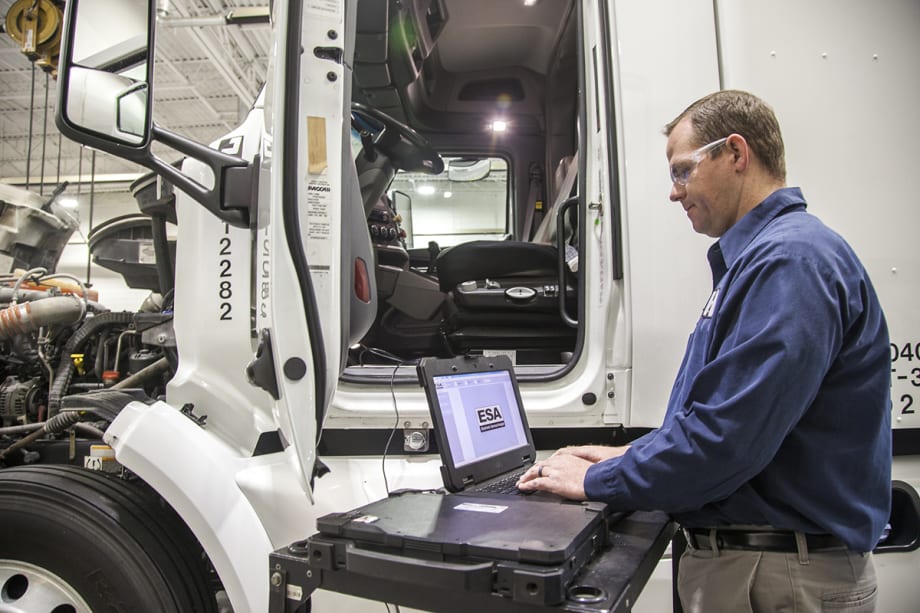
Photo: PacLease
5 min to read
Truck connectivity is still in its infancy, but there are already tangible benefits being enjoyed by the trucking industry.
“It may seem like we’ve been collecting data for a long time, but we’re really just getting started,” said Doug Caley, Paccar engineering manager, when speaking at Trimble’s in.sight user conference.
But while connectivity may still be in the early stages — connected trucks have only been on the road for about five years — it has already had a profound impact on how trucks are diagnosed and serviced.
Managing Service Events
Connected trucks are able to streamline early diagnostics and triage processes when fault codes appear.
“It’s a really fundamental change to the way trucks have been serviced,” Caley said. “In the past…(technicians) didn’t really start on that truck until it rolled in and they could see what color that truck was before getting started on it.”
Next, it would be hooked to a diagnostic tool and troubleshot before the technician could recommend a course of action. Today, connected trucks submit health reports from the road. Technicians can evaluate the problem before the truck arrives at the shop, and when the truck arrives for repairs, the problem has already been identified and the necessary parts procured. But Caley acknowledged not all repair centers are used to this new norm, and may require some coaching from the fleets.
“This is not normal behavior for a dealer or repair facility,” he said. “Sometimes it takes some push from the customer to say, ‘I have this truck coming in, be ready for when the truck comes in so you can expedite that repair and minimize the amount of time.’”
Connected Truck as a Communication Tool
The connected truck can also improve communications between the end user, dealer, repair facility, and OEM.
Caley explained in the case of remote diagnostics, small nuggets of data are being pulled from the truck and fed into a “reasoning engine.” There, machine learning combines the data from that specific truck with information collected from historical failures and the broader truck population and makes a calculation on what could be wrong with the truck and what it will take to fix it. The diagnosis is shared with the fleet manager, dealer or technician, and the truck manufacturer itself.
Assisting with Truck Down Decisions
The connected truck can also assist with truck down decisions to reduce downtime.
Caley gave a real life example of a P011A fault code indicating a stalled coolant pump, which can cause the truck to overheat and damage the engine. But it could also be much less serious sensor failure, which wouldn’t necessitate an immediate repair.
“What do you do with that truck? You can pull over right away and call a tow truck,” Caley noted. “Or you can make the decision to run with it until you’ve either completed the load or, potentially to your next PM cycle. There is a lot of difference in the cost and impact to your business depending on which one of those decisions you make. The goal of remote diagnostics is to allow you to make that decision and to choose the decision that keeps that truck on the road as long as possible.”
In the case of the stalled coolant pump fault code, “Someone who knows how to read it can see what the temperature was doing,” Caley explained. “If the coolant pump stopped circulating, you will see coolant temperatures rising. If it’s rising, you really don’t have any choice but to tow that truck in – the engine is no longer cooling properly.”
In that case, a fleet is looking at one or two days of downtime to get the truck repaired at the nearest repair facility and has to cover the load. If, on the other hand, the engine temperature isn’t rising, it is likely a faulty sensor. That can be quickly confirmed by a technician and the truck sent back on its way.
“The difference is between a couple of days of downtime, and a couple hours of downtime,” Caley said.
Over-the-Air Updates
Connected trucks can receive software updates over the air, eliminating a visit to the shop.
“Over-the-air updating saves a lot of steps,” Caley said. Rather than bringing the truck to the dealer and needing a diagnostics session to determine if an update is available, drivers now receive a notification when an update is ready and can perform the update themselves while parked in a safe location.
“What could be a trip to the dealer can be a very quick repair,” said Caley.
Predictive Diagnostics
In addition to collecting data from your own trucks, OEMs are also feeding that data into a larger database with their full population of vehicles where machine learning can be used to begin predicting failures before they happen.
“Now we can say, we recognize these symptoms. Nothing has failed yet, but it’s going to fail based upon those symptoms,” said Caley. “That’s the holy grail of doing this. We can watch all these trucks and predict what’s going wrong long before it does and do that repair in a PM cycle rather than having to take the truck off the road.”
The challenge, however, is ensuring they’re right. Recommending fleets pull parts before they’ve actually broken won’t sit well if those parts weren’t, in fact, on the brink of failure.
“We don’t want to say, ‘Hey, change this part,’ and be wrong,” Caley said. “We have to be very confident that yes, that part really does need to be changed. That’s what we’re working towards – being able to predict failures before they happen.”
The collection of all this data also allows OEMs such as Paccar to improve enhanced vehicle guidance, or user recommendations, to improve uptime. And ultimately, it will help them build more reliable trucks in the future since they can identify problematic trends across a broad population of vehicles.
More Maintenance

Sponsored•September 16, 2026
Color Match Smarter: Tools That Restore & Perform
For fleet managers and collision repair professionals keeping heavy-duty trucks on the road, getting the color right the first time isn't just about appearance — it's about efficiency, turnaround time, and bottom-line results. Discover how today's digital color tools are transforming the repair process from guesswork to precision.
Read More →
Wrong Repair Prompts Recall of Freightliner, Western Star 4x2 Trucks
DTNA is recalling more than 2,400 trucks that received an incompatible software fix instead of the hardware repair required to address brake valve corrosion.
Read More →
Truck Drivers Need More Than Another Alert
Fleets have more visibility into truck health, safety events, and driver activity than ever. The next challenge is turning all that information into useful guidance for the person who has to decide what to do next.
Read More →
The Maintenance Checks Trucking Fleets Should Prioritize Before Fall Freight Picks Up
Making it through August isn’t the same as being ready for the next several months of operation. Find out what systems may have suffered from summer heat and need to be checked out before fall.
Read More →
What Three Fleets Are Doing Differently When Buying Truck Parts in 2026
With freight improving but costs still climbing, fleet maintenance executives explain how they're balancing price, quality, and supplier relationships.
Read More →
Paccar Recalls 2027 Trucks Built This Summer for Possible Electrical Problem
The nearly 6,000 Kenworth and Peterbilt trucks in the recall could potentially lose engine power, among other things.
Read More →
Will API PC-12 Oil Change Trucking Fleet Maintenance?
The new API PC-12 heavy-duty engine oil category reflects the changing demands of modern diesel engines. But fleets like Foodliner are looking to getting their own data before making decisions on adopting the new oils and questions such as extending oil drain intervals.
Read More →
Brake Safety Week to Focus on Drums and Rotors
Commercial vehicle inspectors are focusing on truck brakes during CVSA's Brake Safety Week, August 23-29.
Read More →Possible Battery-Cable Fires Prompt Recall of 15,000+ International MV and HV Trucks
On the recalled vehicles, manufacturing variations can cause the battery interconnect cable to contact the auxiliary stud and hold down the bracket.
Read More →
Rush, MCT Team Up to Grow Refrigeration Service Network
The joint venture will operate MCT's network of Carrier Transicold dealerships and mobile service locations, with the companies promising greater service capacity and uptime for refrigerated fleets.
Read More →