





“The trucking industry finds itself suspended in midair, waiting to see how these complex forces will unfold."
Facing a Foggy Supply Chain Landscape, Carriers Must be Able to Adapt Quickly
In today’s uncertain supply chain, adaptability isn’t optional. The annual State of Logistics Report offers insight for trucking companies in this time of global disruption.
June 3, 2025

The annual State of Logistics report, "Navigating Through the Fog,” reflects the fact that what is true today may not be true tomorrow in this rapidly changing landscape.
Image: HDT Graphic
7 min to read
With uncertainty continuing to shake global trade and freight markets, it may be tempting for trucking and logistics businesses to wait for things to settle down. But the latest State of Logistics report warns that the real danger lies in standing still.
To succeed in this environment, companies need to stay flexible, act quickly, and make smart use of technology to handle whatever comes next.
The annual State of Logistics Report, created for the Council of Supply Chain Management Professionals by consulting firm Kearney and presented by Penske Logistics, looks at the American economy through the lens of the logistics sector.
The name of this year’s report, “Navigating Through the Fog,” reflects the fact that what is true today may not be true tomorrow in this rapidly changing landscape.
Still Waiting for the Tide to Turn
Last year’s report found the industry “waiting for the tide to turn,” with companies forced to navigate “the certainty of uncertainty” and expecting to find some visibility heading into 2025.
They did not.
“As the fog thickens, the logistics industry must move beyond short-term fixes and fundamentally rethink resilience — not as a luxury, but as a strategic imperative embedded in networks, technology, and decision-making,” said Korhan Acar, Kearney partner and lead author for the State of Logistics Report, in a meeting discussing the report results on June 3.
“In a world defined by disruption, resilience is what ensures continuity, enabling agility and long-term durability. And as AI and automation drive down the cost of building resilient supply chains, the greater risk now lies in standing still.”
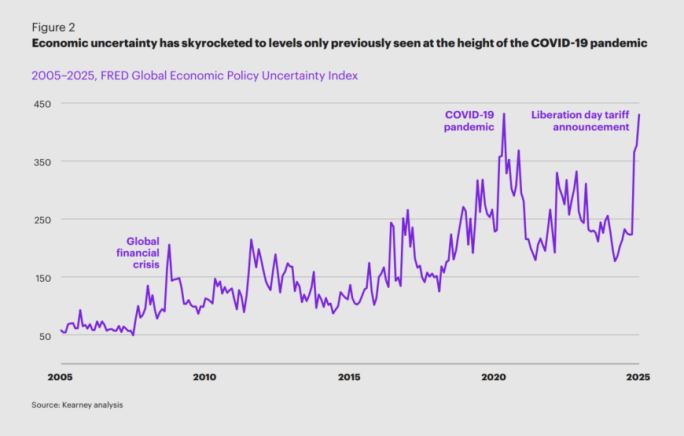
Economic uncertainty is making it extremely difficult for logistics businesses to plan.
Source: Kearney
How Tariffs Are Upending Global Logistics
The outlook for global economic growth is overall fairly stagnant, Acar said, but global trade flows are not. Because of the situation with tariffs, global supply chains and corridors are changing.
“One thing we know is global trade corridors in the world will not be the same as before,” he said.
That doesn’t necessarily mean a widespread return to U.S.-based manufacturing, as some policymakers — including the Trump administration — had hoped tariffs would encourage.
Acar pointed to a survey of CEOs on how they are addressing these global disruptions.
“At first when the tariff conversation started, we were all thinking [moving production closer to the U.S.] would be at the top of CEO’s agenda,” he said.
It’s not.
Only 24% of the survey respondents cited moving production closer.
The first thing CEOs said they were looking at is “friendshoring” — switching to suppliers in countries that are aligned politically, at 36%.
That was followed by creating parallel supply chains, expanding into politically neutral markets, and reducing the number of markets.
Acar explained that there are only certain products where moving production closer makes sense. For other products, even high tariffs aren’t worth the additional costs of moving production closer.
The World Trade Organization has forecast that global trade could contract 0.2% this year. The decline is anticipated to be especially dramatic in North America, where exports could fall 12.6% and imports by 9.6%.
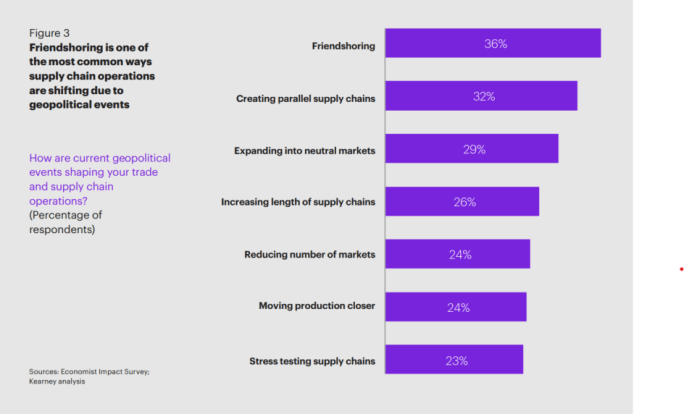
Bringing production back to the U.S. was not high on the list of how companies were being affected by the geopolitical instability in this survey of CEOs.
Source: Kearney
The State of Motor Carriers
In 2024, said the report, the motor carrier sector began stabilizing after years of volatility. Spot and contract rates for truckload modestly declined throughout the year.
But with escalating global geopolitical tensions, said the report authors, “The trucking industry finds itself suspended in midair, waiting to see how these complex forces will unfold."
According to DAT Freight & Analytics, the national average spot rate for dry van shipments in April 2025 was $1.96 per mile, down from $1.99 per mile a year earlier. Contract rates averaged $2.40 per mile in April, down from $2.46 a year earlier.
Sluggish demand and continue overcapacity in the trucking industry are keeping rates low.
The low rates and rising costs in areas such as insurance and maintenance have not pushed as many carriers out of the industry as some had expected. However, carrier exits did accelerate toward the end of the year among smaller operators, as carrier profitability fell to its lowest level since 2010 last year.
Because contract rates typically follow spot market rates, Korhan said, there was an expectation that contract rates would go even lower.
“But my conversations with the majority of the shippers I know was that pushing carriers to below a $2 mark is not going to be healthy and will start to cause some performance issues. That’s why I think contract rates stayed somewhat relatively over that $2 mark.”
Until we see higher shipping volumes or tighter capacity, don’t expect any significant upward movement in rates.
Target’s Brendan Dillon offered a shipper perspective during a panel discussion of the report:
“I think the report clearly details that freight rates remain low, and clearly that’s not a long term sustainable dynamic for the industry,” said Dillon, who is senior vice president of global inventory management, transportation and trade for Target.
“Our strategy at Target is to not be a low-cost shipper, but to be market competitive,” he said, outlining a “portfolio approach” with a mix of transportation providers.
“We really lean into long-term carrier relationships,” he said. Currently, the company is leaning more toward longer-term contract rates and investments in its private fleet.
How Can The Logistics Industry Cut Through the Fog?
With a sluggish global economy keeping freight demand weak, higher interest rates and higher inflation, and all the uncertainty surrounding trade policy, it’s imperative for businesses to be able to adapt swiftly.
Paul Bingham, director of transportation consulting for S&P Global Market Intelligence, said that the uncertainty is so high, “there’s no simple baseline [forecast] that we can say, ‘This is the most probable outcome.’”
So he’s telling clients to plan for multiple scenarios.
“And then it’s not just one and done. It’s continuous. This is a demand on all of us to monitor and to adjust much more quickly and continuously than we quite frankly feel comfortable with.”
Shippers are increasingly turning to third-party logistics providers to help navigate the challenges while improving efficiency and controlling costs.
As a result, 3PLs are expanding the scope of their services and using advanced technologies such as AI, automation, and data analytics.
“The shift from fixed routes and traditional cost-plus models to dynamic, variable routing and agile systems underscores the need for 3PLs to rethink their business strategies and shipper interactions,” said the report.
How Using Technology Can Help Companies Adapt Quickly
Both the report and the panelists emphasized technology such as artificial intelligence and automation as a key lever for resilience.
Logistics firms are increasingly looking to adopt AI for real-time inventory visibility and decision making, the report notes. Predictive analytics tools can analyze traffic, weather, and fuel prices in real time, allowing dispatch systems to adjust routes dynamically. AI-powered freight matching is helping eliminate empty miles.
Expect shippers to expand their use of AI as well. Automated rate analysis, quote generation, and compliance checks. Faster booking processes, better carrier selection, and increased transparency in freight spend. AI-driven demand forecasting helps companies anticipate shipping needs.
The report also said the rise of autonomous trucking could substantially disrupt the motor carrier market.
2024: The State of Logistics in Numbers
The report authors highlighted the following logistics trends and statistics in the report.
U.S. business logistics costs are $2.6 trillion, which amounts to 8.7% of the national GDP. Last year, the numbers were $2.3 trillion and 8.7% respectively.
The logistics industry in 2024 saw a return to pre-pandemic patterns in some areas, but was also marked by flat business volumes, excess truck capacity and rising operational costs.
E-commerce continues to move along at a brisk pace, with global online retail sales nearing $6.3 trillion, resulting in more efficient last-mile delivery, increasingly agile warehousing, and a stronger demand for air freight.
Geopolitical tensions, proposed and enacted tariffs, and shifting trade regulations around the world have combined to increase transit times, capacity constraints, rate volatility in ocean freight (leading to longer home package delivery times and delays), and a greater reliance on third-party logistics providers to deliver end-to-end support.
Mexico overtook China as the United States’ largest trading partner in 2024. Transactions between the U.S. and Mexico hit a record $840 billion, a 6% year-over-year improvement.
Technology investment continues to be an essential component of the modern supply chain. Data analytics, artificial intelligence, as well as robotics and automation are among the headliners supply chain leaders are working on.
More Fleet Management

Sponsored•September 16, 2026
Color Match Smarter: Tools That Restore & Perform
For fleet managers and collision repair professionals keeping heavy-duty trucks on the road, getting the color right the first time isn't just about appearance — it's about efficiency, turnaround time, and bottom-line results. Discover how today's digital color tools are transforming the repair process from guesswork to precision.
Read More →
FMCSA Pauses Biennial-Update Enforcement Amid Motus Transition
Carriers whose updates were due on or after June 1 have more time, while FMCSA works to stabilize its new registration system and warns of phishing sites impersonating its new carrier registration system, Motus.
Read More →
Sponsored•September 14, 2026
2026 Blueprint for Countering Smarter Supply Chain Theft
Cargo theft is no longer just the cost of doing business. It's a multi-billion-dollar criminal enterprise exploiting vulnerabilities across your fleet, drivers, and supply chain.
Read More →


Sponsored•September 1, 2026
How Telematics Improves Visibility, Control, and Performance in Refrigerated Fleets
Explore how telematics help refrigerated fleets improve visibility, uptime, efficiency, compliance, and cargo protection across connected cold chain operations.
Read More →
What the U.S.-Canada Trade War Means for Trucking
Escalating U.S.-Canada tariffs could disrupt cross-border freight, reduce truck volumes, raise costs, and create new uncertainty for carriers on both sides of the border.
Read More →
What Are Trucking’s Top Concerns for 2026?
The American Transportation Research Institute wants to know what's worrying trucking fleet managers, drivers, and other stakeholders in its annual Industry Issues survey.
Read More →
American Trucking Associations Looks for a New Leader
ATA President and CEO Chris Spear abruptly left his job at the association on August 21, at a pivotal time for the trucking industry.
Read More →
Public Wi-Fi Cybersecurity Risks: How Truck Drivers and Fleets Can Protect Their Data
Public Wi-Fi can expose truck drivers and fleets to credential theft, malware, and other cyber threats. Here’s how to reduce the risk on the road.
Read More →
For Nicky Cupp, Fleet Innovation Starts With Frustration
HDT Truck Fleet Innovator Nicky Cupp turns everyday pain points at Fraley & Schilling into opportunities for better technology and smarter processes.
Read More →
Adam Buttgenbach’s Approach to Electric Trucks: Start With Where They Fit
HDT Truck Fleet Innovator Adam Buttgenbach helped PepsiCo build one of North America’s largest EV fleets by focusing on where electric trucks make operational sense.
Read More →