





Related: NACFE Report Outlines Benefits of Regional Haul Routes
EPA Adds SmartWay Day Cab Program, Revises Retread Tire Specs
The Environmental Protection Agency is making some changes to its SmartWay program that offers information on verified fuel-efficient technologies. Day cabs are now eligible for the SmartWay designation, and research into fuel-efficient retreads will result in changes to how those products are classified.
July 9, 2019
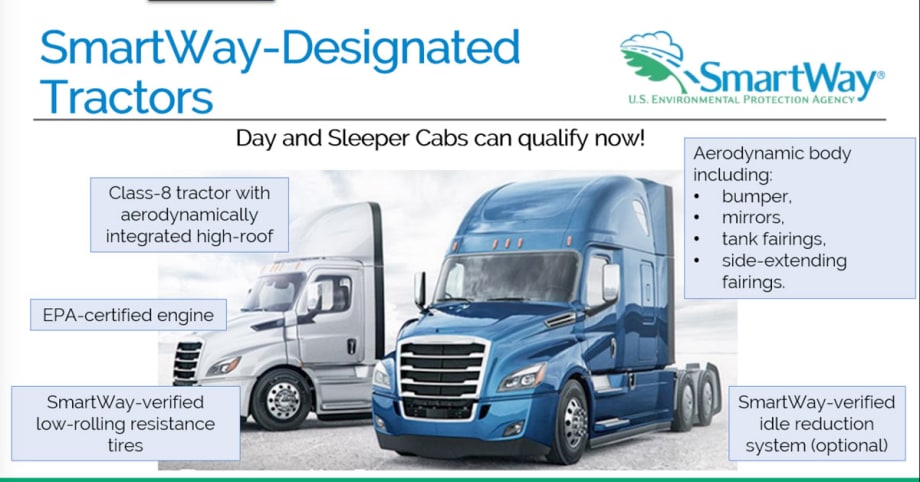
Fleets running fuel-efficient regional day cabs can now get their trucks recognized by SmartWay.
Credit:
EPA presentation
4 min to read
The Environmental Protection Agency is making some changes to its SmartWay program that offers information on verified fuel-efficient technologies. Day cabs are now eligible for the SmartWay designation, and research into fuel-efficient retreads will result in changes to how those products are classified.
EPA officials outlined the developments in a July 9 webinar.
SmartWay day cabs
Responding to requests from SmartWay fleet partners and recognizing a growing trend toward increased regional trucking, EPA has expanded the SmartWay designation program to include both day cabs and sleeper cabs.
The agency expects SmartWay day cabs will be used in regional-haul operations where trucks travel longer daily distances but are still home every night, where operations lend themselves to low-rolling-resistance tires and cab aerodynamics. They don’t predict much penetration of this into specialty areas such as beverage delivery or port drayage.
EPA originally focused on long-haul sleeper cabs because that’s where the bulk of the fuel was consumed.
“What we found as we continued our research was the same low-rolling-resistance and aerodynamic technologies were having an impact even on day cabs, specifically with configurations that are high-roof and tend to match well with a box trailer," explained Sam Waltzer, SmartWay technology team leader within EPA's Technology Assessment Center. "We found they can still make a difference.”
Even when regional trucks aren’t traveling at highway speeds, these technologies can still make a difference, if not as great a one as vehicles that spend most of their day on the open road, he said.
EPA has been evaluating the fuel-savings performance of these technologies at different speeds and found that aero devices still offer savings at speeds of 40-50 mph, but they may be half as much as with vehicles traveling at highway speeds. And rolling resistance is still a factor at all vehicle speeds – although the fuel savings may not be as great, and there may be more trade-offs in these applications that need to be considered.
Today, there are a large variety of low-rolling-resistance tires, and fleets should not just accept the standard regional-spec that comes on the truck as the best option. If you are using day cabs and lower-speed operations, said EPA officials, look at different types of low-rolling-resistance tires compared to what you have on your tractor. That's because you very well may be able to get substantial fuel savings from low-rolling-resistance tires, new or retreads.
One difference from the day cab specs is idle reduction. Sleeper-cab fleets have the option of explaining the alternate strategies they’re using to reduce idling if they don’t install idle reduction equipment such as auxiliary power units or battery-powered air conditioning. For day cabs, where overnight sleeping is not a factor, this isn’t required – although EPA officials noted that there still can be benefits to providing idle-reduction technologies for day cab operators that may have prolonged wait times.
EPA officials noted that these programs are “living” and change as the industry changes, and that things such as idle reduction, or length of chassis cab fairings, could be addressed in future versions of the program.
SmartWay retreads
When EPA first worked to add retreads to its program, it was a challenge to quantify the relative fuel efficiency of a two-part system. How much fuel savings was from the tread itself, and how much from the casing? The agency developed an “interim retread protocol” by which all retreaders tested their treads on the same model casing that they felt represented a typical tire: an American-made Yokohama Super Steel RY-617 in size 295/75R22.5.
In an effort to keep up with the changing market, a couple of years ago, EPA started doing some of its own testing on retreads applied to different casings. “We recognized that common industry practice is to apply retreads to any retreadable tire,” said Dennis Johnson, Technology Assessment Center Director in EPA's Transportation and Climate Division. “What we’ve demonstrated is that when you apply different low-rolling-resistance treads to commercially available casings, we’re seeing comparable fuel savings to new low-rolling-resistance tires.”
The agency is developing new protocols, proposing that it get away from using a standard casing. Instead, it will allow the retreader to choose a casing from a SmartWay-verified new tire when they do their testing. “The expectation is these low-rolling-resistance retreads will be able to achieve comparable performance to the new tire target value," Johnson said.
EPA hopes to have the final retread protocols finalized by the end of 2019.
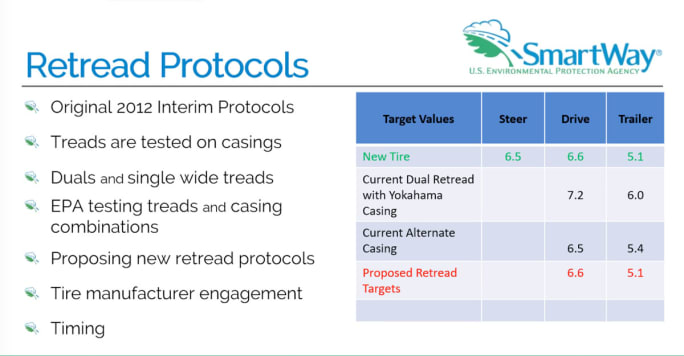
EPA is proposing a new protocol for verifying retreads under SmartWay.
Credit:
EPA presentation
Reefer research
Another area of SmartWay research is refrigeration units for trailers. EPA is testing transportation refrigeration units in climate chambers and looking at the potential for fuel savings from plugging in reefer trailers, as well as looking at how that balances with the increased electrical consumption. It is “in the throes” of the test program and hopes to publish its research within the next year to help the industry understand the return on investment and the potential impact on electrical consumption.
More Fuel Smarts

How Volvo Updated Its D13 for EPA 2027 [Watch]
Volvo’s updated D13 promises lower emissions without sacrificing performance or fuel economy. Take a closer look at what changed inside the engine in this HDT Spotlight video.
Read More →
Diesel Price Spike Shortens Payback for Natural Gas Trucks, Report Says
Energy Vision estimates fleets could recover the higher purchase price of an RNG-fueled Class 8 tractor in 1.3 to 2.8 years under current fuel-price scenarios.
Read More →
Calstart Becomes Catalyst Mobility, Reflecting Broader Focus
Calstart is now Catalyst Mobility, reflecting the nonprofit’s growing national role in clean transportation, including zero-emission trucks, infrastructure and incentive programs.
Read More →

Record Diesel Prices Squeeze Trucking Fleets
Average U.S. diesel prices have climbed to nearly $6 a gallon, surpassing the 2022 record as tight refinery capacity and Middle East disruptions keep fuel costs elevated.
Read More →
Sponsored•September 9, 2026
How Fuel Delivery Shapes Engine Performance
Fuel delivery depends on more than what happens at the injector. For fleet, maintenance and technical professionals, looking at the full path from pump to injector can provide useful context for understanding engine performance.
Read More →
East Coast Port Launches $45M Electric Truck Push
The Port Authority of New York and New Jersey announced millions in incentives for zero-emission drayage trucks, yard tractors, and new charging hubs near the port.
Read More →
California Bill Could Shed Light on Electric Truck Prices
Why do battery-electric Class 8 trucks remain so expensive? A California bill headed to Gov. Gavin Newsom would give fleets and state agencies more visibility into what manufacturers charge.
Read More →
Detroit Opens Orders for EPA 2027 Engines
Detroit isn’t starting from scratch to meet EPA 2027 diesel emissions standards. Its Gen 6 DD13 and DD15 engines keep much of today’s platform while updating the fuel and aftertreatment systems.
Read More →
Zero-Emission Truck Corridor Planned for West Coast
California, Oregon, Washington, British Columbia and Baja California are coordinating plans for truck charging and hydrogen fueling from Canada to Mexico.
Read More →
A Closer Look at Kenworth’s Electric T880E Vocational Truck [Video]
Learn more about Kenworth's T880E battery-electric vocational truck at the Paccar Technical Center, including its range, applications, upfitting considerations, and PTO options, in this HDT Spotlight video.
Read More →