





Related: Regional vs. Long-Haul Tires
Sustainable Tires: Reduce, Reuse and Recycle
Making tires more environmentally friendly involves everything from finding rubber alternatives to retreading and recycling.
March 15, 2019
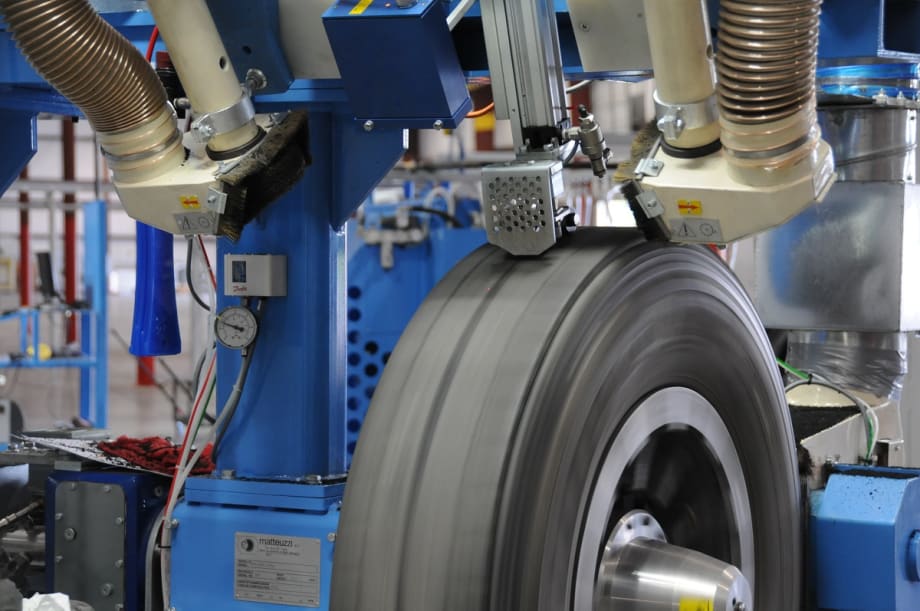
Continental estimates that it collects about 14 pounds of rubber buffings for each retread it produces. The material is collected by vacuum at the head of the buffer, and then reused in new tire production.
Photos: Jim Park
6 min to read
Sustainability is no longer just an annoying buzzword. People really care about it now, and some of those people might be shareholders in your company, or may be your customers. Some of the latter are now insisting that their supply chain partners take a proactive approach to sustainable business practices.
Electric trucks are currently making a big splash in the market as some fleets look to them as a way to be more sustainable. Yet many of those same fleets may overlook the potential for enormous cost savings and waste reduction from using retreaded tires.
In many cases, a Tier 1 on-highway tire can be confidently retreaded at least three times, sometimes four or even five times. Each time a tire is retreaded it cuts the lifecycle cost of the original tire by more than a third, and it reduces replacement-tire costs by more than half on a per-unit basis. According to Bridgestone, a rigorous retreading program can reduce a fleet’s overall tire costs to less than 1.5 cents per mile compared to the industry average of around 3-4 cents per mile. And of course, each time a tire is retreaded, one less tire carcass winds up in a landfill site.
“This helps to defer millions of tires from landfills, putting them back into service and enabling them to continue to run for thousands more miles,” says LaTres Jarrett, director of marketing for Bandag, Bridgestone Americas Tire Operations.
Tires are not only a major source of landfill congestion. On the front end, they require vast quantities of renewable and non-renewable resources such as rubber and petroleum. One retread saves 15 gallons of oil during the manufacturing process compared to a new tire, Jarrett points out. “If approximately 15 million tires are retreaded each year, that adds up to about 225 million gallons of oil saved annually.”
According to the U.S. Environmental Protection Agency, retreads contain 75% post-consumer recycled material and save almost 40 pounds of raw materials per tire, including rubber, steel, and carbon black. Retreading truck tires in the U.S. reduces carbon emissions by 396,000 tons annually, since the retreading process generates 70% fewer emissions than production of a new tire.
But retreading isn’t the only way tires are becoming more environmentally friendly.
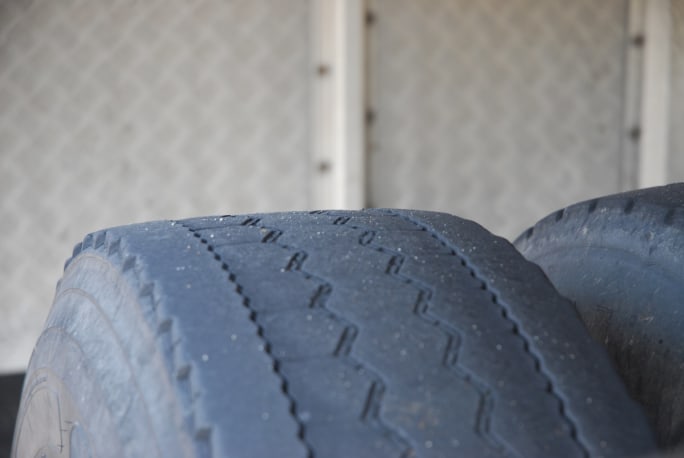
Tire treads run down to the legal minimums (2/32 on drive and trailer tires and 4/32 on steer tires) are at greater risk of casing damage in their final weeks of life. Pulling them at 6/32 greatly increases your chances of successfully retreading that valuable casing.
Recycling and rubber alternatives
Some tire makers are making strides in reducing more of their environmental footprint by developing manufacturing and recycling processes that could eventually see as much as 80% of the content of a new tire coming from material recycled from previously used tires.
Previously, used tires were processed into technically inferior products such as floor mats, were hauled off to landfills, or were simply incinerated.
According to Michelin, the present worldwide recovery rate for tires is 70% and the recycling rate is 50%. The company announced last summer that within 20 years, when its renewable and recycling ambitions are fully realized, it will be using 80% sustainable materials in the manufacturing of its products and 100% of tires will be recycled.
Continental is now operating a plant in Hanover, Germany, that combines technically advanced tire retreading operation with an industrial-scale rubber-recycling unit. Using a proprietary process, Continental has succeeded in recycling rubber from used tires in such a way that the raw material will be directly returned into the production cycle for new or retreaded tires. Continental is currently using 3% recycled material in tire production and says it will be at 10% by 2025.
In addition, several major global tire manufacturers are now developing alternatives to natural rubber, such as rubber latex generated from the Russian dandelion plant, or Taragaxum. Others are experimenting with a cultivated plant called Guayule. While natural rubber is a renewable resource and not endangered, demand for rubber products is pressuring growers to expand operations in sensitive ecosystems in tropical regions.
By developing alternatives that can be grown in Europe and North America, tire makers also can shorten the supply chain, reducing the carbon footprint from transportation. It will also reduce the impact of deforestation in regions where traditional rubber is produced.
Continental has produced service-ready tires made with Taragaxum and they are now in the testing phase.
Tier 1 vs. Tier 4
But there’s a big black hairy fly in all this green ointment: cheap but crappy imported tires. These Tier 4 tires are on the market now, and they sell for about half the price of a Tier 1 tire — because they are half the tire. Miles to removal are usually much lower, the engineering hasn’t gone into tread design and compounding so wear is usually worse, and despite claims that some of these tires are on the EPA’s SmartWay list, few of them perform the way a Tier 1 tier does.
On top of that, they are 65% less likely to be retreaded than a Tier 1 tire. The use of Tier 4 tires in the replacement market has increased by 13% between 1998 and 2016, while premium new replacement tires have declined 4%, according to the report “Retread Tires in the United States & Canada: An Analysis of the Economic & Environmental Benefits for Fleet Operators and the U.S. Government,” co-authored by The University of Michigan Transportation Research Initiative and several other universities. More dramatically, the use of retreaded tires has declined by 10% over the same period.
The decline in retread sales isn’t good for anybody. Those Tier 4 tires can’t be recycled into new tire production because the material quality isn’t there, and they generally can’t be retreaded, either. So they wind up in landfills at a rate of three or four cheap tires to one premium tire retreaded three times.
“It’s a pretty short-sighted decision to buy Tier 4 product instead of Tier 1 or Tier 2 product,” says John Barnes, head of Continental’s ContiLifeCycle (Retreading) for commercial vehicle tires in the Americas region. “The value for the consumer just isn’t there when you do the math. At about $250, they are more expensive than a retread, yet they are about half the price of a new premium tire. But when you consider the cost of one premium tire retreaded a few times to run three-quarter of a million miles versus the four Tier 4 tires you’d need to go the same mileage, you’re upside down.”
Retread supporters, led by Marangoni Tread North America, have been trying to educate customers and legislators alike with the “Retread Instead” campaign, which promotes the environmental and economic benefits of retreading tires instead of buying, selling and running low-quality tires that cannot be retreaded. It promotes the durability of retreads, the environmental impact of non-retreadable truck tires, the need to conserve natural resources, as well as the economic impact of the thousands of U.S. jobs in retreading and related industries.
When selecting tires, look carefully at the total cost of that tire, from the acquisition cost to the total lifecycle cost, as well as the environmental cost of the tire. Tires that can be retreaded and don’t provide the longest miles to take-off may seem cheap on the front end, but we’ll all pay the price for their use in the long run.
Subscribe to Our Newsletter
More Equipment

How Volvo Updated Its D13 for EPA 2027 [Watch]
Volvo’s updated D13 promises lower emissions without sacrificing performance or fuel economy. Take a closer look at what changed inside the engine in this HDT Spotlight video.
Read More →
Michelin Tire Improves Efficiency and Durability for Regional Fleets
The Michelin X Multi Energy D2 is a regional haul drive tire engineered to help fleets improve fuel efficiency, durability and traction in demanding stop-and-go operations.
Read More →
ZF Expands Commercial Vehicle Push in North America
ZF is expanding its North American commercial-vehicle presence with new transmission applications, electrification, trailer technology and autonomous-driving systems.
Read More →
Tesla Wants a Self-Driving Semi. Are Cameras Enough?
Could Tesla’s camera-only autonomous driving technology work on an 80,000-pound Semi? In this commentary, HDT's Deborah Lockridge takes a look at Tesla, Cybercab, and how autonomous trucks see the road.
Read More →
Kodiak: Driverless Long-Haul Truck Launch on Track for 2026
Kodiak AI says its driverless long-haul safety case is 93% complete and it remains on track to begin commercial operations by year-end 2026.
Read More →
What DOT’s Automated Vehicle Strategy Means for Trucking
The U.S. Department of Transportation issued a new automated-vehicle strategy that outlines plans for driverless-truck regulations, cross-state freight corridors, and federal safety standards.
Read More →
East Coast Port Launches $45M Electric Truck Push
The Port Authority of New York and New Jersey announced millions in incentives for zero-emission drayage trucks, yard tractors, and new charging hubs near the port.
Read More →
PlusAI Going Public to Fund Autonomous Truck Launch
A SPAC deal could provide PlusAI with up to $300 million as it works toward a 2027 commercial launch of factory-built autonomous trucks.
Read More →
NHTSA Moves to Rewrite Truck Fuel-Economy Rules
The National Highway Traffic Safety Administration says it lacks authority to regulate medium- and heavy-duty truck engines separately from complete vehicles, but the existing standards have not yet been eliminated.
Read More →
Detroit Opens Orders for EPA 2027 Engines
Detroit isn’t starting from scratch to meet EPA 2027 diesel emissions standards. Its Gen 6 DD13 and DD15 engines keep much of today’s platform while updating the fuel and aftertreatment systems.
Read More →