Heavy Duty Trucking Logo
MenuMENU
SearchSEARCH

Retreads May Soon Be On SmartWay's Green List

Have a look at the list of U.S. EPA SmartWay approved low-rolling-resistance, fuel-efficient tires and you'll notice there are no retreads on the list.

Jim Park
Jim ParkFormer HDT Equipment Editor
Read Jim's Posts
July 12, 2010
Retreads May Soon Be On SmartWay's Green List

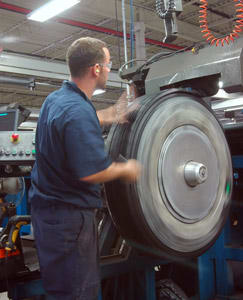
What constitutes a fuel-efficient retreaded tire? An industry committee could soon have the answer. (Photo by Jim Park)

4 min to read


Have a look at the list of U.S. EPA SmartWay approved low-rolling-resistance, fuel-efficient tires and you'll notice there are no retreads on the list.

Ad Loading...

They are absent because of the difficulty in quantifying the relative fuel efficiency of a two-part system. Like tractor and trailer braking systems, casing and treads are designed to work together, but a host of variables in both cases makes objective measurements a challenge. Of late, there has been a lot of interest in getting retreaded tires onto the SmartWay list. We should see them there soon, possibly as early as 2011.

Historically, tire manufacturers and retreaders individually provided EPA with data on their retreads, but they often used different test methods. Left to sort the data out for itself, EPA concluded it needed more consistency across the tests and the results in order to make a decision. So, a committee of tire manufacturers from within the Rubber Manufacturers Association was formed and charged with developing a single test method and a reporting system to help EPA sort out the multitude of treads and casings on the market that could conceivably one day become a single retreaded tire.

Ad Loading...

Part of the challenge has been defining the "retreaded tire" within the SmartWay context. Is it the casing you measure, or the tread? Kyle Jensen, manager of industry and government relations at Bridgestone Bandag Tire Solutions, says while measuring the rolling resistance contribution of the tread alone is difficult enough, measuring casings is equally complex.

"Each retreaded tire is a unique product because of the history of the casing," he says. "Given its age, previous applications, etc., achieving rolling resistance values for each casing would not be easy."

Without a precise definition of a retreaded tire in this context, the default position is that a SmartWay casing should be the basis for a SmartWay retread. That, however, could allow any tread - even a deep lug tread - to be used on a SmartWay casing, and thus be considered a SmartWay retread. That's clearly not the desired outcome.

Typically, the casing accounts for less than half of the tire's efficiency, and there generally isn't a great deal of difference across casing brands of similar design and application. The tread, most agree, has a greater effect on rolling resistance.

"Most of the casing is steel. You can't do much with that," says Roger Stansbie, director of radial truck tire technology development at Continental Tire. "It's the rubber surrounding the steel where you can fine-tune some minor improvements. When we develop a low-rolling-resistance tire, what we're doing is refining the tread compound and the tread design."

Ad Loading...

The RMA committee is working on the premise that if you de-emphasize the role of the casing - after establishing a rolling resistance standard for applicable casings - and work toward an objective rolling resistance measurement for tread designs and compounds, you'd have a more objective way of determining the fuel efficiency of a retreaded tire.

Larry Tucker, marketing manager for commercial tires at Goodyear, is a member of the RMA committee examining this situation. He says EPA is looking for a way to define a tire that meets its greenhouse gas reduction objectives, and industry is stepping up the plate to help.

"We are going to decide on which test method, what wheel position, and what testing criteria is needed to provide accurate data on rolling resistance by wheel position, by tread design, and by casing," he says. "It will be our responsibility to give the EPA the data it needs to make informed decisions in setting the target values."

Assuming the committee is successful, the next step would be to develop a common mark manufacturers can use to certify their retreads to SmartWay standards. "We have to identify a 'retreaded tire,' which includes the casing and the tread. The marking will have to go on the face or the shoulder of the tread," Tucker says.

"Once we have collected sufficient data on retread tires, our intention is to analyze the data to better understand the range of rolling resistance for retread tires, the effect of the casing on retread tire rolling resistance, and even the effect of the tire retread process itself on retread tire rolling resistance," says Dave Ryan, spokesman for SmartWay. "We need to understand these factors before we can establish retread tire criteria for SmartWay."

Ad Loading...

If the RMA committee is successful in establishing a measuring system for tire treads that opens the doors to using retreaded tires on any casing – not just SmartWay casings – fleets facing a looming deadline in California will be heaving a huge sigh of relief.

To qualify under the California Air Resources Board rules right now, only SmartWay-certified casings can be used for approved retreaded tires, says Michelin's Baldwin. There just are not enough casings from SmartWay-approved tires in the pipeline yet. If fleets have to buy new SmartWay tires in order to get into California, the budget impact will be huge.

"Our challenge as tire manufacturers, and the retread subcommittee, is to get the data EPA needs in a very timely fashion to they can make a decision in a very timely manner," notes Tucker.

Taking care of casings

If you ever wanted to build an economic argument for an aggressive maintenance program, just look at the value accrued from retreading a single casing two, three, or maybe four times. Sixty percent savings in tire costs is very compelling.

But you don't get value like that for nothing.

Pat Demianenko, national sales manager for retread systems at Goodyear, says the best way to optimize tire life when retreading is to pull them a little earlier than you would if you were just running them out.

"You want to protect the top belt of the tire, and prevent moisture from entering the casing through a puncture. If you leave a little more tread on the tire, you'll have an extra margin of safety," he explains. "We suggest pulling the tire with at least 6/32 of tread. You'll give up a little life on the original, but you'll gain a lot in retreadability."

Proper care throughout the life of the tire includes maintaining correct inflation pressure for the application, and prompt and proper repair of any damage. If you follow those guidelines, the casing could be retreaded two or three times in a long-haul application, and many more times in some applications, like refuse or other vocational services.

Each casing is carefully inspected prior to retreading, so any possible casing damage will be revealed. Your retreader can track your rejects, and you can use that information to spot weaknesses in your maintenance operation. You can look at brand and model performance, wear patterns, and previous damage, and then see trends.

Goodyear's G-tracks program allows fleets to track casings by brand, how many and what type of repairs have been made on the tire, how many times it has been retreaded, and if it had been rejected and why.

If you track your tires closely enough internally, you can trace it back to the specific truck and possibly even the wheel position for closer examination.


Subscribe to Our Newsletter

More Maintenance

A woman holding a tablet with a screen showing rectangles of various colors
SponsoredSeptember 16, 2026

Color Match Smarter: Tools That Restore & Perform

For fleet managers and collision repair professionals keeping heavy-duty trucks on the road, getting the color right the first time isn't just about appearance — it's about efficiency, turnaround time, and bottom-line results. Discover how today's digital color tools are transforming the repair process from guesswork to precision.

Read More →
Maintenanceby StaffSeptember 14, 2026

Wrong Repair Prompts Recall of Freightliner, Western Star 4x2 Trucks

DTNA is recalling more than 2,400 trucks that received an incompatible software fix instead of the hardware repair required to address brake valve corrosion.

Read More →
Illustration with driver behind the wheel, an alert sign, and a laptop
Driversby Lauren FletcherSeptember 9, 2026

Truck Drivers Need More Than Another Alert

Fleets have more visibility into truck health, safety events, and driver activity than ever. The next challenge is turning all that information into useful guidance for the person who has to decide what to do next.

Read More →
Ad Loading...
Illustration of truck going down road with orange overlay and the words "Maintenance Basics"
MaintenanceSeptember 2, 2026

The Maintenance Checks Trucking Fleets Should Prioritize Before Fall Freight Picks Up

Making it through August isn’t the same as being ready for the next several months of operation. Find out what systems may have suffered from summer heat and need to be checked out before fall.

Read More →
Graphic illustration of balancing quality and price with truck shop photo in the background
Maintenanceby Deborah LockridgeAugust 6, 2026

What Three Fleets Are Doing Differently When Buying Truck Parts in 2026

With freight improving but costs still climbing, fleet maintenance executives explain how they're balancing price, quality, and supplier relationships.

Read More →
Maintenanceby StaffAugust 3, 2026

Paccar Recalls 2027 Trucks Built This Summer for Possible Electrical Problem

The nearly 6,000 Kenworth and Peterbilt trucks in the recall could potentially lose engine power, among other things.

Read More →
Ad Loading...
Cover feature graphic showing concept engine oil art
Maintenanceby Deborah LockridgeAugust 1, 2026

Will API PC-12 Oil Change Trucking Fleet Maintenance?

The new API PC-12 heavy-duty engine oil category reflects the changing demands of modern diesel engines. But fleets like Foodliner are looking to getting their own data before making decisions on adopting the new oils and questions such as extending oil drain intervals.

Read More →
CVSA inspector photo in background with CVSA logo superimposed on top
Maintenanceby News/Media ReleaseJuly 31, 2026

Brake Safety Week to Focus on Drums and Rotors

Commercial vehicle inspectors are focusing on truck brakes during CVSA's Brake Safety Week, August 23-29.

Read More →
Maintenanceby Deborah LockridgeJuly 29, 2026

Possible Battery-Cable Fires Prompt Recall of 15,000+ International MV and HV Trucks

On the recalled vehicles, manufacturing variations can cause the battery interconnect cable to contact the auxiliary stud and hold down the bracket.

Read More →
Ad Loading...
Graphic showing Rush and MCT logos with blue tractor pulling white refrigerated trailer in the background
Maintenanceby News/Media ReleaseJuly 24, 2026

Rush, MCT Team Up to Grow Refrigeration Service Network

The joint venture will operate MCT's network of Carrier Transicold dealerships and mobile service locations, with the companies promising greater service capacity and uptime for refrigerated fleets.

Read More →