




EPA Outlines SmartWay Verification Program for Retreaded Tires
The U.S. Environmental Protection Agency has established a verification program for retreaded tires used on Class 8 line-haul trucks. Once a retreaded tire receives EPA certification, fleets using those tires will be compliant with CARB regulations for low-rolling-resistance tires
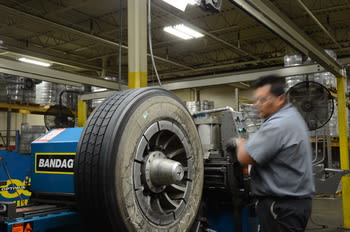
SmartWay approved retreaded tires are just around the corner. Photo by Jim Park.
The U.S. Environmental Protection Agency has established a verification program for retreaded tires used on Class 8 line-haul trucks. Once a retreaded tire receives EPA certification, fleets using those tires will be compliant with CARB regulations for low-rolling-resistance tires.
In a letter to tire manufacturers dated June 11, 2012, and obtained yesterday by Heavy Duty Trucking, the EPA outlined testing procedures manufacturers of retreaded tires must use to demonstrate fuel efficient performance of their product. The letter states that EPA will begin accepting applications for verification of retread products immediately.
According to EPA, "verified low-rolling-resistance retread products must provide reductions in fuel consumption of at least 3% as compared to the most popular retread products now in use."
There are currently no retreaded tires on the list of SmartWay approved low-rolling-resistance, fuel-efficient tires. That changes with this announcement.
Several problems have historically stood in the way of retread certification. First, a retread is a two-part system. The question that arises is which to measure, the casing, the tread, or both. Tire manufacturers and retreaders have provided EPA with data on their retreads, but they often used different test methods. Left to sort the data out for itself, EPA concluded it needed better consistency across the tests and the results in order to make a decision.
Matt Schnedler, retread product marketing manager at Bridgestone Commercial Solutions, said that while measuring the rolling-resistance contribution of the tread alone is difficult enough, measuring casings is equally complex.
"The complexity comes from the countless possibilities of casing and tread combinations," he says. "Therefore, it becomes very difficult to achieve rolling resistance values for all retreaded tires, as each combination is unique."
Without a precise definition of a retreaded tire in this context, the default position is that a SmartWay casing should be the basis for a SmartWay retread. That, however, would allow any tread -- even a deep lug tread -- to be used on a SmartWay casing, and thus be considered a SmartWay retread. That was clearly not the desired outcome.
Consistency in Testing
A committee of tire manufacturers was formed in 2010 from within the Rubber Manufacturers Association to develop a single test method and a reporting system.
Larry Tucker, marketing manager for commercial tires at Goodyear, and a member of the RMA committee examining this situation, said that EPA was looking for a way to define a tire that meets its greenhouse gas reduction objectives, and industry stepped up the plate to help.
"We had to decide on which test method, what wheel position, and what testing criteria would be needed to provide accurate data on rolling resistance by wheel position, by tread design, and by casing," he said. "It will be our responsibility to give the EPA the data it needs to make informed decisions in setting the target values."
The EPA letter describes the newly defined test casing as "an American-made Yokohama Super Steel RY-617 in size 295/75R22.5." It will be used for all treads with conventional-width tires used in dual configuration. The test casing chosen was selected by the industry panel, the letter says.
The test protocol requires three new unused casings to be prepared for retreading in a normal manner, but tread curing must be conducted at the "worst case" (time and temperature) condition allowed by the manufacturer.
Additionally, for retreads used on single-wide tires, manufacturers may use an alternate casing made from a current EPA-verified new single-wide tire. The letter provided no additional detail on the single-wide test casing. The test procedure allows results obtained from products with the same tread pattern (except fewer central tread rows and/or lugs) and rubber compound as a product verified with the test casing to be applied to the tread model sized for the single-wide casing.
Tests are to be conducted using a standard 8.25-in. test rim with the test tire turned against a 2-meter drum (or a mathematical equivalent) using the ISO 28580 method at 85% of the maximum load rating of the tire. The resulting rolling resistance coefficient is recorded and reported in the manufacturer's data submission to EPA.
EPA's testing procedure opens the door to using retreaded tires on any casing -- not just SmartWay approved casings -- which will come as a huge relief to fleets operating 53-foot dry van trailers in California. Those fleets currently face a shortage of SmartWay casings, which could have required fleets to use virgin Smartway tires on all trailers operating in that state.
Related Stories:
7/12/2010 - Retreads May Soon Be on SmartWay's Green List
3/24/2011 Retreads: Money Saved is Money Earned
2/15/2012 EPA's SmartWay Looks for a Smarter Way
Updated 7/19/2012 to include current Bridgestone source rather than 2010 reference.
More Drivers

Truck Drivers Need More Than Another Alert
Fleets have more visibility into truck health, safety events, and driver activity than ever. The next challenge is turning all that information into useful guidance for the person who has to decide what to do next.
Read More →
FMCSA Removes 110 Truck Driver Training Schools from Certified ELDT List
Federal regulators also are targeting more than 160 additional training providers and launching a nationwide audit of third-party CDL skills testers as part of a broader crackdown on trucking fraud.
Read More →
Hours of Service Pilot Programs: FMCSA Readies for 2027 Rollout
Two pilot programs could eventually reshape hours-of-service rules, giving truck drivers options to pause their 14-hour clock or use longer split sleeper rest periods.
Read More →
Medical Cards, English Proficiency Reshape Roadcheck Violations
Medical-card violations jumped to the top of the driver out-of-service list during CVSA’s 2026 International Roadcheck, while English-language proficiency violations appeared among the leading violations for the first time.
Read More →
Driver Trust Can Make or Break the Success of Fleet Safety Technology
New Teletrac Navman research suggests that onboarding, transparency about driver data, and positive feedback can play a significant role in how commercial drivers respond to safety and coaching technology.
Read More →
EEOC Sues KLLM Over Alleged Sex Discrimination in Driver Training
KLLM is facing a federal sex-discrimination lawsuit over policies the EEOC alleges put female truck driver trainees at a disadvantage.
Read More →
FMCSA Moves to Codify English Language Requirements for Commercial Drivers
By changing regulations on English-language proficiency requirements for commercial drivers, rather than relying on a guidance memo, the FMCSA said future administrations won't be able to walk back the Trump administration's stricter enforcement with just a memo.
Read More →
Drivers Put Western Star Trucks to the Test at Star Nation Experience
Watch to get an inside look at the Western Star trucks, technology, and community behind the Star Nation Experience 2026!
Read More →
Trump Administration Looks to Put More Veterans Behind the Wheel
The Freedom Haulers program pulls together existing and expanded programs at several federal agencies to recruit veterans to drive commercial heavy-duty trucks and cut the red tape for them to get a CDL, training, and employment.
Read More →
Putting Mack’s Command Steer to the Test
A test drive of Mack’s Command Steer active steering system evaluates how it can make truck driving easier and less tiring.
Read More →