





Learn more: How CDA Works to Cut Emissions, Improve Efficiency
Eaton: Cylinder Deactivation Tests Show Emissions-Reduction Effectiveness
Eaton announced test results on the effectiveness of cylinder deactivation (CDA) to help engine makers meet future emissions requirements.
November 16, 2021
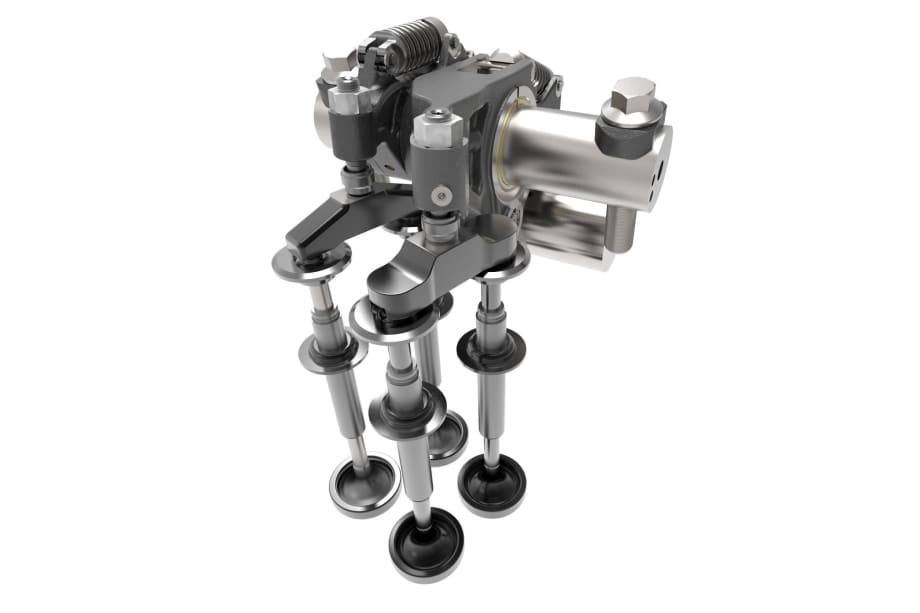
Cylinder deactivation, or CDA, holds promise for lower-emission diesel engines.
Photo: Eaton
2 min to read
Eaton said it has demonstrated cylinder deactivation (CDA) as an effective technology for meeting future global emissions requirements for diesel-powered commercial vehicles.
To date, the technology has been evaluated with a close-coupled selective catalytic reduction (SCR) aftertreatment system with and without a 48-volt electric heater.
“Our CDA technology has proven it can help our customers meet increasingly strict emissions regulations for diesel engines,” said Christopher Mancuso, business unit director, Engine Air Management, Eaton’s Vehicle Group. “This comes at a time when many global manufacturers are determining what technologies they will leverage in next-generation vehicles to reduce harmful emissions.”
New emissions regulations spearheaded by the California Air Resources Board, the U.S. Environmental Protection Agency and the European Commission are slated for adoption in coming years. These agencies, in concert with other national and international regulators, seek to significantly reduce greenhouse gas emissions and air pollutants produced by heavy-duty trucks, vans and buses.
Rapid catalyst warm-up essential
Findings from the Southwest Research Institute demonstrate that using CDA and a close-coupled SCR catalyst reduced both nitrous oxide (NOx) and carbon dioxide (CO2) emissions with fuel consumption savings of up to 40% at idle.
Previous results using CDA and a close-coupled SCR catalyst demonstrated compliance to forthcoming U.S. regulations for NOx and CO2 emissions for diesel commercial vehicles. Testing with the new low-load cycle resulted in a 5% drop in CO2 while dramatically reducing NOx. The assessment was developed by CARB to replicate real-world urban tractor and vocational vehicle operations at low engine loads.
Eaton’s 2021 testing with SwRI showed further advancement, dropping NOx levels by 99.4% on the composite federal test procedure and lowering the low-load-cycle NOx to well within current guidelines. Notably, using the same aftertreatment system with the addition of a 48-volt electric heater located upstream of the SCR further achieved a reduction in CO2.
CDA technology can benefit vehicle manufacturers facing tightening emissions standards in Europe as well. The next set of requirements, known as Euro VII for heavy-duty trucks, is targeted for the second part of the decade.
In the U.S., CARB is introducing more stringent regulations as soon as 2024, while the EPA has circled 2027 to begin applying stricter emissions limits on new-model heavy-duty vehicles.
Collectively, these standards are designed to reduce tailpipe NOx emissions up to 90%, accelerating the need for global engine manufacturers to employ additional emissions-reduction strategies such as electric catalyst heating.
More Fuel Smarts

Wex Adds Cardless Fuel Payments for Over-the-Road Customers
A new fuel card feature for Wex customers offers convenience and security.
Read More →
New California Law Could Shed Light on Electric Truck Prices
Why do battery-electric Class 8 trucks remain so expensive? A California bill signed by Gov. Gavin Newsom would give fleets and state agencies more visibility into what manufacturers charge.
Read More →
How Volvo Updated Its D13 for EPA 2027 [Watch]
Volvo’s updated D13 promises lower emissions without sacrificing performance or fuel economy. Take a closer look at what changed inside the engine in this HDT Spotlight video.
Read More →

Diesel Price Spike Shortens Payback for Natural Gas Trucks, Report Says
Energy Vision estimates fleets could recover the higher purchase price of an RNG-fueled Class 8 tractor in 1.3 to 2.8 years under current fuel-price scenarios.
Read More →
Calstart Becomes Catalyst Mobility, Reflecting Broader Focus
Calstart is now Catalyst Mobility, reflecting the nonprofit’s growing national role in clean transportation, including zero-emission trucks, infrastructure and incentive programs.
Read More →
Record Diesel Prices Squeeze Trucking Fleets
Average U.S. diesel prices have climbed to nearly $6 a gallon, surpassing the 2022 record as tight refinery capacity and Middle East disruptions keep fuel costs elevated.
Read More →
Sponsored•September 9, 2026
How Fuel Delivery Shapes Engine Performance
Fuel delivery depends on more than what happens at the injector. For fleet, maintenance and technical professionals, looking at the full path from pump to injector can provide useful context for understanding engine performance.
Read More →
East Coast Port Launches $45M Electric Truck Push
The Port Authority of New York and New Jersey announced millions in incentives for zero-emission drayage trucks, yard tractors, and new charging hubs near the port.
Read More →
Detroit Opens Orders for EPA 2027 Engines
Detroit isn’t starting from scratch to meet EPA 2027 diesel emissions standards. Its Gen 6 DD13 and DD15 engines keep much of today’s platform while updating the fuel and aftertreatment systems.
Read More →
Zero-Emission Truck Corridor Planned for West Coast
California, Oregon, Washington, British Columbia and Baja California are coordinating plans for truck charging and hydrogen fueling from Canada to Mexico.
Read More →